

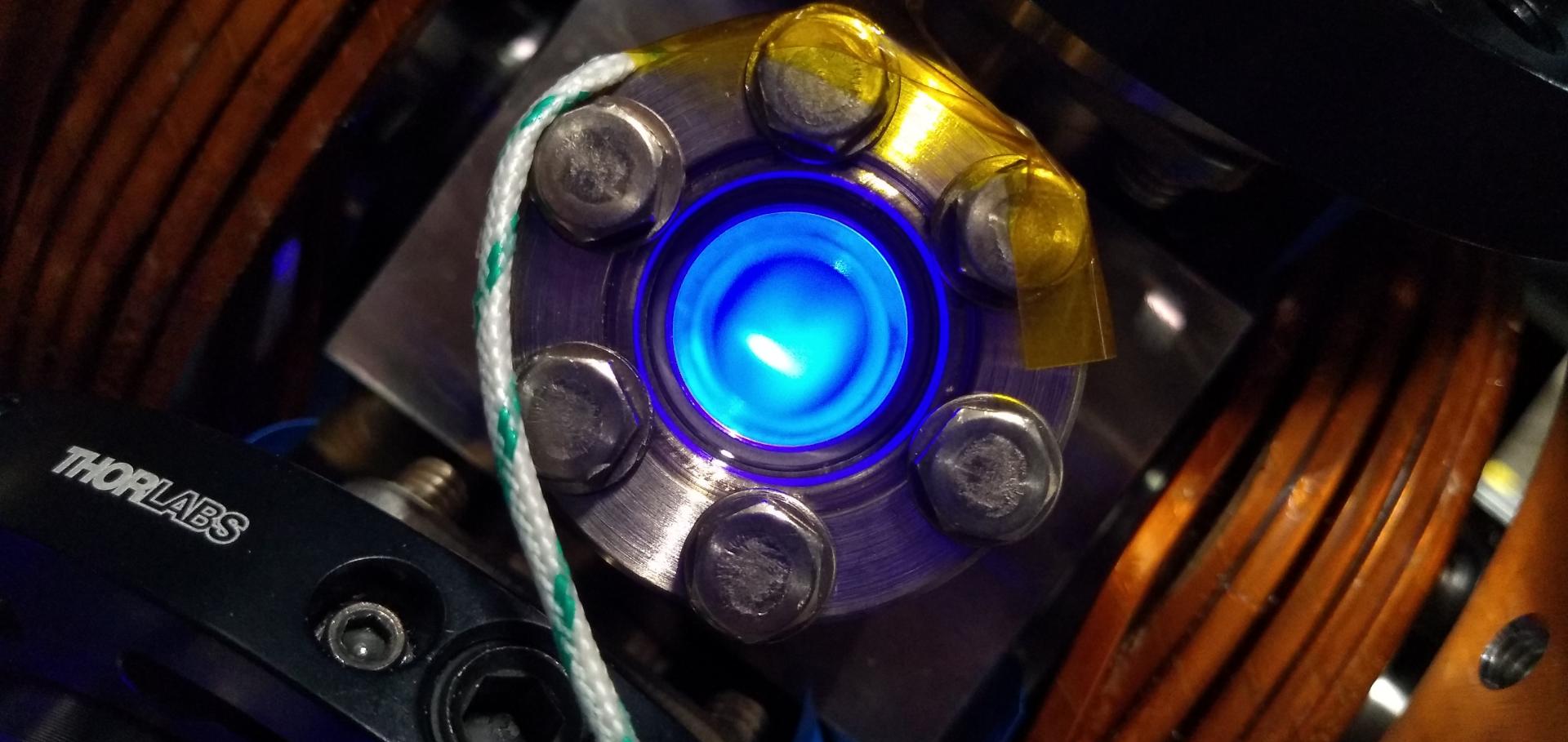
A high-flux source of cold strontium with a loading rate of 4×10¹⁰ atoms/s for open release
AVS Quantum Science American Vacuum Society 8:3 (2026) 033201
Abstract:
We present a high-flux source of cold strontium atoms based on a two-dimensional magneto-optical trap (2D MOT) and a Zeeman slower. We use the source to load a 3D MOT in a separate science chamber, observing a loading rate of 4×10¹⁰ atoms/s—to our knowledge, the highest reported loading flux for strontium. To characterize the vacuum pressure in the science chamber, we load the atoms into a magnetic trap and measure a lifetime of between 8 and 24 s, depending on the oven temperature. Finally, we characterize the atom flux and velocity distributions from the oven and from the 2D MOT source, finding reasonable agreement with models in the free molecular flow regime. Our results show that it is possible to readily produce a cold strontium flux at comparable levels to those of alkali species, at oven temperatures compatible with long-term operation, and at vacuum pressures suitable for state-of-the-art quantum experiments. We make our design available at no cost to benefit researchers in the quantum community.Passive quantum interconnects: Multiplexed remote entanglement generation with cavity-assisted photon scattering
Physical Review Applied American Physical Society (APS) 26:3 (2026) 034021
Abstract:
We propose a time- and wavelength-multiplexed remote atom-atom entanglement generation protocol based on cavity-assisted photon scattering (CAPS). This is designed to achieve a high rate and high fidelity with robustness to operational imperfections, parameter fluctuations, and auxiliary time costs, such as percent-level photon impurity, timing and cavity parameter jitter, and atom shuttling time costs. We benchmark this protocol using comprehensive analytical and numerical modeling of the atom-cavity dynamics, including state-dependent pulse-delay effects, photon temporal impurity, atom-cavity system parameter fluctuations, and crosstalk among atoms through a shared cavity mode. With realistic atom-cavity system performance, we predict successful atom-atom Bell pair generation even without in-cavity qubit reset, substantially enhanced from two-photon-interference-based protocols, at a predicted heralded fidelity of 0.999. We further show that the predicted rate scales further by the use of wavelength multiplexing while maintaining the fidelity.Graphix: A software framework for Measurement-Based Quantum Computation
ArXiv 2608.24781 (2026)
Entanglement Boosting: Low-Volume Logical Bell Pair Preparation for Distributed Fault-Tolerant Quantum Computation
PRX Quantum American Physical Society (APS) 7:3 (2026) 033014
Abstract:
Distributed architecture is a promising route to scaling fault-tolerant quantum computing (FTQC) beyond the inherent limitations of single processors, for which high-fidelity logical Bell pairs need to be prepared from many noisy physical Bell pairs with high efficiency. For practical implementation of distributed FTQC, logical Bell pair preparation must be designed not only for efficient Bell pair consumption but also for the spacetime volume of the protocol; however, entanglement distillation protocols have primarily focused on minimizing the consumption of Bell pairs, often resulting in protocols that require a substantial number of local operations. A key challenge is to find an appropriate balance between these two contrasting features. To resolve this issue, we introduce a metric for characterizing the practical cost of preparing high-fidelity logical Bell pairs, (LLV), which is a circuit-volume metric incorporating, in a single quantity, both the cost of physical Bell pair consumption and the volume associated with local operations. Guided by this metric, we propose the protocol that achieves efficient preparation of logical Bell pairs encoded in rotated surface code, with LLV reduced by orders of magnitude compared to prior state-of-the-art methods. In this protocol, paralleling recent advances in magic state cultivation, we employ soft-information decoders and postselection to suppress the logical error rates of Bell pairs to practical levels, e.g. less than from 86 noisy physical Bell pairs at 1% error, while all local operations are implementable within a spatial region of a single surface-code patch with two-dimensional local connectivity. This is a substantial reduction from other protocols, such as remote lattice surgery operations requiring nearly 1000 physical Bell pairs under the same setting. To further augment the entanglement boosting, we also present a pipelined implementation of entanglement distillation using high-rate quantum error-correcting codes, enabling arbitrarily low logical error rates while also maintaining physically efficient implementations. These results pave the way for the practical implementation of distributed FTQC, reinforcing the benefits of fast interconnect technologies and serving as a guiding principle for the efficient design of protocols and devices.A prototype differential atom interferometer for fundamental physics
Nature Nature Research 654:8119 (2026) 622-628