Home
Department Of Physics text logo
  • Research
    • Our research
    • Our research groups
    • Our research in action
    • Research funding support
    • Summer internships for undergraduates
  • Study
    • Undergraduates
    • Postgraduates
  • Engage
    • For young people
    • For teachers
    • For the public
    • For alumni
    • For business
  • Support
Menu
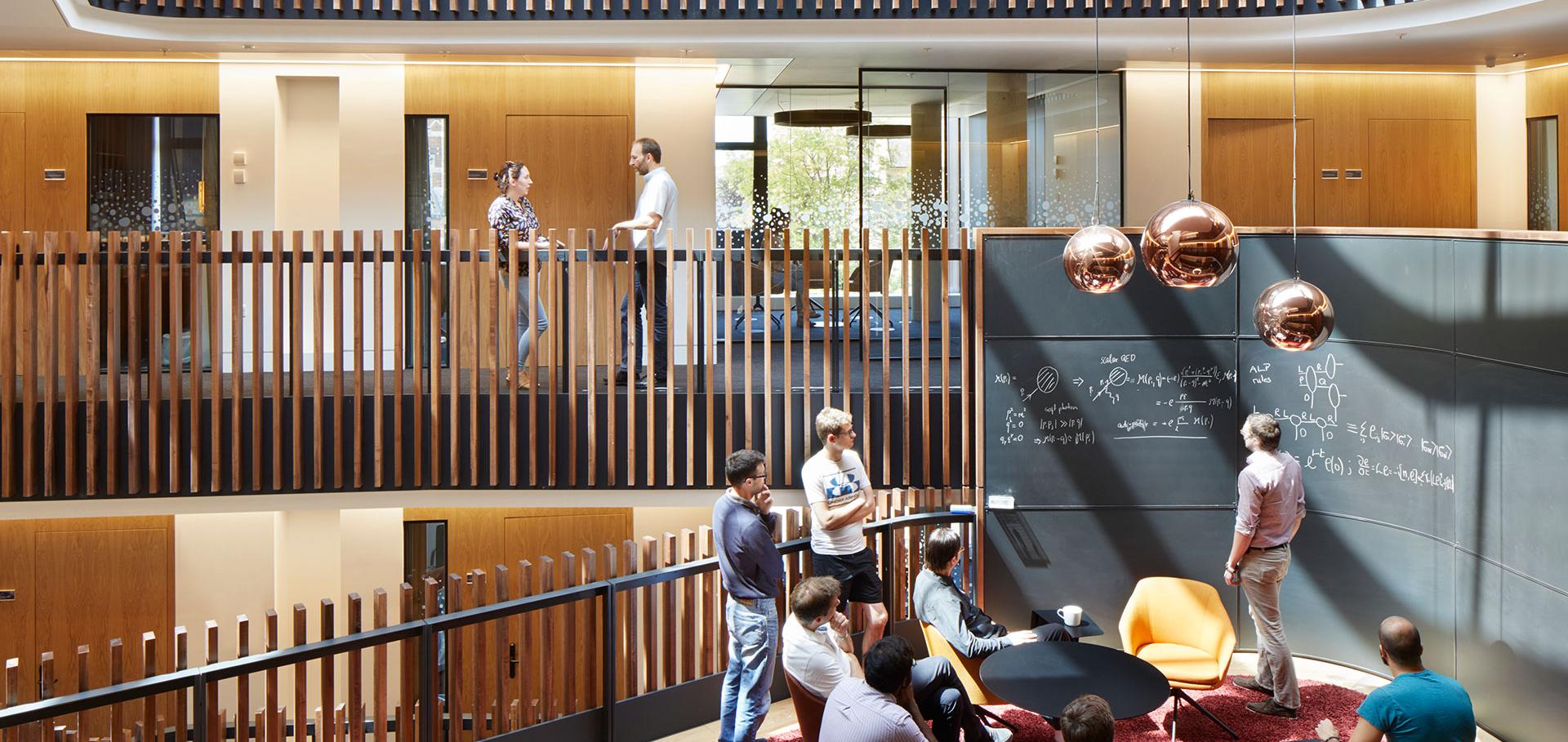
Theoretical physicists working at a blackboard collaboration pod in the Beecroft building.
Credit: Jack Hobhouse

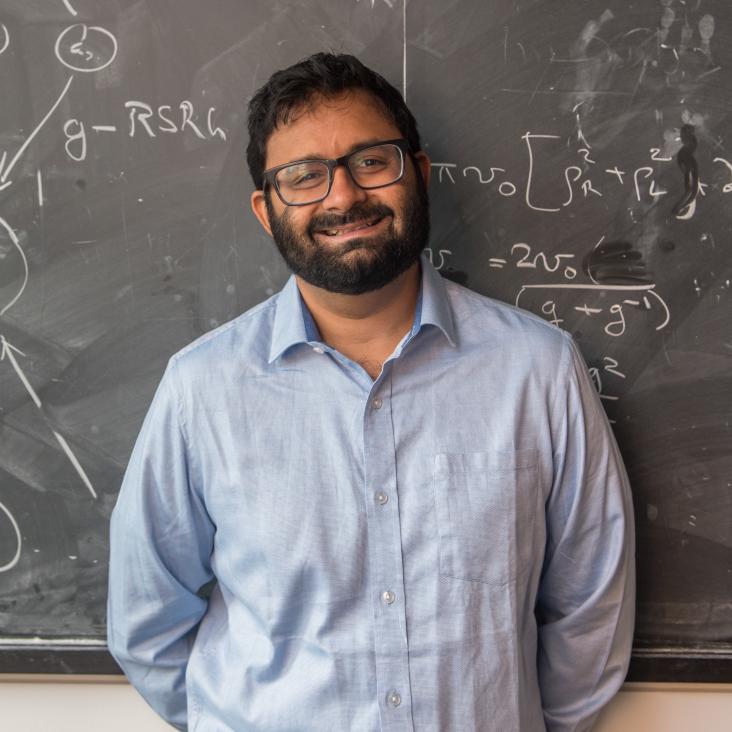
Siddharth Parameswaran

Professor of Physics

Research theme

  • Fields, strings, and quantum dynamics
  • Quantum materials
  • Quantum optics & ultra-cold matter

Sub department

  • Rudolf Peierls Centre for Theoretical Physics

Research groups

  • Condensed Matter Theory
sid.parameswaran@physics.ox.ac.uk
Telephone: 01865 273968
Rudolf Peierls Centre for Theoretical Physics, room 70.29
Hilary Term 2026: Quantum Matter 2 Course Pages
  • About
  • Research
  • Teaching
  • Publications

Another Dimension to Flatland: New Phases from Stacking Fractional Quantum Hall States?

Journal Club for Condensed Matter Physics Journal Club for Condensed Matter Physics (2026)

Authors:

Siddharth Parameswaran, Yves Kwan
More details from the publisher

Gibbs resampling transitions and structured fast-measurement protocols

(2026)

Authors:

Daan Timmers, Benedikt Placke, Siddharth A Parameswaran
Details from ArXiV

Interface phases and dynamics in two-dimensional quantum magnets: A "holographic" approach from universality to quantum simulation

(2026)

Authors:

Abhishodh Prakash, Jaydev Singh Rao, Siddharth A Parameswaran, Alessio Lerose
Details from ArXiV

Nonequilibrium dynamics of doped Chern ferromagnets: a case study for false vacuum decay

(2026)

Authors:

Kilian Kuhlbrodt, Olivier Huber, Oliver Breach, Weijie Li, Xiaodong Xu, Kenji Watanabe, Takashi Taniguchi, Martin Kroner, Siddharth A Parameswaran, Atac Imamoglu
Details from ArXiV

Emergent interacting phases in the strong-coupling limit of twisted M-valley moiré systems: application to SnSe2

Physical Review B American Physical Society 114:5 (2026) L051113

Authors:

Ming-Rui Li, Dumitru Călugăru, Yi Jiang, Hanqi Pi, Ammon Fischer, Henning Schlömer, Lennart Klebl, Xia Z Xia, Maia G Vergniory, Dante M Kennes, Kin Fai Mak, Jie Shan, Siddharth Ashok Parameswaran, Hong Yao, B Andrei Bernevig, Haoyu Hu

Abstract:

We establish twisted SnSe2 as a tunable platform for simulating dimension-dependent correlated physics, distinct from conventional K-valley moiré systems. By constructing interacting Wannier models, we show that the stacking configuration dictates the effective lattice geometry. In AAstacked bilayers, a momentum-space nonsymmorphic symmetry constrains the single-particle hopping within each valley to be effectively one-dimensional, while still allowing fully two-dimensional interactions, thereby giving rise to an effective quasi-one-dimensional system. This dimensional reduction stabilizes exotic phases including dimerized states with finite residual entropy, valence bond solids, and quantum paramagnetism. Conversely, AB-stacking maps to a frustrated Kagome lattice; here, strong interactions drive the emergence of a classical spin liquid. The high tunability of this moiré system, which allows control over both the filling and interaction strength (via twist angle), renders twisted SnSe2 a versatile platform for realizing a wide range of exotic correlated quantum phases.
More details from the publisher
Details from ORA
More details

Pagination

  • Current page 1
  • Page 2
  • Page 3
  • Page 4
  • Page 5
  • Page 6
  • Page 7
  • Page 8
  • Page 9
  • …
  • Next page Next
  • Last page Last

Footer Menu

  • Contact us
  • Giving to the Dept of Physics
  • Work with us
  • Media

User account menu

  • Log in

Follow us

FIND US

Clarendon Laboratory,

Parks Road,

Oxford,

OX1 3PU

CONTACT US

Tel: +44(0)1865272200

University of Oxfrod logo Department Of Physics text logo
IOP Juno Champion logo Athena Swan Silver Award logo

© University of Oxford - Department of Physics

Cookies | Privacy policy | Accessibility statement

Built by: Versantus

  • Home
  • Research
  • Study
  • Engage
  • Our people
  • News & Comment
  • Events
  • Our facilities & services
  • About us
  • Giving to Physics
  • Current students
  • Staff intranet