
Home
Department Of Physics text logo
  • Research
    • Our research
    • Our research groups
    • Our research in action
    • Research funding support
    • Summer internships for undergraduates
  • Study
    • Undergraduates
    • Postgraduates
  • Engage
    • For young people
    • For teachers
    • For the public
    • For alumni
    • For business
  • Support
Menu
Theoretical physicists working at a blackboard collaboration pod in the Beecroft building.
Credit: Jack Hobhouse

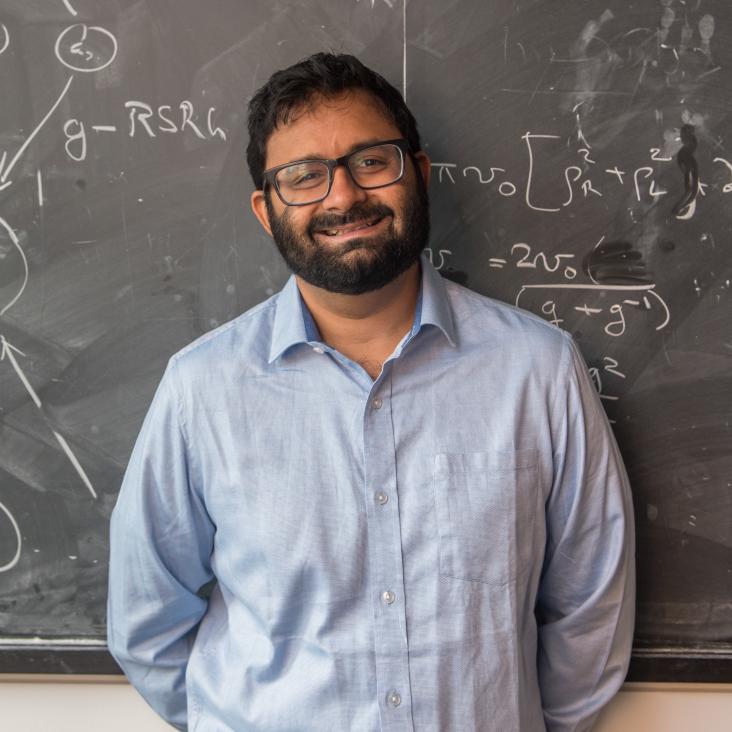
Siddharth Parameswaran

Professor of Physics

Research theme

  • Fields, strings, and quantum dynamics
  • Quantum materials
  • Quantum optics & ultra-cold matter

Sub department

  • Rudolf Peierls Centre for Theoretical Physics

Research groups

  • Condensed Matter Theory
sid.parameswaran@physics.ox.ac.uk
Telephone: 01865 273968
Rudolf Peierls Centre for Theoretical Physics, room 70.29
Hilary Term 2026: Quantum Matter 2 Course Pages
  • About
  • Research
  • Teaching
  • Publications

Mean-field modeling of moiré materials: a user's guide with selected applications to twisted bilayer graphene

Advances in Physics Taylor and Francis 74:1-4 (2025) 11-96

Authors:

Yves H Kwan, Ziwei Wang, Glenn Wagner, Nick Bultinck, Steven H Simon, Siddharth A Parameswaran

Abstract:

We review the theoretical modeling of moiré materials, focusing on various aspects of magic-angle twisted bilayer graphene (MA-TBG) viewed through the lens of Hartree–Fock mean-field theory. We first provide an elementary introduction to the continuum modeling of moiré bandstructures, and explain how interactions are incorporated to study correlated states. We then discuss how to implement mean-field simulations of ground state structure and collective excitations in this setting. With this background established, we rationalize the power of mean-field approximations in MA-TBG, by discussing the idealized ‘chiral-flat’ strong-coupling limit, in which ground states at electron densities commensurate with the moiré superlattice are exactly captured by mean-field ansätze. We then illustrate the phenomenological shortcomings of this limit, leading us naturally into a discussion of the intermediate-coupling incommensurate Kekulé spiral (IKS) order and its origins in ever-present heterostrain. IKS and its placement within an expanded Hartree–Fock manifold form our first ‘case study’. Our second case study involves time-dependence, and focuses on the collective modes of various broken-symmetry insulators in MA-TBG. As a third and final case study, we return to the strong-coupling picture, which can be stabilized by aligning MA-TBG to an hBN substrate. In this limit, we show how mean field theory can be adapted to the translationally non-invariant setting in order to quantitatively study the energetics of domain walls in orbital Chern insulating states. We close with a discussion of extensions and further applications. Used either as a standalone reference or alongside the accompanying open-source code, this review should enable readers with a basic knowledge of band theory and many-body physics to systematically build and analyze detailed models of generic moiré systems.

More details from the publisher
Details from ORA
More details

Mean-field Modelling of Moiré Materials: A User's Guide with Selected Applications to Twisted Bilayer Graphene

(2025)

Authors:

Yves H Kwan, Ziwei Wang, Glenn Wagner, Nick Bultinck, Steven H Simon, Siddharth A Parameswaran
Details from ArXiV

Solvable quantum circuits in tree+1 dimensions

PRX Quantum American Physical Society 6:4 (2025) 040316

Authors:

Oliver Breach, Benedikt Placke, Pieter Claeys, Siddharth A Parameswaran

Abstract:

We devise tractable models of unitary quantum many-body dynamics on tree graphs, as a first step toward a deeper understanding of dynamics in non-Euclidean spaces. To this end, we first demonstrate how to construct strictly local quantum circuits that preserve the symmetries of trees, such that their dynamical light cones grow isotropically. For trees with coordination number 𝑧, such circuits can be built from 𝑧-site gates. We then introduce a family of gates for which the dynamics are exactly solvable; these satisfy a set of constraints that we term “tree-unitarity.” Notably, tree-unitarity reduces to the previously established notion of dual-unitarity for 𝑧 =2, when the tree reduces to a line. Among the unexpected features of tree-unitarity is a trade-off between “maximum butterfly velocity” dynamics of out-of-time-order correlators and the existence of nonvanishing correlation functions in multiple directions, a tension absent in one-dimensional dual-unitary models and their Euclidean generalizations. We connect the existence of (a wide class of) solvable dynamics with nonmaximal butterfly velocity directly to a property of the underlying circuit geometry called 𝛿-hyperbolicity, and argue that such dynamics can only arise in non-Euclidean geometries. We give various examples of tree-unitary gates, discuss dynamical correlations, out-of-time-order correlators, and entanglement growth, and show that the kicked Ising model on a tree is a physically motivated example of maximum-velocity tree-unitary dynamics.
More details from the publisher
Details from ORA
More details

Long-time divergences in the nonlinear response of gapped one-dimensional many-particle systems

SciPost Physics SciPost 19:4 (2025) 086

Authors:

Michele Fava, Sarang Gopalakrishnan, Romain Vasseur, Siddharth Parameswaran, Fabian Essler

Abstract:

SciPost Journals Publication Detail SciPost Phys. 19, 086 (2025) Long-time divergences in the nonlinear response of gapped one-dimensional many-particle systems
More details from the publisher
Details from ORA
More details

Gate-tunable double-dome superconductivity in twisted trilayer graphene

Nature Physics Springer Nature 21:11 (2025) 1773-1779

Authors:

Zekang Zhou, Jin Jiang, Paritosh Karnatak, Ziwei Wang, Glenn Wagner, Kenji Watanabe, Takashi Taniguch, Christian Schönenberger, Siddharth Ashok Parameswaran, Steven H Simon, Mitali Banerjee

Abstract:

Graphene moiré systems are ideal environments for investigating complex phase diagrams and gaining fundamental insights into the mechanisms that underlie them, as they permit controlled manipulation of electronic properties. Magic-angle twisted trilayer graphene has emerged as a key platform for exploring moiré superconductivity due to the robustness of its superconducting order and the ability to tune its energy bands with an electric field. Here we report the direct observation of two domes of superconductivity in the phase diagram of magic-angle twisted trilayer graphene. The dependence of the superconductivity of doped holes on the temperature, magnetic field and bias current shows that it is suppressed near a specific filling of the moiré flat band, leading to a double dome in the phase diagram within a finite range of the displacement field. The transport properties are also indicative of a phase transition and the potentially distinct nature of superconductivity in the two domes. Hartree–Fock calculations incorporating mild strain yield an incommensurate Kekulé spiral state whose effective spin polarization peaks in the regime where superconductivity is suppressed in the experiments.
More details from the publisher
Details from ORA
More details

Pagination

  • First page First
  • Previous page Prev
  • Page 1
  • Page 2
  • Page 3
  • Current page 4
  • Page 5
  • Page 6
  • Page 7
  • Page 8
  • Page 9
  • …
  • Next page Next
  • Last page Last

Footer Menu

  • Contact us
  • Giving to the Dept of Physics
  • Work with us
  • Media

User account menu

  • Log in

Follow us

FIND US

Clarendon Laboratory,

Parks Road,

Oxford,

OX1 3PU

CONTACT US

Tel: +44(0)1865272200

University of Oxfrod logo Department Of Physics text logo
IOP Juno Champion logo Athena Swan Silver Award logo

© University of Oxford - Department of Physics

Cookies | Privacy policy | Accessibility statement

Built by: Versantus

  • Home
  • Research
  • Study
  • Engage
  • Our people
  • News & Comment
  • Events
  • Our facilities & services
  • About us
  • Giving to Physics
  • Current students
  • Staff intranet