Reinterpretation of searches for supersymmetry in models with variable R-parity-violating coupling strength using the full ATLAS Run 2 Dataset

ArXiv 2603.15007 (2026)

Search for Higgs boson pair production in association with top-quark pairs using 196 fb$^{-1}$ of proton-proton collision data at $\sqrt{s}=$ 13 and 13.6 TeV with the ATLAS detector

ArXiv 2603.13113 (2026)

Search for displaced decays of long-lived particles in events with missing transverse momentum in $\sqrt{s} = 13$ TeV $pp$ collisions with the ATLAS detector

ArXiv 2603.12051 (2026)

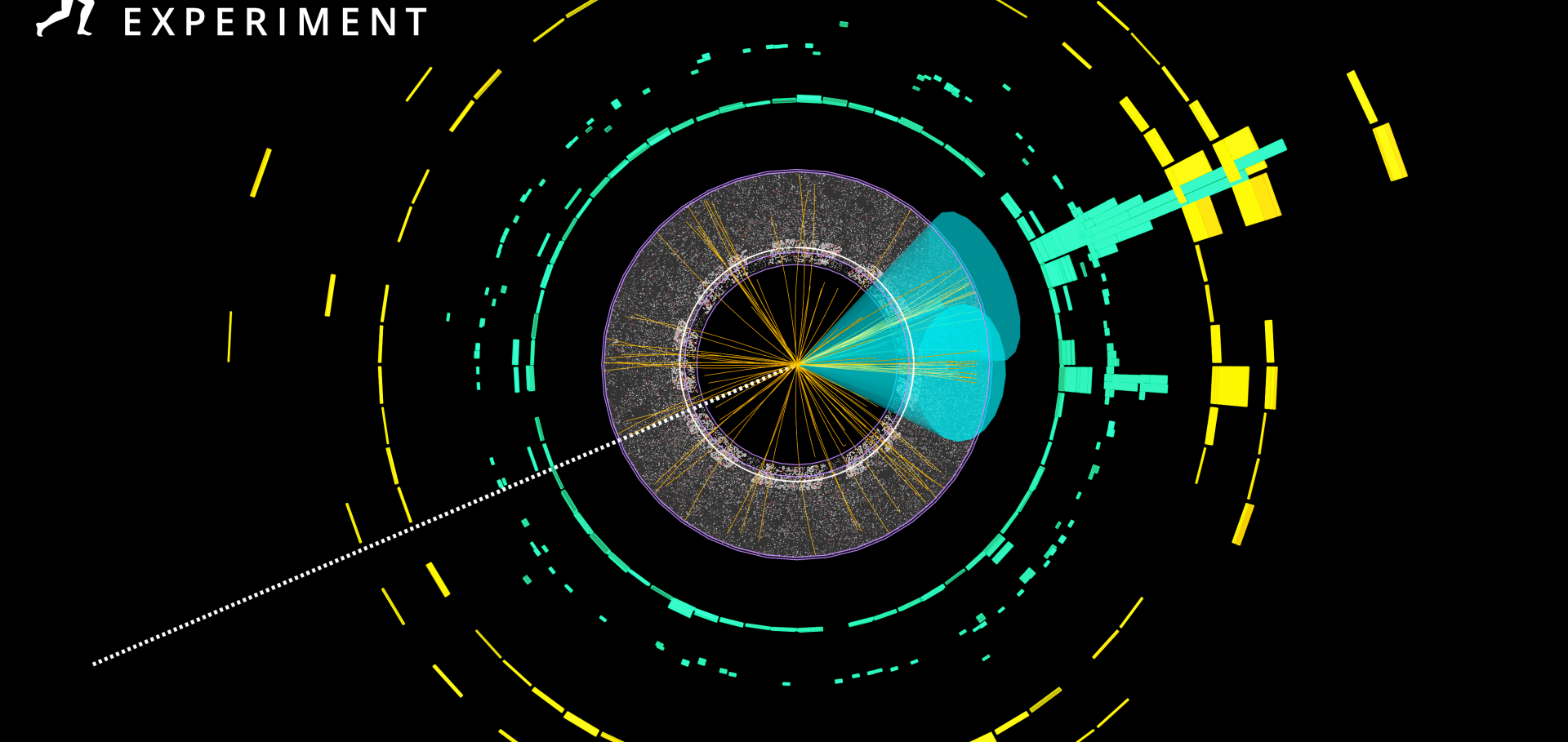
Search for Beyond the Standard Model physics with anomaly detection in multilepton final states in pp collisions at $$\sqrt{s}=13~\textrm{TeV}$$ with the ATLAS detector

The European Physical Journal C SpringerOpen 86:3 (2026) 247

Authors:

G Aad, E Aakvaag, B Abbott, S Abdelhameed, K Abeling, NJ Abicht, SH Abidi, M Aboelela, A Aboulhorma, H Abramowicz, Y Abulaiti, BS Acharya, A Ackermann, C Adam Bourdarios, L Adamczyk, SV Addepalli, MJ Addison, J Adelman, A Adiguzel, T Adye, AA Affolder, Y Afik, MN Agaras, A Aggarwal, C Agheorghiesei

Abstract:

A model-agnostic search for Beyond the Standard Model physics is presented, targeting final states with at least four light leptons (electrons or muons). The search regions are separated by event topology and unsupervised machine learning is used to identify anomalous events in the full 140 fb-1$$^{-1}$$ of proton–proton collision data collected with the ATLAS detector during Run 2. No significant excess above the Standard Model background expectation is observed. Model-agnostic limits are presented in each topology, along with limits on several benchmark models including vector-like leptons, wino-like charginos and neutralinos, or smuons. Limits are set on the flavourful vector-like lepton model for the first time.

Photometry and Spectroscopy of SN 2024pxl: A Luminosity Link among Type Iax Supernovae

The Astrophysical Journal American Astronomical Society 999:2 (2026) 227

Authors:

Mridweeka Singh, Lindsey A Kwok, Saurabh W Jha, R Dastidar, Conor Larison, Alexei V Filippenko, Jennifer E Andrews, Moira Andrews, GC Anupama, Prasiddha Arunachalam, Katie Auchettl, Dominik Bánhidi, Barnabas Barna, K Azalee Bostroem, Thomas G Brink, Régis Cartier, Ping Chen, Collin T Christy, David A Coulter, Sofia Covarrubias, Kyle W Davis, Connor B Dickinson, Yize Dong, Joseph Farah

Abstract:

We present extensive ultraviolet to optical photometric and optical to near-infrared (NIR) spectroscopic follow-up observations of the nearby intermediate-luminosity (MV = −16.81 ± 0.19 mag) Type Iax supernovae (SNe Iax) 2024pxl in NGC 6384. SN 2024pxl exhibits a faster light curve than the high-luminosity members of this class, and slower than low-luminosity events. The observationally well-constrained rise time of ∼11 days and an estimated synthesized 56Ni mass of 0.03 M⊙, based on analytical modeling of the integrated spectral energy distribution light curve, are consistent with models of the weak deflagration of a carbon-oxygen white dwarf. Our optical spectral sequence of SN 2024pxl shows weak Si ii lines and spectral evolution similar to other high-luminosity SNe Iax, but also a prominent early-time C ii line, like lower-luminosity SNe Iax. The late-time optical spectrum of SN 2024pxl closely matches that of SN 2014dt, and its NIR spectral evolution aligns with that of other well-studied, high-luminosity SNe Iax. The spectral-line expansion velocities of SN 2024pxl are at the lower end of the SNe Iax velocity distribution, and the velocity distribution of iron-group elements compared to intermediate-mass elements suggests that the ejecta are mixed on large scales, as expected in pure deflagration models. SN 2024pxl exhibits characteristics intermediate between those of high-luminosity and low-luminosity SNe Iax, further establishing a link across this diverse class.