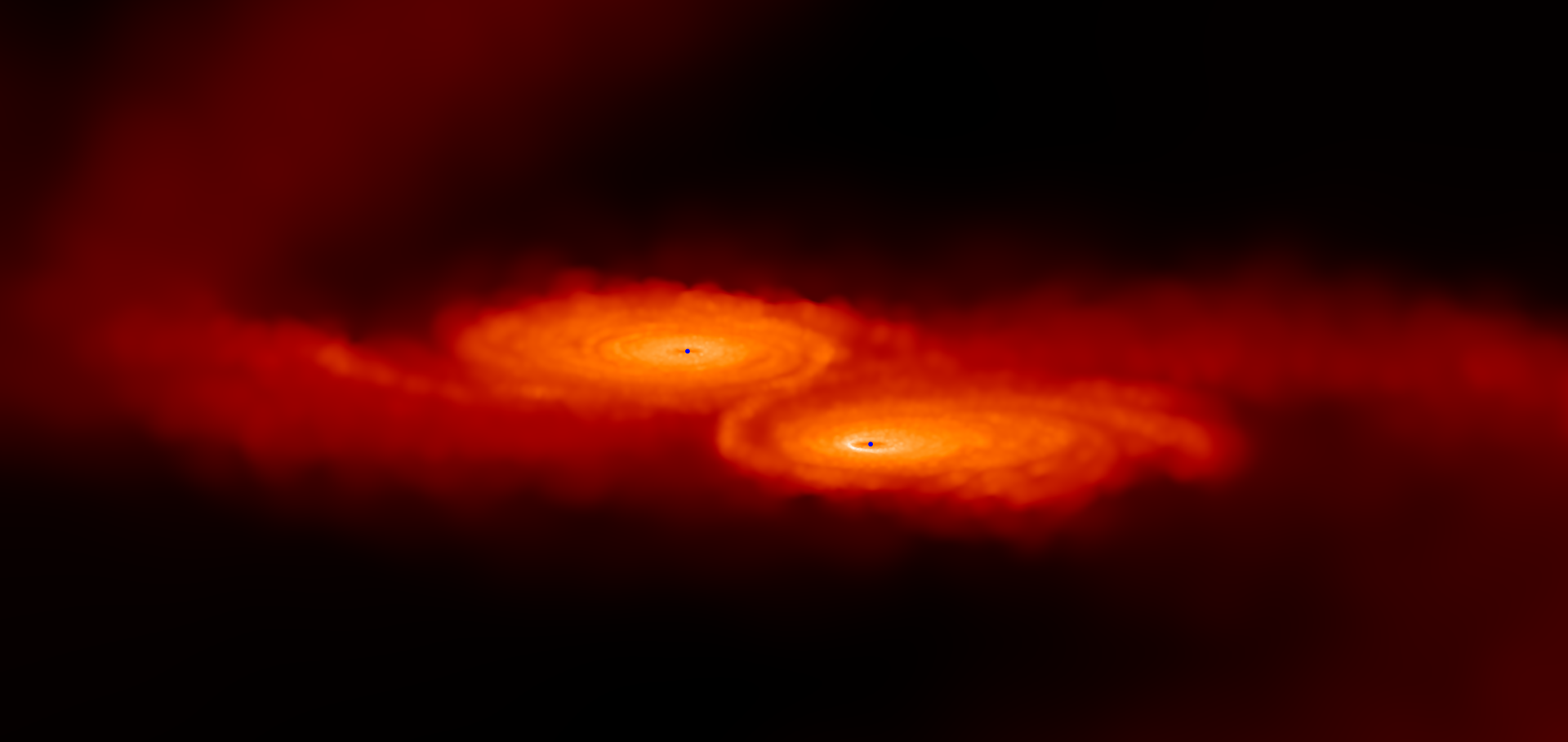
Protoplanets with core masses below the critical mass fill in their Roche lobe

Monthly Notices of the Royal Astronomical Society 418:3 (2011) 1928-1934

Authors:

C Terquem, T Heinemann

Abstract:

We study the evolution of a protoplanet of a few earth masses embedded in a protoplanetary disc. If we assume that the atmosphere of the protoplanet, i.e. the volume of gas in hydrostatic equilibrium bound to the core, has a surface radius smaller than the Roche lobe radius, we show that it expands as it accretes both planetesimals and gas at a fixed rate from the nebula until it fills in the Roche lobe. The evolution occurs on a time-scale shorter than the formation or migration time-scales. Therefore, we conclude that protoplanets of a few earth masses have an atmosphere that extends to the Roche lobe surface, where it joins on to the nebula. This is true even when the Bondi radius is smaller than the Roche lobe radius. This is in contrast to the commonly used models in which the static atmosphere extends up to the Bondi radius and is surrounded by a cold accretion flow. As a result, any calculation of the tidal torque exerted by the disc on to the protoplanet should exclude the material present in the Roche lobe, since it is bound to the protoplanet. © 2011 The Authors Monthly Notices of the Royal Astronomical Society © 2011 RAS.

Sources of intrinsic rotation in the low-flow ordering

Nuclear Fusion 51:11 (2011)

Authors:

FI Parra, M Barnes, PJ Catto

Abstract:

A low flow, δf gyrokinetic formulation to obtain the intrinsic rotation profiles is presented. The momentum conservation equation in the low-flow ordering contains new terms, neglected in previous first-principles formulations, that may explain the intrinsic rotation observed in tokamaks in the absence of external sources of momentum. The intrinsic rotation profile depends on the density and temperature profiles and on the up-down asymmetry. © 2011 IAEA, Vienna.

Sources of intrinsic rotation in the low-flow ordering

Nuclear Fusion IOP Publishing 51:11 (2011) 113001-113001

Authors:

Felix I Parra, Michael Barnes, Peter J Catto

Abstract:

A low flow, δf gyrokinetic formulation to obtain the intrinsic rotation profiles is presented. The momentum conservation equation in the low-flow ordering contains new terms, neglected in previous first-principles formulations, that may explain the intrinsic rotation observed in tokamaks in the absence of external sources of momentum. The intrinsic rotation profile depends on the density and temperature profiles and on the up–down asymmetry.

Sources of intrinsic rotation in the low-flow ordering

Nuclear Fusion IOP Publishing 51:11 (2011) 113001

Authors:

Felix I Parra, Michael Barnes, Peter J Catto

Galactic dynamics: Second Edition

, 2011

Authors:

J Binney, S Tremaine

Abstract:

Since it was first published in 1987,Galactic Dynamicshas become the most widely used advanced textbook on the structure and dynamics of galaxies and one of the most cited references in astrophysics. Now, in this extensively revised and updated edition, James Binney and Scott Tremaine describe the dramatic recent advances in this subject, makingGalactic Dynamicsthe most authoritative introduction to galactic astrophysics available to advanced undergraduate students, graduate students, and researchers.Every part of the book has been thoroughly overhauled, and many sections have been completely rewritten. Many new topics are covered, including N-body simulation methods, black holes in stellar systems, linear stability and response theory, and galaxy formation in the cosmological context. Binney and Tremaine, two of the world's leading astrophysicists, use the tools of theoretical physics to describe how galaxies and other stellar systems work, succinctly and lucidly explaining theoretical principles and their applications to observational phenomena. They provide readers with an understanding of stellar dynamics at the level needed to reach the frontiers of the subject.This new edition of the classic text is the definitive introduction to the field.A complete revision and update of one of the most cited references in astrophysicsProvides a comprehensive description of the dynamical structure and evolution of galaxies and other stellar systemsServes as both a graduate textbook and a resource for researchersIncludes 20 color illustrations, 205 figures, and more than 200 problemsCovers the gravitational N-body problem, hierarchical galaxy formation, galaxy mergers, dark matter, spiral structure, numerical simulations, orbits and chaos, equilibrium and stability of stellar systems, evolution of binary stars and star clusters, and much moreCompanion volume toGalactic Astronomy, the definitive book on the phenomenology of galaxies and star clusters. © 2008 by Princeton University Press. All Rights Reserved.