

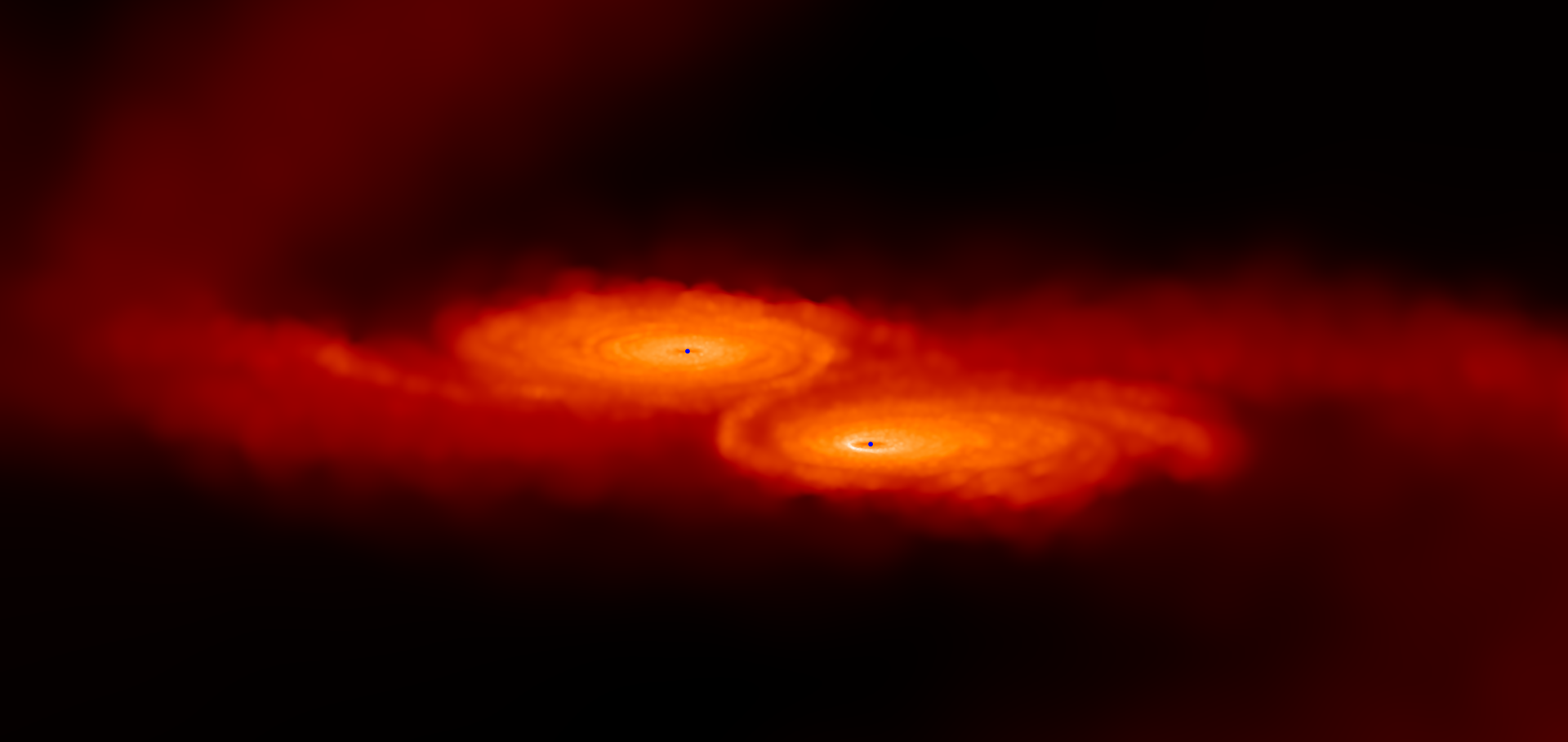
The dynamical structure of nonradiative black hole accretion flows
Astrophysical Journal 573:2 I (2002) 738-748
Abstract:
We analyze three-dimensional magnetohydrodynamic simulations of a nonradiative accretion flow around a black hole using a pseudo-Newtonian potential. The flow originates from a torus initially centered at 100 gravitational (Schwarzschild) radii. Accretion is driven by turbulent stresses generated self-consistently by the magnetorotational instability. The resulting flow has three well-defined dynamical components: a hot, thick, rotationally dominated Keplerian disk; a surrounding magnetized corona with vigorous circulation and outflow; and a magnetically confined jet along the centrifugal funnel wall. Inside 10 gravitational radii, the disk becomes very hot, more toroidal, and highly intermittent. These results contrast sharply with quasi-spherical, self-similar viscous models. There are no significant dynamical differences between simulations that include resistive heating and those that do not. We conclude by deducing some simple radiative properties of our solutions, and apply the results to the accretion-powered Galactic center source Sgr A*.Two-body relaxation in cosmological simulations
Monthly Notices of the Royal Astronomical Society 333:2 (2002) 378-382
Abstract:
It is logically possible that early two-body relaxation in simulations of cosmological clustering influences the final structure of massive clusters. Convergence studies in which mass and spatial resolution are simultaneously increased cannot eliminate this possibility. We test the importance of two-body relaxation in cosmological simulations with simulations in which there are two species of particles. The cases of two mass ratios, √2:1 and 4:1, are investigated. Simulations are run with both a spatially fixed softening length and adaptive softening using the publicly available codes GADGET and MLAPM, respectively. The effects of two-body relaxation are detected in both the density profiles of haloes and the mass function of haloes. The effects are more pronounced with a fixed softening length, but even in this case they are not so large as to suggest that results obtained with one mass species are significantly affected by two-body relaxation. The simulations that use adaptive softening are less affected by two-body relaxation and produce slightly higher central densities in the largest haloes. They run about three times faster than the simulations that use a fixed softening length.Galaxies with a Central Minimum in Stellar Luminosity Density
(2002)
Dynamical relaxation and the orbits of low-mass extrasolar planets
Monthly Notices of the Royal Astronomical Society 332:2 (2002)
Abstract:
We consider the evolution of a system containing a population of massive planets formed rapidly through a fragmentation process occurring on a scale on the order of 100 au and a lower mass planet that assembles in a disc on a much longer time-scale. During the formation phase, the inner planet is kept on a circular orbit owing to tidal interaction with the disc, while the outer planets undergo dynamical relaxation. Interaction with the massive planets left in the system after the inner planet forms may increase the eccentricity of the inner orbit to high values, producing systems similar to those observed.Observable consequences of cold clouds as dark matter
Monthly Notices of the Royal Astronomical Society 332:2 (2002) L29-L33