Home
Department Of Physics text logo
  • Research
    • Our research
    • Our research groups
    • Our research in action
    • Research funding support
    • Summer internships for undergraduates
  • Study
    • Undergraduates
    • Postgraduates
  • Engage
    • For alumni
    • For business
    • For schools
    • For the public
  • Support
Menu
Atomic and Laser Physics
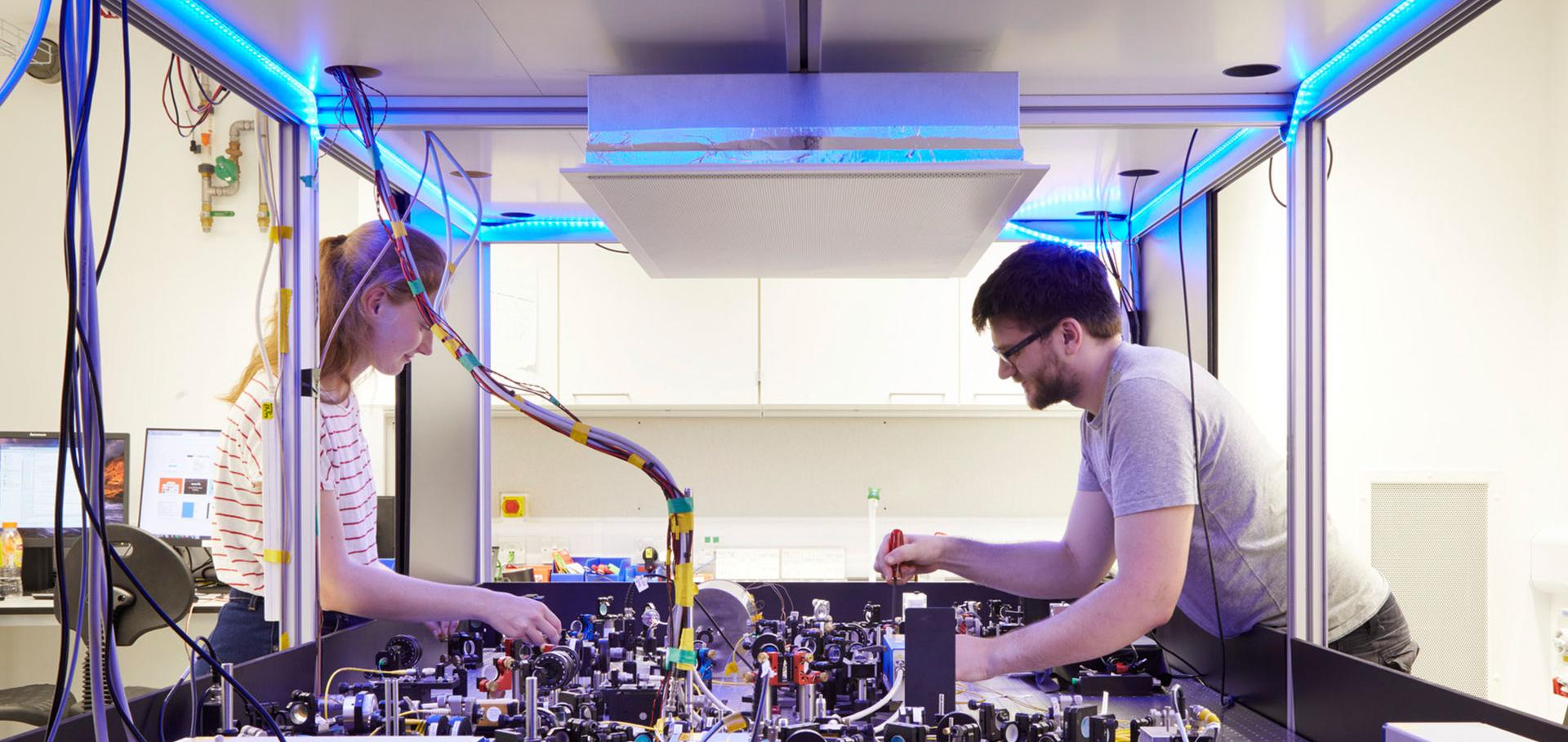
Credit: Jack Hobhouse

Dr Christopher Ballance

Future Leaders Fellow

Research theme

  • Quantum information and computation

Sub department

  • Atomic and Laser Physics

Research groups

  • Ion trap quantum computing
chris.ballance@physics.ox.ac.uk
Telephone: 01865 (2)72122
Clarendon Laboratory, room 512.40.23
  • About
  • Publications

Experimental quantum key distribution certified by Bell's theorem

(2021)

Authors:

DP Nadlinger, P Drmota, BC Nichol, G Araneda, D Main, R Srinivas, DM Lucas, CJ Ballance, K Ivanov, EY-Z Tan, P Sekatski, RL Urbanke, R Renner, N Sangouard, J-D Bancal
More details from the publisher
Details from ArXiV

Micromotion minimisation by synchronous detection of parametrically excited motion

(2021)

Authors:

DP Nadlinger, P Drmota, D Main, BC Nichol, G Araneda, R Srinivas, LJ Stephenson, CJ Ballance, DM Lucas
More details from the publisher
Details from ArXiV

Benchmarking a high-fidelity mixed-species entangling gate

Physical Review Letters American Physical Society 125:8 (2020) 080504

Authors:

Amy Hughes, Vera Schäfer, Keshav Thirumalai, David Nadlinger, Sarah Woodrow, David Lucas, Christopher Ballance

Abstract:

We implement a two-qubit logic gate between a 43Ca+ hyperfine qubit and a 88Sr+ Zeeman qubit. For this pair of ion species, the S–P optical transitions are close enough that a single laser of wavelength 402 nm can be used to drive the gate but sufficiently well separated to give good spectral isolation and low photon scattering errors. We characterize the gate by full randomized benchmarking, gate set tomography, and Bell state analysis. The latter method gives a fidelity of 99.8(1)%, comparable to that of the best same-species gates and consistent with known sources of error.
More details from the publisher
Details from ORA
More details
More details
Details from ArXiV

Benchmarking a high-fidelity mixed-species entangling gate

(2020)

Authors:

AC Hughes, VM Schäfer, K Thirumalai, DP Nadlinger, SR Woodrow, DM Lucas, CJ Ballance
More details from the publisher

High-rate high-fidelity entanglement of qubits across an elementary quantum network

Physical Review Letters American Physical Society 124:11 (2020) 110501

Authors:

Laurent Stephenson, David Nadlinger, Bethan Nichol, Peter Drmota, Timothy Ballance, Keshav Thirumalai, Joseph Goodwin, David Lucas, Christopher Ballance

Abstract:

We demonstrate remote entanglement of trapped-ion qubits via a quantum-optical fiber link with fidelity and rate approaching those of local operations. Two 88Sr+ qubits are entangled via the polarization degree of freedom of two spontaneously emitted 422 nm photons which are coupled by high-numerical-aperture lenses into single-mode optical fibers and interfere on a beam splitter. A novel geometry allows high-efficiency photon collection while maintaining unit fidelity for ion-photon entanglement. We generate heralded Bell pairs with fidelity 94% at an average rate 182 s−1 (success probability 2.18×10⁻⁴).

More details from the publisher
Details from ORA
More details
More details

Pagination

  • First page First
  • Previous page Prev
  • …
  • Page 3
  • Page 4
  • Page 5
  • Page 6
  • Current page 7
  • Page 8
  • Page 9
  • Page 10
  • Page 11
  • …
  • Next page Next
  • Last page Last

Footer Menu

  • Contact us
  • Giving to the Dept of Physics
  • Work with us
  • Media

User account menu

  • Log in

Follow us

FIND US

Clarendon Laboratory,

Parks Road,

Oxford,

OX1 3PU

CONTACT US

Tel: +44(0)1865272200

University of Oxfrod logo Department Of Physics text logo
IOP Juno Champion logo Athena Swan Silver Award logo

© University of Oxford - Department of Physics

Cookies | Privacy policy | Accessibility statement

Built by: Versantus

  • Home
  • Research
  • Study
  • Engage
  • Our people
  • News & Comment
  • Events
  • Our facilities & services
  • About us
  • Giving to Physics
  • Current students
  • Staff intranet