Home
Department Of Physics text logo
  • Research
    • Our research
    • Our research groups
    • Our research in action
    • Research funding support
    • Summer internships for undergraduates
  • Study
    • Undergraduates
    • Postgraduates
  • Engage
    • For alumni
    • For business
    • For schools
    • For the public
Menu
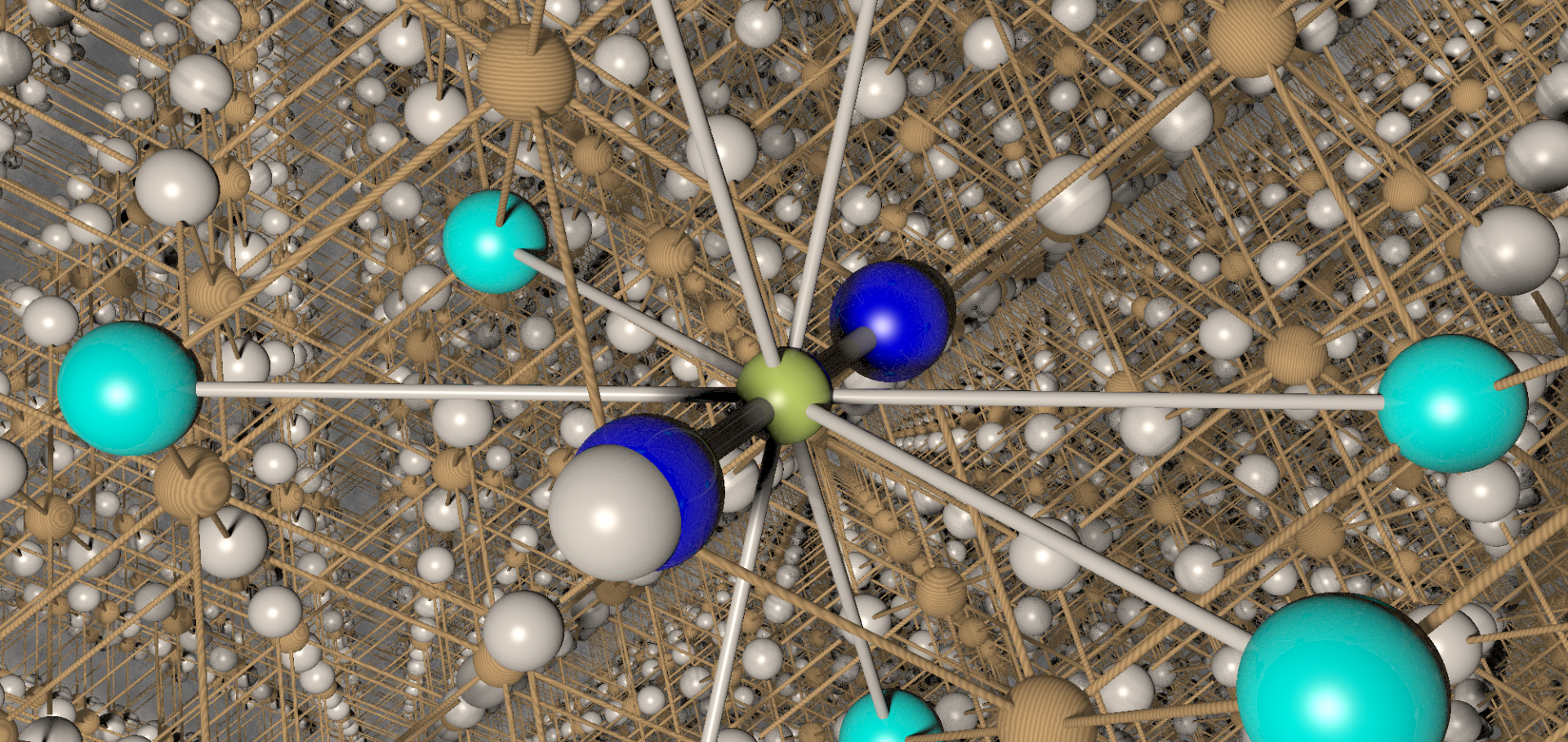
Crystal structure inside calcium fluoride with an implanted muon
Credit: SJB

Professor Stephen Blundell

Professor of Physics

Research theme

  • Quantum materials

Sub department

  • Condensed Matter Physics

Research groups

  • Muons and magnets
Stephen.Blundell@physics.ox.ac.uk
Telephone: 01865 (2)72347
Clarendon Laboratory, room 108
  • About
  • Books
  • Teaching
  • Research
  • Publications

Will Spin-Relaxation Times in Molecular Magnets Permit Quantum Information Processing?

Physical Review Letters 98 (2007) 057201 4pp

Authors:

A Ardavan, John J.L. Morton, Olivier Rival, Stephen J. Blundell
More details from the publisher
More details
More details
Details from ArXiV

Characterization of the crystal and magnetic structures of the mixed-anion coordination polymer Cu(HCO2)(NO3)(pyz) {pyz = Pyrazine} by X-ray diffraction, ac magnetic susceptibility, dc magnetization, muon-spin relaxation, and spin dimer analysis.

Inorg Chem 46:1 (2007) 213-220

Authors:

JL Manson, T Lancaster, JA Schlueter, SJ Blundell, ML Brooks, FL Pratt, CL Nygren, H-J Koo, D Dai, M-H Whangbo

Abstract:

The mixed-anion coordination polymer Cu(HCO2)(NO3)(pyz) was synthesized, its crystal structure was determined by X-ray diffraction, and its magnetic structure was characterized by ac susceptibility, dc magnetization, muon-spin relaxation, and spin dimer analysis. The crystal structure consists of five-coordinate Cu2+ ions that are connected through syn-anti bridging mu-HCO2- and mu-pyz ligands to form a highly corrugated two-dimensional layered network. Bulk magnetic measurements show a broad maximum in chi(T) at 6.6 K. The HCO2- and pyz ligands mediate ferromagnetic and antiferromagnetic spin exchange interactions between adjacent Cu2+ ions with the spin exchange parameters J/kB = 8.17 and -5.4 K, respectively (H = -JSigmaSi x Sj). The muon-spin relaxation data show a transition to a long-range magnetic ordering below TN = 3.66(3) K. For T < TN, the M(H) and chi'ac measurements provide evidence for a field-induced spin-flop transition at 15.2 kOe. That Cu(HCO2)(NO3)(pyz) undergoes a long-range magnetic ordering is an unexpected result because the one-dimensional Cu(NO3)2(pyz) and three-dimensional Cu(HCO2)2(pyz) compounds display linear chain antiferromagnetism with no long-range magnetic ordering down to 2 K.
More details from the publisher
More details

A muon-spin relaxation study of BiMnO3

JOURNAL OF PHYSICS-CONDENSED MATTER 19:37 (2007) ARTN 376203

Authors:

T Lancaster, SJ Blundell, PJ Baker, FL Pratt, W Hayes, I Yamada, M Azuma, M Takano
More details from the publisher

Dissipation in the superconducting state of κ-(BEDT-TTF)2Cu(NCS)2

PHYSICAL REVIEW B 76:1 (2007) ARTN 014506

Authors:

Liang Yin, Moon-Sun Nam, James G Analytis, Stephen J Blundell, Arzhang Ardavan, John A Schlueter, Takahiko Sasaki
More details from the publisher
Details from ArXiV

Muon spin rotation of organic compounds

(2007) 179-208
More details from the publisher

Pagination

  • First page First
  • Previous page Prev
  • …
  • Page 101
  • Page 102
  • Page 103
  • Page 104
  • Current page 105
  • Page 106
  • Page 107
  • Page 108
  • Page 109
  • …
  • Next page Next
  • Last page Last

Footer Menu

  • Contact us
  • Giving to the Dept of Physics
  • Work with us
  • Media

User account menu

  • Log in

Follow us

FIND US

Clarendon Laboratory,

Parks Road,

Oxford,

OX1 3PU

CONTACT US

Tel: +44(0)1865272200

University of Oxfrod logo Department Of Physics text logo
IOP Juno Champion logo Athena Swan Silver Award logo

© University of Oxford - Department of Physics

Cookies | Privacy policy | Accessibility statement

Built by: Versantus

  • Home
  • Research
  • Study
  • Engage
  • Our people
  • News & Comment
  • Events
  • Our facilities & services
  • About us
  • Giving to Physics
  • Current students
  • Staff intranet