Home
Department Of Physics text logo
  • Research
    • Our research
    • Our research groups
    • Our research in action
    • Research funding support
    • Summer internships for undergraduates
  • Study
    • Undergraduates
    • Postgraduates
  • Engage
    • For alumni
    • For business
    • For schools
    • For the public
Menu
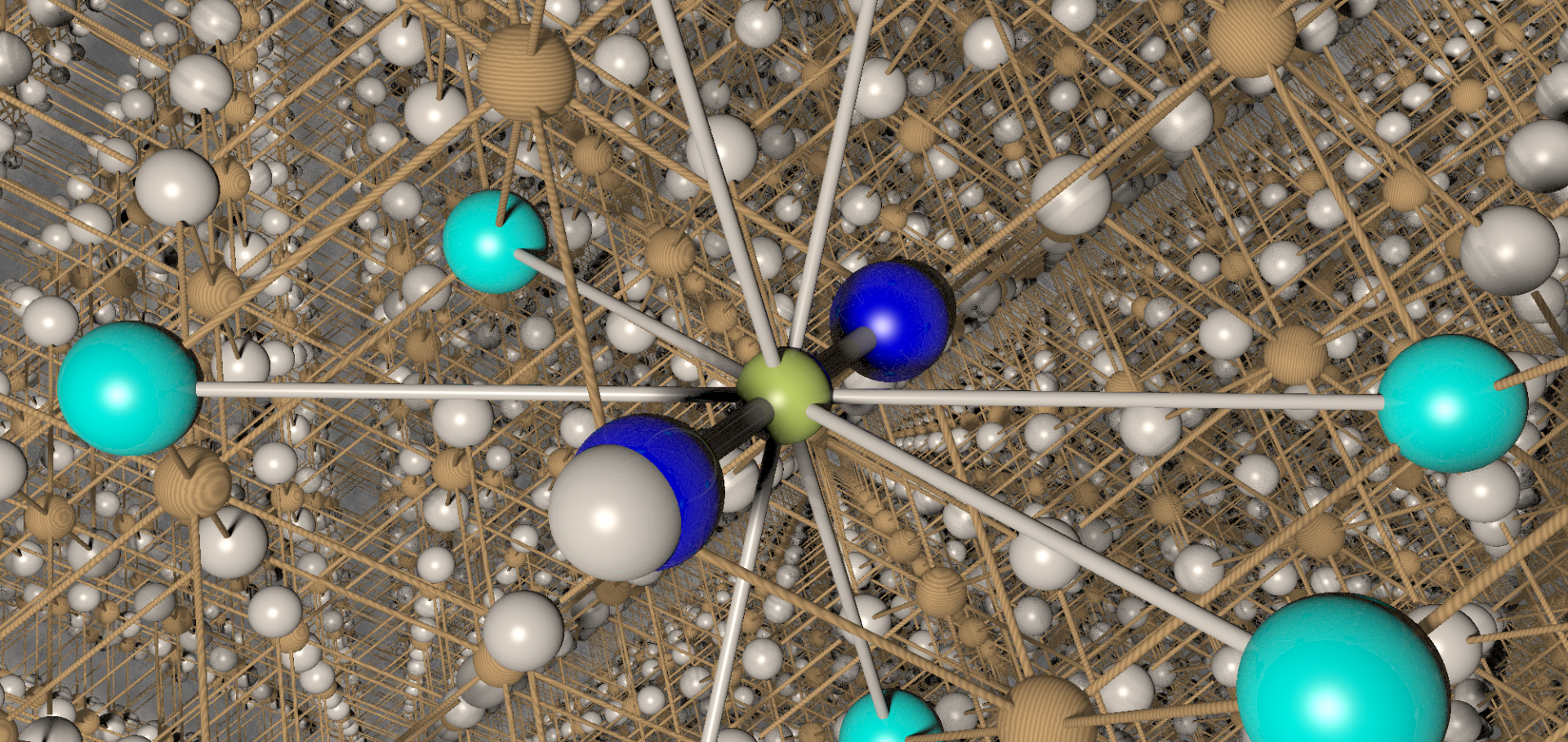
Crystal structure inside calcium fluoride with an implanted muon
Credit: SJB

Professor Stephen Blundell

Professor of Physics

Research theme

  • Quantum materials

Sub department

  • Condensed Matter Physics

Research groups

  • Muons and magnets
Stephen.Blundell@physics.ox.ac.uk
Telephone: 01865 (2)72347
Clarendon Laboratory, room 108
  • About
  • Books
  • Teaching
  • Research
  • Publications

A superfluid universe, by K. Huang

Contemporary Physics Taylor & Francis 58:2 (2017) 203-204
More details from the publisher

Group theory in a nutshell for physicists, by A. Zee

Contemporary Physics Taylor & Francis 58:2 (2017) 197-198
More details from the publisher

Coexistence of magnetism and superconductivity in separate layers of the iron-based superconductor

Physical Review B American Physical Society 95:13 (2017) 134419

Authors:

Craig V Topping, Franziska KK Kirschner, Stephen Blundell, Peter J Baker, Daniel N Woodruff, F Schild, Hu Sun, Simon J Clarke

Abstract:

The magnetic properties attributed to the hydroxide layer of Li1-xFex(OH)Fe1-ySe have been elucidated by the study of superconducting and nonsuperconducting members of this family of compounds. Both ac magnetometry and muon spin relaxation measurements of nonsuperconductors find a magnetic state existing below ≈10 K which exhibits slow relaxation of magnetization. This magnetic state is accompanied by a low-temperature heat capacity anomaly present in both superconducting and nonsuperconducting variants suggesting that the magnetism persists into the superconducting state. The estimated value of magnetic moment present within the hydroxide layer supports a picture of a glassy magnetic state, probably comprising clusters of iron ions of varying cluster sizes distributed within the lithium hydroxide layer.
More details from the publisher
Details from ORA
More details
More details

Strong coupling of microwave photons to antiferromagnetic fluctuations in an organic magnet

(2017)

Authors:

M Mergenthaler, J Liu, JJ Le Roy, N Ares, AL Thompson, L Bogani, F Luis, SJ Blundell, T Lancaster, A Ardavan, GAD Briggs, PJ Leek, EA Laird
More details from the publisher

Room-temperature helimagnetism in FeGe thin films

Scientific Reports Nature Publishing Group 7 (2017) 123

Authors:

Shilei Zhang, Ioannis Stasinopoulos, Tom Lancaster, Fan Xiao, Andreas Bauer, Felix Rucker, Alexander A Baker, Adriana I Figueroa, Zaher Salman, Francis L Pratt, Stephen J Blundell, Thomas Prokscha, Andreas Suter, Johannes Waizner, Markus Garst, Dirk Grundler, Gerrit van der Laan, Christian Pfleiderer, Thorsten Hesjedal

Abstract:

Chiral magnets are promising materials for the realisation of high-density and low-power spintronic memory devices. For these future applications, a key requirement is the synthesis of appropriate materials in the form of thin films ordering well above room temperature. Driven by the Dzyaloshinskii-Moriya interaction, the cubic compound FeGe exhibits helimagnetism with a relatively high transition temperature of 278K in bulk crystals. We demonstrate that this temperature can be enhanced significantly in thin films. Using x-ray spectroscopic and ferromagnetic resonance techniques, we provide unambiguous experimental evidence for long-wavelength helimagnetic order at room temperature and magnetic properties similar to the bulk material. We obtain αintr = 0:0036 ± 0:0003 at 310K for the intrinsic damping parameter. We probe the dynamics of the system by means of muon-spin rotation, indicating that the ground state is reached via a freezing out of slow dynamics. Our work paves the way towards the fabrication of thin films of chiral magnets that host certain spin whirls, so-called skyrmions, at room temperature and potentially offer integrability into modern electronics.
More details from the publisher
Details from ORA
More details
More details

Pagination

  • First page First
  • Previous page Prev
  • …
  • Page 32
  • Page 33
  • Page 34
  • Page 35
  • Current page 36
  • Page 37
  • Page 38
  • Page 39
  • Page 40
  • …
  • Next page Next
  • Last page Last

Footer Menu

  • Contact us
  • Giving to the Dept of Physics
  • Work with us
  • Media

User account menu

  • Log in

Follow us

FIND US

Clarendon Laboratory,

Parks Road,

Oxford,

OX1 3PU

CONTACT US

Tel: +44(0)1865272200

University of Oxfrod logo Department Of Physics text logo
IOP Juno Champion logo Athena Swan Silver Award logo

© University of Oxford - Department of Physics

Cookies | Privacy policy | Accessibility statement

Built by: Versantus

  • Home
  • Research
  • Study
  • Engage
  • Our people
  • News & Comment
  • Events
  • Our facilities & services
  • About us
  • Giving to Physics
  • Current students
  • Staff intranet