Home
Department Of Physics text logo
  • Research
    • Our research
    • Our research groups
    • Our research in action
    • Research funding support
    • Summer internships for undergraduates
  • Study
    • Undergraduates
    • Postgraduates
  • Engage
    • For alumni
    • For business
    • For schools
    • For the public
Menu
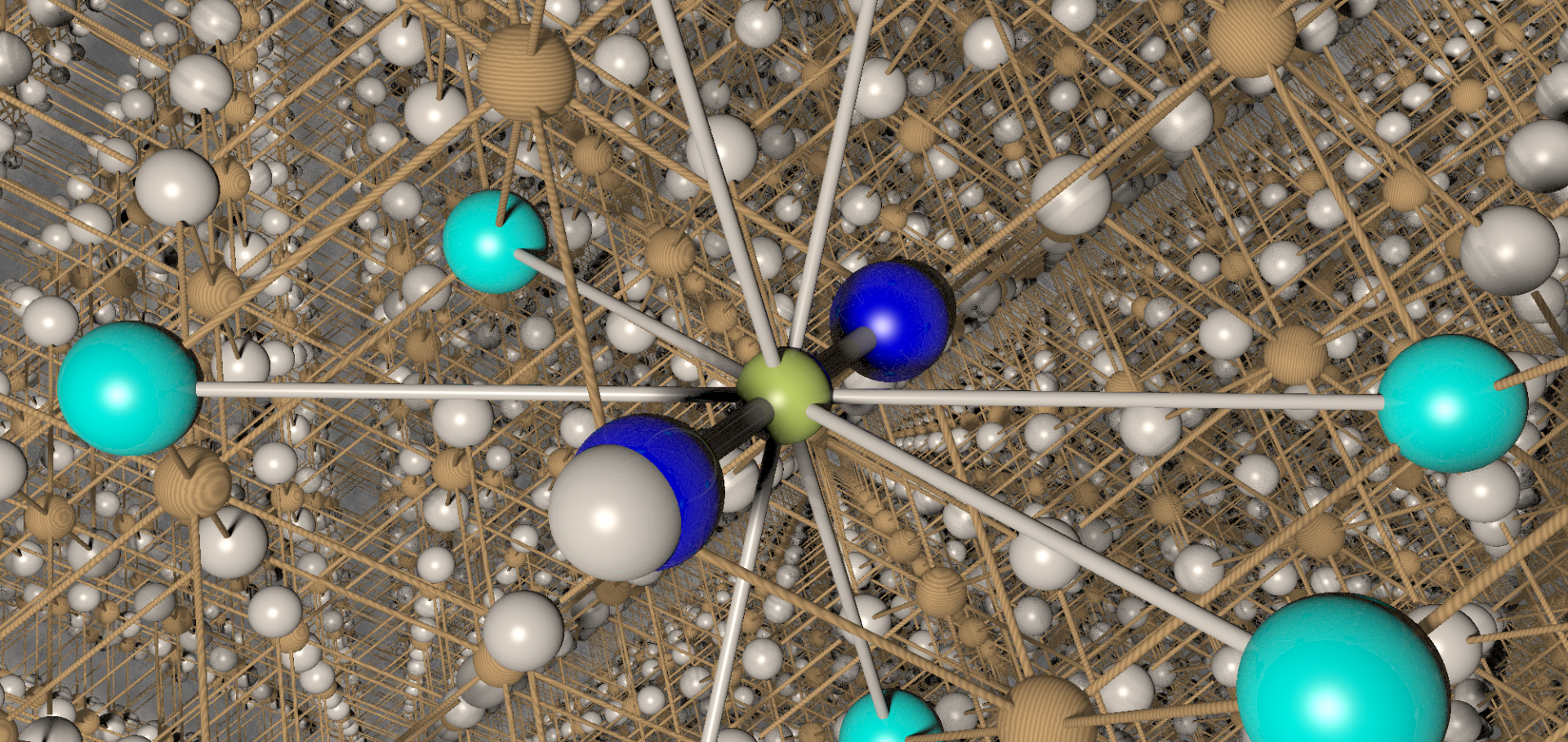
Crystal structure inside calcium fluoride with an implanted muon
Credit: SJB

Professor Stephen Blundell

Professor of Physics

Research theme

  • Quantum materials

Sub department

  • Condensed Matter Physics

Research groups

  • Muons and magnets
Stephen.Blundell@physics.ox.ac.uk
Telephone: 01865 (2)72347
Clarendon Laboratory, room 108
  • About
  • Books
  • Teaching
  • Research
  • Publications

Static and fluctuating magnetic moments in the ferroelectric metal LiOsO3

JPS Conference Proceedings Physical Society of Japan 日本物理学会 21:011013 (2018) 1-6

Authors:

Franziska Kirschner, Franz Lang, FL Pratt, T Lancaster, Y Shi, Y Guo, Andrew Boothroyd, Stephen Blundell

Abstract:

LiOsO3 is the first example of a new class of material called a ferroelectric metal. We performed zero-field and longitudinal-field μSR, along with a combination of electronic structure and dipole field calculations, to determine the magneticground state of LiOsO3. We find that the sample contains both static Li nuclear moments and dynamic Os electronic moments. Below ≈0.7 K, the fluctuations of the Os moments slow down, though remain dynamic down to 0.08 K. We expect this could result in a frozen-out, disordered ground state at even lower temperatures.
More details from the publisher
Details from ORA
Details from ArXiV

Nodal multigap superconductivity in KCa2Fe4As4F2

PHYSICAL REVIEW B 97:6 (2018) 060509(R)

Authors:

M Smidman, FKK Kirschner, DT Adroja, AD Hillier, F Lang, ZC Wang, GH Cao, SJ Blundell
More details from the publisher
Details from ORA
More details

Two-gap superconductivity with line nodes in CsCa2Fe4As4F2

Physical Review B American Physical Society 97:6 (2018) 060506(R)

Authors:

Franziska Kirschner, DT Adroja, Z-W Wang, Franz Lang, M Smidman, PJ Baker, G-H Cao, Stephen J Blundell

Abstract:

We report the results of a muon-spin rotation ($\mu$SR) experiment to determine the superconducting ground state of the iron-based superconductor $CsCa_2Fe_4As_4F_2$ with $T_{\rm c} \approx 28.3\,K$. This compound is related to the fully-gapped superconductor $CaCsFe_4As_4$, but here the Ca-containing spacer layer is replaced with one containing $Ca_2F_2$. The temperature evolution of the penetration depth strongly suggests the presence of line nodes and is best modelled by a system consisting of both an $s-$ and a $d-$wave gap. We also find a potentially magnetic phase which appears below $\approx 10\,K$ but does not appear to compete with the superconductivity. This compound contains the largest alkali atom in this family of superconductors and our results yield a value for the in-plane penetration depth of $\lambda_{ab}(T=0)=423(5)\,nm$.
More details from the publisher
Details from ORA
More details
Details from ArXiV

Multigap superconductivity in RbCa2Fe4As4F2 investigated using muSR measurements

(2018)

Authors:

DT Adroja, FKK Kirschner, F Lang, M Smidman, AD Hillier, Zhi-Cheng Wang, Guang-Han Cao, GBG Stenning, SJ Blundell
More details from the publisher

Extreme sensitivity of a topochemical reaction to cation substitution: SrVO2H versus SrV1-xTixO1.5H1.5

Inorganic Chemistry American Chemical Society 57:5 (2018) 2890-2898

Authors:

Midori Amano Patino, Dihao Zeng, Stephen Blundell, John McGrady, Michael Hayward

Abstract:

The anion-ordered oxide-hydride SrVO2H is an antiferromagnetic insulator due to strong correlations between vanadium d electrons. In an attempt to hole-dope SrVO2H into a metallic state, a strategy of first preparing SrV1-xTixO3 phases and then converting them to the corresponding SrV1-xTixO2H phases via reaction with CaH2 was followed. This revealed that the solid solution between SrVO3 and SrTiO3 is only stable at high temperature. In addition, reactions between SrV0.95Ti0.05O3 and CaH2 were observed to yield SrV0.95Ti0.05O1.5H1.5 not SrV0.95Ti0.05O2H. This dramatic change in reactivity for a very modest change in initial chemical composition is attributed to an electronic destabilization of SrVO2H on titanium substitution. Density functional theory calculations indicate that the presence of an anion-ordered, tetragonal SrMO2H phase is uniquely associated with a d2 electron count and that titanium substitution leads to an electronic destabilization of SrV1-xTixO2H phases, which, ultimately, drives further reaction of SrV1-xTixO2H to SrV1-xTixO1.5H1.5. The observed sensitivity of the reaction products to the chemical composition of initial phases highlights some of the difficulties associated with electronically doping metastable materials prepared by topochemical reactions.
More details from the publisher
Details from ORA
More details
More details

Pagination

  • First page First
  • Previous page Prev
  • …
  • Page 28
  • Page 29
  • Page 30
  • Page 31
  • Current page 32
  • Page 33
  • Page 34
  • Page 35
  • Page 36
  • …
  • Next page Next
  • Last page Last

Footer Menu

  • Contact us
  • Giving to the Dept of Physics
  • Work with us
  • Media

User account menu

  • Log in

Follow us

FIND US

Clarendon Laboratory,

Parks Road,

Oxford,

OX1 3PU

CONTACT US

Tel: +44(0)1865272200

University of Oxfrod logo Department Of Physics text logo
IOP Juno Champion logo Athena Swan Silver Award logo

© University of Oxford - Department of Physics

Cookies | Privacy policy | Accessibility statement

Built by: Versantus

  • Home
  • Research
  • Study
  • Engage
  • Our people
  • News & Comment
  • Events
  • Our facilities & services
  • About us
  • Giving to Physics
  • Current students
  • Staff intranet