Home
Department Of Physics text logo
  • Research
    • Our research
    • Our research groups
    • Our research in action
    • Research funding support
    • Summer internships for undergraduates
  • Study
    • Undergraduates
    • Postgraduates
  • Engage
    • For alumni
    • For business
    • For schools
    • For the public
Menu
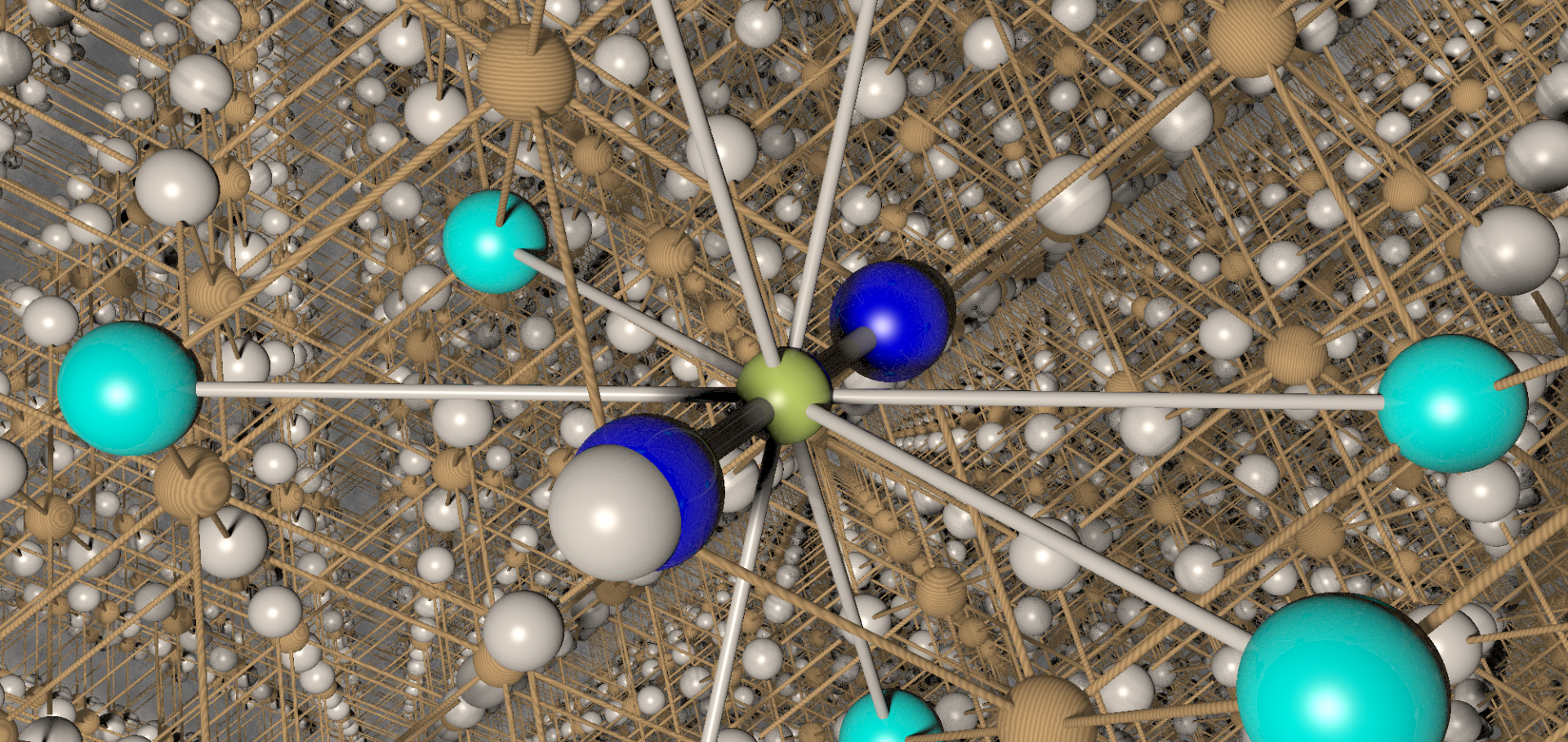
Crystal structure inside calcium fluoride with an implanted muon
Credit: SJB

Professor Stephen Blundell

Professor of Physics

Research theme

  • Quantum materials

Sub department

  • Condensed Matter Physics

Research groups

  • Muons and magnets
Stephen.Blundell@physics.ox.ac.uk
Telephone: 01865 (2)72347
Clarendon Laboratory, room 108
  • About
  • Books
  • Teaching
  • Research
  • Publications

Design and commissioning of a high magnetic field muon spin relaxation spectrometer at the ISIS pulsed neutron and muon source.

Rev Sci Instrum 82:7 (2011) 073904

Authors:

JS Lord, I McKenzie, PJ Baker, SJ Blundell, SP Cottrell, SR Giblin, J Good, AD Hillier, BH Holsman, PJC King, T Lancaster, R Mitchell, JB Nightingale, M Owczarkowski, S Poli, FL Pratt, NJ Rhodes, R Scheuermann, Z Salman

Abstract:

The high magnetic field (HiFi) muon instrument at the ISIS pulsed neutron and muon source is a state-of-the-art spectrometer designed to provide applied magnetic fields up to 5 T for muon studies of condensed matter and molecular systems. The spectrometer is optimised for time-differential muon spin relaxation studies at a pulsed muon source. We describe the challenges involved in its design and construction, detailing, in particular, the magnet and detector performance. Commissioning experiments have been conducted and the results are presented to demonstrate the scientific capabilities of the new instrument.
More details from the publisher
More details

Observation of a level crossing in a molecular nanomagnet using implanted muons.

J Phys Condens Matter 23:24 (2011) 242201

Authors:

T Lancaster, JS Möller, SJ Blundell, FL Pratt, PJ Baker, T Guidi, GA Timco, REP Winpenny

Abstract:

We have observed an electronic energy level crossing in a molecular nanomagnet (MNM) using muon spin relaxation. This effect, not observed previously despite several muon studies of MNM systems, provides further evidence that the spin relaxation of the implanted muon is sensitive to the dynamics of the electronic spin. Our measurements on a broken ring MNM [H(2)N(t)Bu(is)Pr][Cr(8)CdF(9)(O(2)CC(CH(3))(3))(18)], which contains eight Cr ions, show clear evidence for the S = 0 --> S = 1 transition that takes place at B(c) = 2.3 T. The crossing is observed as a resonance-like dip in the average positron asymmetry and also in the muon spin relaxation rate, which shows a sharp increase in magnitude at the transition and a peak centred within the S = 1 regime.
More details from the publisher
More details

Observation of a level crossing in a molecular nanomagnet using implanted muons

(2011)

Authors:

T Lancaster, JS Moeller, SJ Blundell, FL Pratt, PJ Baker, T Guidi, GA Timco, REP Winpenny
More details from the publisher

Magnetic order in quasi-two-dimensional molecular magnets investigated with muon-spin relaxation

(2011)

Authors:

Andrew J Steele, Tom Lancaster, Stephen J Blundell, Peter J Baker, Francis L Pratt, Chris Baines, Marianne M Conner, Heather I Southerland, Jamie L Manson, John A Schlueter
More details from the publisher

The forgotten brothers

Physics World IOP Publishing 24:04 (2011) 26-29
More details from the publisher

Pagination

  • First page First
  • Previous page Prev
  • …
  • Page 75
  • Page 76
  • Page 77
  • Page 78
  • Current page 79
  • Page 80
  • Page 81
  • Page 82
  • Page 83
  • …
  • Next page Next
  • Last page Last

Footer Menu

  • Contact us
  • Giving to the Dept of Physics
  • Work with us
  • Media

User account menu

  • Log in

Follow us

FIND US

Clarendon Laboratory,

Parks Road,

Oxford,

OX1 3PU

CONTACT US

Tel: +44(0)1865272200

University of Oxfrod logo Department Of Physics text logo
IOP Juno Champion logo Athena Swan Silver Award logo

© University of Oxford - Department of Physics

Cookies | Privacy policy | Accessibility statement

Built by: Versantus

  • Home
  • Research
  • Study
  • Engage
  • Our people
  • News & Comment
  • Events
  • Our facilities & services
  • About us
  • Giving to Physics
  • Current students
  • Staff intranet