Home
Department Of Physics text logo
  • Research
    • Our research
    • Our research groups
    • Our research in action
    • Research funding support
    • Summer internships for undergraduates
  • Study
    • Undergraduates
    • Postgraduates
  • Engage
    • For young people
    • For teachers
    • For the public
    • For alumni
    • For business
  • Support
Menu
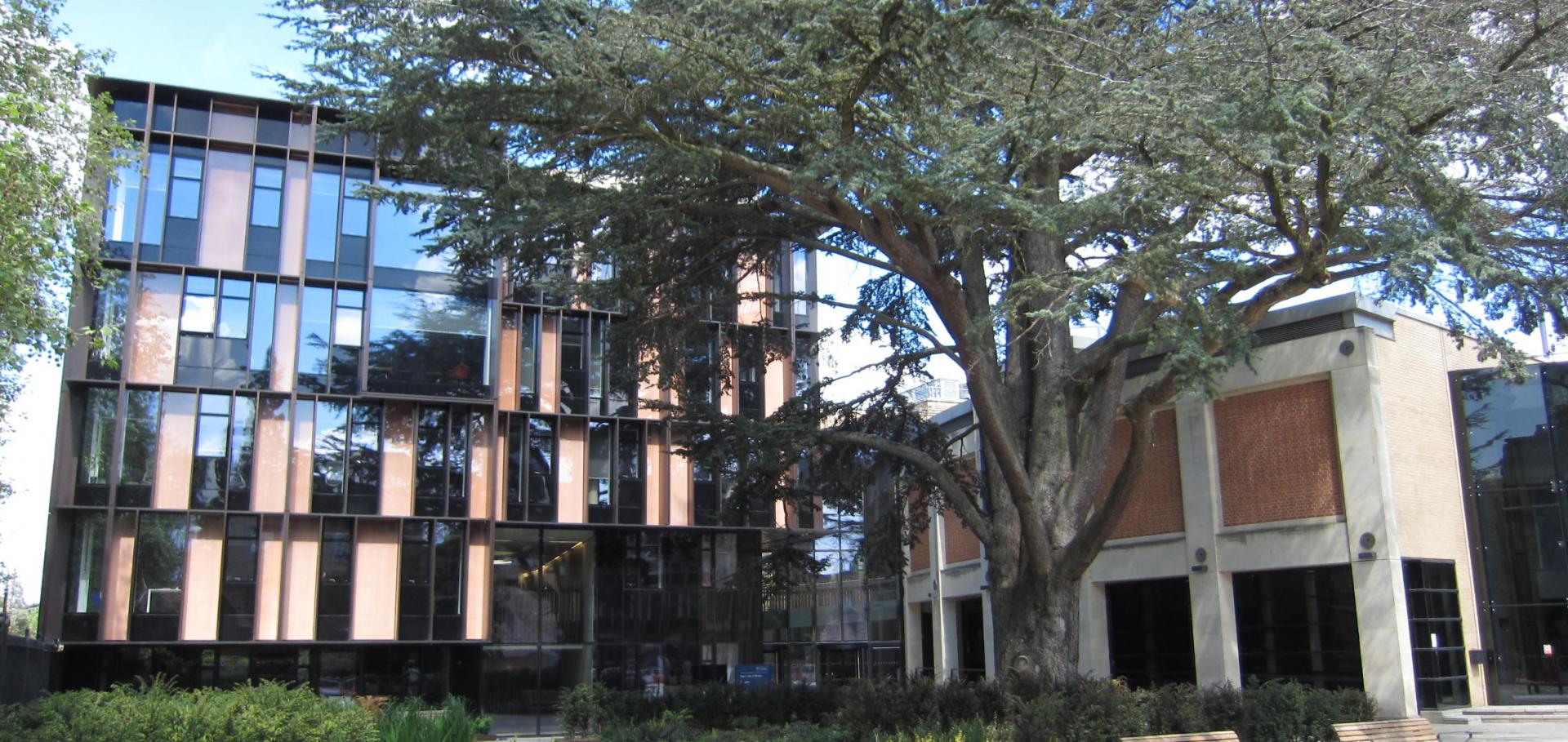
Clarendon Laboratory and Beecroft Building

Andrew Boothroyd

Head of Department

Research theme

  • Quantum materials

Sub department

  • Condensed Matter Physics

Research groups

  • X-ray and neutron scattering
Andrew.Boothroyd@physics.ox.ac.uk
Telephone: 01865 (2)72376
Clarendon Laboratory, room 375,374B,374A,371A,371,177,175,172 (office)
ORCID ID 0000-0002-3575-7471
ResearcherID AAA-7883-2021
  • About
  • News
  • Research
  • Teaching
  • Prizes, awards and recognition
  • Software
  • Vacancies
  • Publications

Textbook

Principles of Neutron Scattering from Condensed Matter

Published by Oxford University Press in July 2020

Buy now

Low-energy quasi-one-dimensional spin dynamics in charge-ordered La2-xSrxNiO4

PHYSICAL REVIEW B 83:9 (2011) ARTN 094414

Authors:

PG Freeman, D Prabhakaran, K Nakajima, A Stunault, M Enderle, C Niedermayer, CD Frost, K Yamada, AT Boothroyd
More details from the publisher
Details from ArXiV

Spin anisotropy of the resonance peak in superconducting FeSe0.5Te0.5

PHYSICAL REVIEW B 83:18 (2011) ARTN 180506

Authors:

P Babkevich, B Roessli, SN Gvasaliya, L-P Regnault, PG Freeman, E Pomjakushina, K Conder, AT Boothroyd
More details from the publisher
Details from ArXiV

Probing photo-induced melting of antiferromagnetic order in La0.5Sr1.5MnO4 by ultrafast resonant soft X-ray diffraction

ArXiv 1012.496 (2010)

Authors:

H Ehrke, RI Tobey, S Wall, SA Cavill, M Först, V Khanna, Th Garl, N Stojanovic, D Prabhakaran, AT Boothroyd, M Gensch, A Mirone, P Reutler, A Revcolevschi, SS Dhesi, A Cavalleri

Abstract:

Photo-excitation in complex oxides1 transfers charge across semicovalent bonds, drastically perturbing spin and orbital orders2. Light may then be used in compounds like magnetoresistive manganites to control magnetism on nanometre lengthscales and ultrafast timescales. Here, we show how ultrafast resonant soft x-ray diffraction can separately probe the photo-induced dynamics of spin and orbital orders in La0.5Sr1.5MnO4. Ultrafast melting of CE antiferromagnetic spin order is evidenced by the disappearance of a (1/4,1/4,1/2) diffraction peak. On the other hand the (1/4,1/4,0) peak, reflecting orbital order, is only partially reduced. Cluster calculations aid our interpretation by considering different magnetically ordered states accessible after photo-excitation. Nonthermal coupling between light and magnetism emerges as a primary aspect of photo-induced phase transitions in manganites.
Details from ArXiV
More details from the publisher

Ultrafast resonant soft X-ray scattering in manganites: Direct measurement of time-dependent orbital order

Optics InfoBase Conference Papers (2010)

Authors:

H Ehrke, RI Tobey, S Wall, SA Cavill, D Prabhakaran, AT Boothroyd, M Gensch, P Reutler, A Revcolevschi, SS Dhesi, A Cavalleri

Abstract:

We present ultrafast resonant soft-x-ray diffraction measurements of time-dependent orbital order in the single-layer-manganite La0.5Sr1.5MnO4. These experiments reveal the appearance of a metastable phase with reduced ordering, different from any thermal state of the system. © OSA / UP 2010.

Magnetic spectrum of the two-dimensional antiferromagnet La2 CoO4 studied by inelastic neutron scattering

Physical Review B - Condensed Matter and Materials Physics 82:18 (2010)

Authors:

P Babkevich, D Prabhakaran, CD Frost, AT Boothroyd

Abstract:

We report measurements of the magnetic excitation spectrum of the layered antiferromagnet La2 CoO4 by time-of-flight neutron inelastic scattering. In the energy range probed in our experiments (0-250 meV) the magnetic spectrum consists of spin-wave modes with strong in-plane dispersion extending up to 60 meV, and a nearly dispersionless peak at 190 meV. The spin-wave modes exhibit a small (∼1meV) dispersion along the magnetic zone boundary. We show that the magnetic spectrum can be described very well by a model of a Heisenberg antiferromagnet that includes the full spin and orbital degrees of freedom of Co2⊃+ in an axially distorted crystal field. The collective magnetic dynamics are found to be controlled by dominant nearest-neighbor exchange interactions, strong XY-like single-ion anisotropy and a substantial unquenched orbital angular momentum. © 2010 The American Physical Society.
More details from the publisher
More details
Details from ArXiV

Pagination

  • First page First
  • Previous page Prev
  • …
  • Page 42
  • Page 43
  • Page 44
  • Page 45
  • Current page 46
  • Page 47
  • Page 48
  • Page 49
  • Page 50
  • …
  • Next page Next
  • Last page Last

Footer Menu

  • Contact us
  • Giving to the Dept of Physics
  • Work with us
  • Media

User account menu

  • Log in

Follow us

FIND US

Clarendon Laboratory,

Parks Road,

Oxford,

OX1 3PU

CONTACT US

Tel: +44(0)1865272200

University of Oxfrod logo Department Of Physics text logo
IOP Juno Champion logo Athena Swan Silver Award logo

© University of Oxford - Department of Physics

Cookies | Privacy policy | Accessibility statement

Built by: Versantus

  • Home
  • Research
  • Study
  • Engage
  • Our people
  • News & Comment
  • Events
  • Our facilities & services
  • About us
  • Giving to Physics
  • Current students
  • Staff intranet