

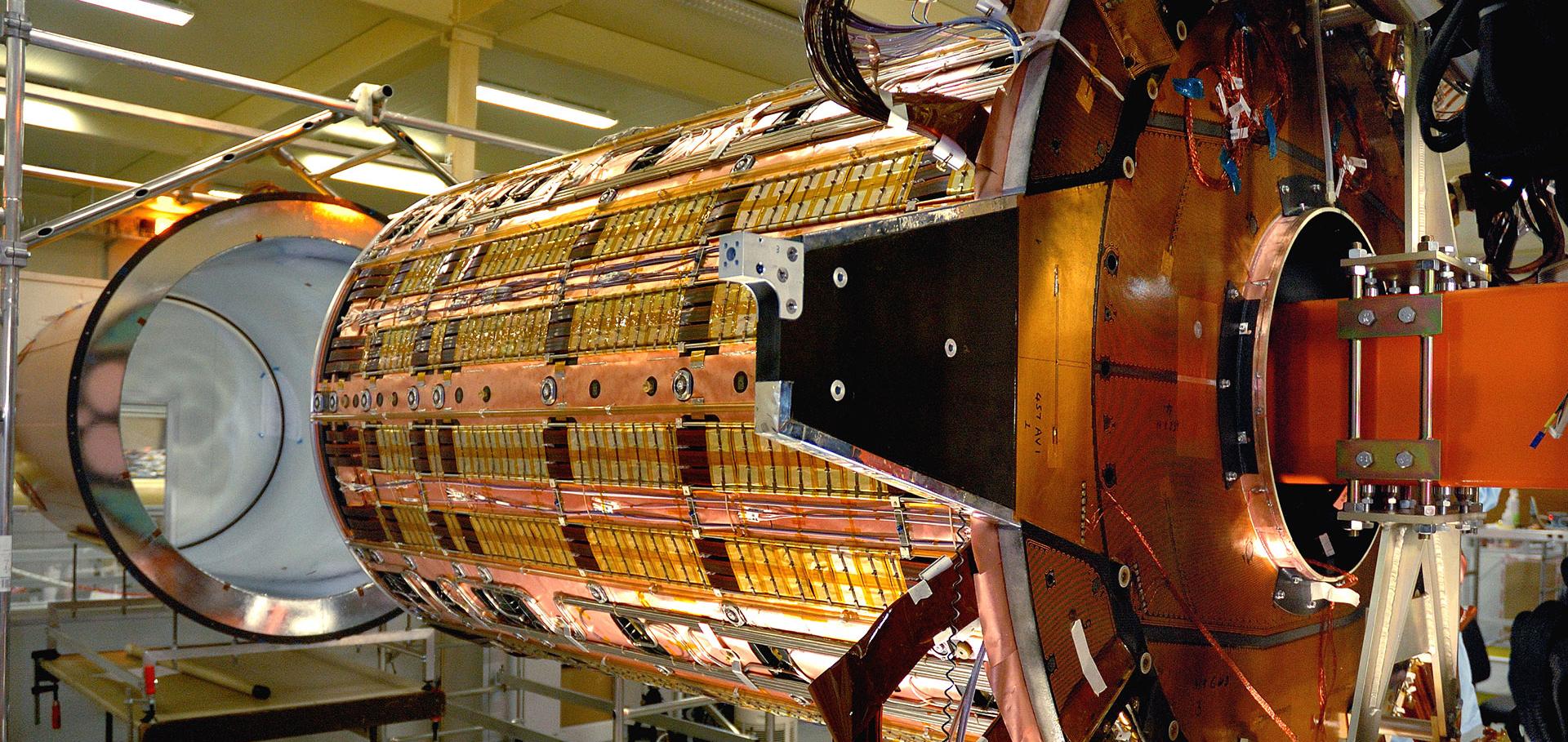

The ATLAS inner detector trigger performance in pp collisions at 13 TeV during LHC Run 2
The European Physical Journal C SpringerOpen 82:3 (2022) 206
Abstract:
Abstract The design and performance of the inner detector trigger for the high level trigger of the ATLAS experiment at the Large Hadron Collider during the 2016–2018 data taking period is discussed. In 2016, 2017, and 2018 the ATLAS detector recorded $$35.6~\mathrm {fb}^{-1}$$ 35.6 fb - 1 , $$46.9~\mathrm {fb}^{-1}$$ 46.9 fb - 1 , and $$60.6~\mathrm {fb}^{-1}$$ 60.6 fb - 1 respectively of proton–proton collision data at a centre-of-mass energy of 13 TeV. In order to deal with the very high interaction multiplicities per bunch crossing expected with the 13 TeV collisions the inner detector trigger was redesigned during the long shutdown of the Large Hadron Collider from 2013 until 2015. An overview of these developments is provided and the performance of the tracking in the trigger for the muon, electron, tau and b -jet signatures is discussed. The high performance of the inner detector trigger with these extreme interaction multiplicities demonstrates how the inner detector tracking continues to lie at the heart of the trigger performance and is essential in enabling the ATLAS physics programme.Search for Higgs bosons decaying into new spin-0 or spin-1 particles in four-lepton final states with the ATLAS detector with 139 fb−1 of pp collision data at $$ \sqrt{s} $$ = 13 TeV
Journal of High Energy Physics Springer 2022:3 (2022) 41
Abstract:
We consider a model where the electroweak symmetry breaking is driven by strong dynamics, resulting in an electroweak doublet scalar condensate, and transmitted to the standard model matter fields via another electroweak doublet scalar. At low energies the effective theory therefore shares features with a type-I two Higgs doublet model. However, important differences arise due to the rich composite spectrum expected to contain new vector resonances accessible at the LHC. We carry out a systematic analysis of the vector resonance signals at LHC and find that the model remains viable, but will be tightly constrained by direct searches as the projected integrated luminosity, around 200 fb(-1), of the current run becomes available.Peer revieweStudy of $B_c^+\to J/ψD_s^+$ and $B_c^+\to J/ψD_s^{*+}$ decays in $pp$ collisions at $\sqrt{s} = 13$ TeV with the ATLAS detector
ArXiv 2203.01808 (2022)
Search for neutral long-lived particles in $pp$ collisions at $\sqrt{s}=13$ TeV that decay into displaced hadronic jets in the ATLAS calorimeter
ArXiv 2203.01009 (2022)
Search for events with a pair of displaced vertices from long-lived neutral particles decaying into hadronic jets in the ATLAS muon spectrometer in pp collisions at $\sqrt{s}=13$ TeV
ArXiv 2203.00587 (2022)