Home
Department Of Physics text logo
  • Research
    • Our research
    • Our research groups
    • Our research in action
    • Research funding support
    • Summer internships for undergraduates
  • Study
    • Undergraduates
    • Postgraduates
  • Engage
    • For alumni
    • For business
    • For schools
    • For the public
Menu
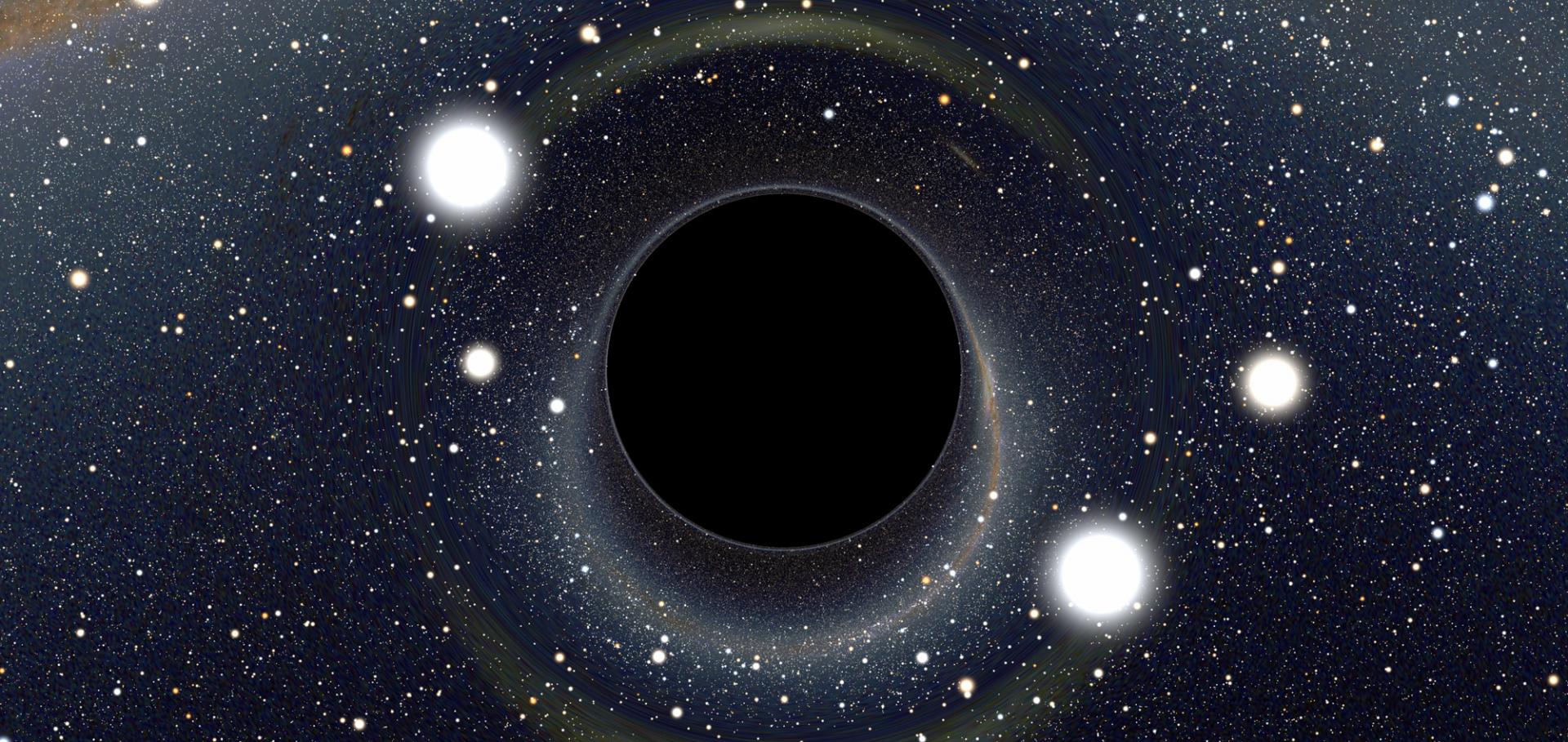
Black Hole

Lensing of space time around a black hole. At Oxford we study black holes observationally and theoretically on all size and time scales - it is some of our core work.

Credit: ALAIN RIAZUELO, IAP/UPMC/CNRS. CLICK HERE TO VIEW MORE IMAGES.

Andrew Bunker

Professor of Astrophysics

Research theme

  • Astronomy and astrophysics

Sub department

  • Astrophysics

Research groups

  • Galaxy formation and evolution
Andy.Bunker@physics.ox.ac.uk
Telephone: 01865 (2)83126
Denys Wilkinson Building, room 702
  • About
  • Publications

The Evolution of Gas-Phase Metallicity and Resolved Abundances in Star-forming Galaxies at $z \approx0.6-1.8$

(2020)

Authors:

S Gillman, AL Tiley, AM Swinbank, U Dudzevičiūtė, RM Sharples, Ian Smail, CM Harrison, Andrew J Bunker, Martin Bureau, M Cirasuolo, Georgios E Magdis, Trevor Mendel, John P Stott
More details from the publisher

An ALMA survey of the brightest sub-millimetre sources in the SCUBA-2–COSMOS field

Monthly Notices of the Royal Astronomical Society Oxford University Press (OUP) 495:3 (2020) 3409-3430

Authors:

JM Simpson, Ian Smail, U Dudzevičiūtė, Y Matsuda, B-C Hsieh, W-H Wang, AM Swinbank, SM Stach, Fang Xia An, JE Birkin, Y Ao, AJ Bunker, SC Chapman, Chian-Chou Chen, KEK Coppin, S Ikarashi, RJ Ivison, I Mitsuhashi, T Saito, H Umehata, R Wang, Y Zhao
More details from the publisher
More details

K-CLASH: Strangulation and ram pressure stripping in galaxy cluster members at 0.3 < z < 0.6

Monthly Notices of the Royal Astronomical Society Oxford University Press 496:3 (2020) 3841-3861

Authors:

Sam P Vaughan, Alfred L Tiley, Roger L Davies, Laura J Prichard, Scott M Croom, Martin Bureau, John P Stott, Andrew Bunker, Michele Cappellari, Behzad Ansarinejad, Matt J Jarvis

Abstract:

Galaxy clusters have long been theorized to quench the star formation of their members. This study uses integral-field unit observations from the K-band MultiObject Spectrograph (KMOS) – Cluster Lensing And Supernova survey with Hubble (CLASH) survey (K-CLASH) to search for evidence of quenching in massive galaxy clusters at redshifts 0.3 < z < 0.6. We first construct mass-matched samples of exclusively star-forming cluster and field galaxies, then investigate the spatial extent of their H α emission and study their interstellar medium conditions using emission line ratios. The average ratio of H α half-light radius to optical half-light radius ($r_{\mathrm{e}, {\rm {H}\,\alpha }}/r_{\mathrm{e}, R_{\mathrm{c} } }$) for all galaxies is 1.14 ± 0.06, showing that star formation is taking place throughout stellar discs at these redshifts. However, on average, cluster galaxies have a smaller $r_{\mathrm{e}, {\rm {H}\alpha }}/r_{\mathrm{e}, R_{\mathrm{c} } }$ ratio than field galaxies: 〈$r_{\mathrm{e}, {\rm {H}\alpha }}/r_{\mathrm{e}, R_{\mathrm{c} } }$〉 = 0.96 ± 0.09 compared to 1.22 ± 0.08 (smaller at a 98 per cent credibility level). These values are uncorrected for the wavelength difference between H α emission and Rc-band stellar light but implementing such a correction only reinforces our results. We also show that whilst the cluster and field samples follow indistinguishable mass–metallicity (MZ) relations, the residuals around the MZ relation of cluster members correlate with cluster-centric distance; galaxies residing closer to the cluster centre tend to have enhanced metallicities (significant at the 2.6σ level). Finally, in contrast to previous studies, we find no significant differences in electron number density between the cluster and field galaxies. We use simple chemical evolution models to conclude that the effects of disc strangulation and ram-pressure stripping can quantitatively explain our observations.
More details from the publisher
Details from ORA
More details

K-CLASH: Strangulation and Ram Pressure Stripping in Galaxy Cluster Members at 0.3 < z < 0.6

(2020)

Authors:

Sam P Vaughan, Alfred L Tiley, Roger L Davies, Laura J Prichard, Scott M Croom, Martin Bureau, John P Stott, Andrew Bunker, Michele Cappellari, Behzad Ansarinejad, Matt J Jarvis
More details from the publisher

SCUBA-2 Ultra Deep Imaging EAO Survey (STUDIES). IV. Spatial Clustering and Halo Masses of Submillimeter Galaxies

The Astrophysical Journal American Astronomical Society 895:2 (2020) 104

Authors:

Chen-Fatt Lim, Chian-Chou Chen, Ian Smail, Wei-Hao Wang, Wei-Leong Tee, Yen-Ting Lin, Douglas Scott, Yoshiki Toba, Yu-Yen Chang, YiPing Ao, Arif Babul, Andy Bunker, Scott C Chapman, David L Clements, Christopher J Conselice, Yu Gao, Thomas R Greve, Luis C Ho, Sungwook E Hong, Ho Seong Hwang, Maciej Koprowski, Michał J Michałowski, Hyunjin Shim, Xinwen Shu, James M Simpson
More details from the publisher
More details

Pagination

  • First page First
  • Previous page Prev
  • …
  • Page 55
  • Page 56
  • Page 57
  • Page 58
  • Current page 59
  • Page 60
  • Page 61
  • Page 62
  • Page 63
  • …
  • Next page Next
  • Last page Last

Footer Menu

  • Contact us
  • Giving to the Dept of Physics
  • Work with us
  • Media

User account menu

  • Log in

Follow us

FIND US

Clarendon Laboratory,

Parks Road,

Oxford,

OX1 3PU

CONTACT US

Tel: +44(0)1865272200

University of Oxfrod logo Department Of Physics text logo
IOP Juno Champion logo Athena Swan Silver Award logo

© University of Oxford - Department of Physics

Cookies | Privacy policy | Accessibility statement

Built by: Versantus

  • Home
  • Research
  • Study
  • Engage
  • Our people
  • News & Comment
  • Events
  • Our facilities & services
  • About us
  • Giving to Physics
  • Current students
  • Staff intranet