Home
Department Of Physics text logo
  • Research
    • Our research
    • Our research groups
    • Our research in action
    • Research funding support
    • Summer internships for undergraduates
  • Study
    • Undergraduates
    • Postgraduates
  • Engage
    • For alumni
    • For business
    • For schools
    • For the public
  • Support
Menu
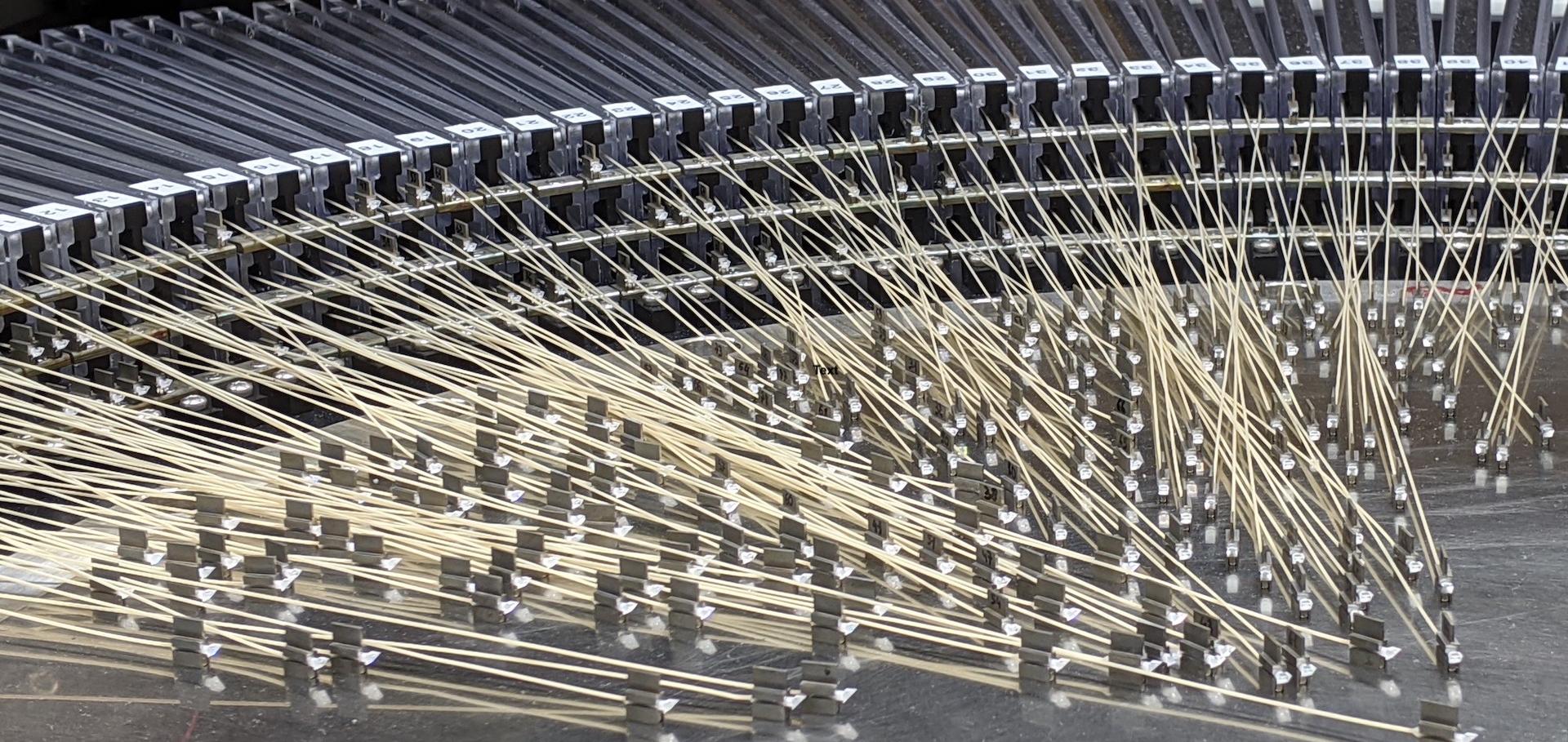
Part of a WEAVE fibre configuration

Part of the WEAVE focal plane showing optical fibres positioned on a set of targets in the telescope focal plane.

Prof Gavin Dalton

Professor of Astrophysics

Research theme

  • Astronomy and astrophysics

Sub department

  • Astrophysics

Research groups

  • Astronomical instrumentation
  • Extremely Large Telescope
Gavin.Dalton@physics.ox.ac.uk
  • About
  • Research
  • Publications

The Oxford-Dartmouth Thirty Degree Survey II: Clustering of Bright Lyman Break Galaxies - Strong Luminosity Dependent Bias at z=4

(2005)

Authors:

Paul D Allen, Leonidas A Moustakas, Gavin Dalton, Emily MacDonald, Chris Blake, Lee Clewley, Catherine Heymans, Gary Wegner
More details from the publisher

The 2dF Galaxy Redshift Survey: Luminosity functions by density environment and galaxy type

Monthly Notices of the Royal Astronomical Society 356:3 (2005) 1155-1167

Authors:

DJ Croton, GR Farrar, P Norberg, M Colless, JA Peacock, IK Baldry, CM Baugh, J Bland-Hawthorn, T Bridges, R Cannon, S Cole, C Collins, W Couch, G Dalton, R De Propris, SP Driver, G Efstathiou, RS Ellis, CS Frenk, K Glazebrook, C Jackson, O Lahav, I Lewis, S Lumsden, S Maddox, D Madgwick, BA Peterson, W Sutherland, K Taylor

Abstract:

We use the 2dF Galaxy Redshift Survey to measure the dependence of the bJ-band galaxy luminosity function on large-scale environment, defined by density contrast in spheres of radius 8h-1 Mpc, and on spectral type, determined from principal component analysis. We find that the galaxy populations at both extremes of density differ significantly from that at the mean density. The population in voids is dominated by late types and shows, relative to the mean, a deficit of galaxies that becomes increasingly pronounced at magnitudes brighter than MbJ, - 5 log10 h ≲ -18.5. In contrast, cluster regions have a relative excess of very bright early-type galaxies with MbJ, - 5 log10 h ≲ -21. Differences in the mid- to faint-end population between environments are significant: at MbJ, -5 log10 h = -18 early- and late-type cluster galaxies show comparable abundances, whereas in voids the late types dominate by almost an order of magnitude. We find that the luminosity functions measured in all density environments, from voids to clusters, can be approximated by Schechter functions with parameters that vary smoothly with local density, but in a fashion that differs strikingly for early- and late-type galaxies. These observed variations, combined with our finding that the faint-end slope of the overall luminosity function depends at most weakly on density environment, may prove to be a significant challenge for models of galaxy formation.
More details from the publisher

The 2dF Galaxy Redshift Survey: The nature of the relative bias between galaxies of different spectral type

Monthly Notices of the Royal Astronomical Society 356:2 (2005) 456-474

Authors:

E Conway, S Maddox, V Wild, JA Peacock, E Hawkins, P Norberg, DS Madgwick, IK Baldry, CM Baugh, J Bland-Hawthorn, T Bridges, R Cannon, S Cole, M Colless, C Collins, W Couch, G Dalton, R De Propris, SP Driver, G Efstathiou, RS Ellis, CS Frenk, K Glazebrook, C Jackson, B Jones, O Lahav, I Lewis, S Lumsden, W Percival, BA Peterson, W Sutherland, K Taylor

Abstract:

We present an analysis of the relative bias between early- and late-type galaxies in the Two-degree Field Galaxy Redshift Survey (2dFGRS) - as defined by the η parameter of Madgwick et al., which quantifies the spectral type of galaxies in the survey. We calculate counts in cells for flux-limited samples of early- and late-type galaxies, using approximately cubical cells with sides ranging from 7 to 42 h-1 Mpc. We measure the variance of the counts in cells using the method of Efstathiou et al., which we find requires a correction for a finite volume effect equivalent to the integral constraint bias of the autocorrelation function. Using a maximum-likelihood technique we fit lognormal models to the one-point density distribution, and develop methods of dealing with biases in the recovered variances resulting from this technique. We then examine the joint density distribution function, f(δE, δL), and directly fit deterministic bias models to the joint counts in cells. We measure a linear relative bias of ≈1.3, which does not vary significantly with ℓ. A deterministic linear bias model is, however, a poor approximation to the data, especially on small scales (ℓ ≤ 28 h-1 Mpc) where deterministic linear bias is excluded at high significance. A power-law bias model with index b1 ≈ 0.75 is a significantly better fit to the data on all scales, although linear bias becomes consistent with the data for ℓ ≳ 40 h-1 Mpc.
More details from the publisher
More details

The 2dF Galaxy Redshift Survey: Power-spectrum analysis of the final dataset and cosmological implications

(2005)

Authors:

S Cole, WJ Percival, JA Peacock, P Norberg, CM Baugh, CS Frenk, I Baldry, J Bland-Hawthorn, T Bridges, R Cannon, M Colless, C Collins, W Couch, NJG Cross, G Dalton, VR Eke, R De Propris, SP Driver, G Efstathiou, RS Ellis, K Glazebrook, C Jackson, A Jenkins, O Lahav, I Lewis, S Lumsden, S Maddox, D Madgwick, BA Peterson, W Sutherland, K Taylor
More details from the publisher

Intelligent design: The response

Physics World 18:12 (2005) 18-19

Authors:

JE MacDonald, S Morris, D Eaton, A McEvoy, A Steane, A Briggs, K Burnett, G Dalton, P Ewart, A Peacocke, J Wark, W Phillips, N Deliyanakis, GL Rogers, M Bland, RP Crease
More details from the publisher
More details

Pagination

  • First page First
  • Previous page Prev
  • …
  • Page 51
  • Page 52
  • Page 53
  • Page 54
  • Current page 55
  • Page 56
  • Page 57
  • Page 58
  • Page 59
  • …
  • Next page Next
  • Last page Last

Footer Menu

  • Contact us
  • Giving to the Dept of Physics
  • Work with us
  • Media

User account menu

  • Log in

Follow us

FIND US

Clarendon Laboratory,

Parks Road,

Oxford,

OX1 3PU

CONTACT US

Tel: +44(0)1865272200

University of Oxfrod logo Department Of Physics text logo
IOP Juno Champion logo Athena Swan Silver Award logo

© University of Oxford - Department of Physics

Cookies | Privacy policy | Accessibility statement

Built by: Versantus

  • Home
  • Research
  • Study
  • Engage
  • Our people
  • News & Comment
  • Events
  • Our facilities & services
  • About us
  • Giving to Physics
  • Current students
  • Staff intranet