The VISTA IR camera
Proceedings of SPIE the International Society for Optical Engineering 5492:PART 2 (2004) 988-997
Abstract:
The VISTA IR Camera has now completed its detailed design phase and is on schedule for delivery to ESO's Cerro Paranal Observatory in 2006. The camera consists of 16 Raytheon VIRGO 2048×2048 HgCdTe arrays in a sparse focal plane sampling a 1.65 degree field of view. A 1.4m diameter filter wheel provides slots for 7 distinct science filters, each comprising 16 individual filter panes. The camera also provides autoguiding and curvature sensing information for the VISTA telescope, and relies on tight tolerancing to meet the demanding requirements of the f/1 telescope design. The VISTA IR camera is unusual in that it contains no cold pupil-stop, but rather relies on a series of nested cold baffles to constrain the light reaching the focal plane to the science beam. In this paper we present a complete overview of the status of the final IR Camera design, its interaction with the VISTA telescope, and a summary of the predicted performance of the system.The current status of the UK-FMOS spectrograph
Proceedings of SPIE the International Society for Optical Engineering 5492:PART 3 (2004) 1362-1370
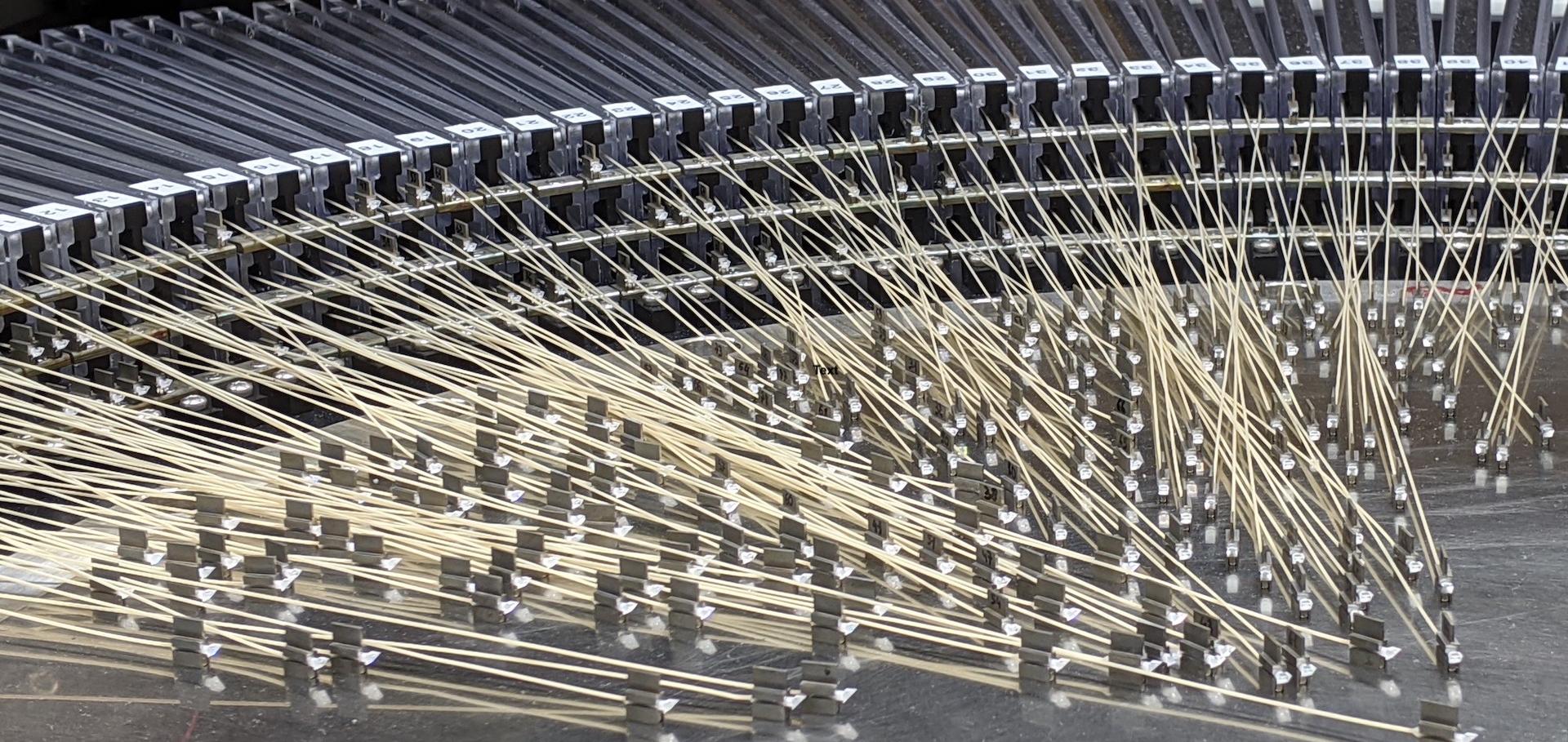
Abstract:
FMOS is a near-IR OH-suppressed multi-fibre fed spectrograph for the Subaru telescope. The spectrograph will accept 200 optical fibres from the ECHIDNA positioner system at the 30arcmin Prime focus of the telescope. We will describe the recent activities here in the UK in progressing the instrument from its conceptual phase through detailed design and into manufacture. A variety of technical areas will be described including: the opto-mechanical system design and construction, development of the HAWAH-II detector control system, the thermal system design & control and OH suppression techniques.Galaxy groups in the two-degree field galaxy redshift survey: The luminous content of the groups
Monthly Notices of the Royal Astronomical Society 355:3 (2004) 769-784
Abstract:
The Two-degree Field Galaxy Redshift Survey (2dFGRS) Percolation-Inferred Galaxy Group (2PIGG) catalogue of ∼29 000 objects is used to study the luminous content of galaxy systems of various sizes. Mock galaxy catalogues constructed from cosmological simulations are used to gauge the accuracy with which intrinsic group properties can be recovered. It is found that a Schechter function is a reasonable fit to the galaxy luminosity functions in groups of different mass in the real data, and that the characteristic luminosity LThe 2dF galaxy redshift survey: The local E+A galaxy population
Monthly Notices of the Royal Astronomical Society 355:3 (2004) 713-727
Abstract:
We select a sample of low-redshift (z ∼ 0.1) E+A galaxies from the 2dF Galaxy Redshift Survey (2dFGRS). The spectra of these objects are defined by strong hydrogen Balmer absorption lines (Hδ, Hγ, Hβ) combined with a lack of [O II] 3727-Å emission, together implying a recently truncated burst of star formation. The E+A spectrum is thus a signpost to galaxies in the process of evolution. We quantify the local environments, clustering properties and luminosity function of the E+A galaxies. We find that the environments are consistent with the ensemble of 2dFGRS galaxies: low-redshift E+A systems are located predominantly in the field, existing as isolated objects or in poor groups. However, the luminosity distribution of galaxies selected using three Balmer absorption lines Hδγβ appears more typical of ellipticals. Indeed, morphologically these galaxies are preferentially spheroidal (E/S0) systems. In a small but significant number we find evidence for recent major mergers, such as tidal tails. We infer that major mergers are one important formation mechanism for E+A galaxies, as suggested by previous studies. At low redshift the merger probability is high in the field and low in clusters, thus these recently formed spheroidal systems do not follow the usual morphology-density relation for ellipticals. Regarding the selection of E+A galaxies: we find that basing the Balmer-line criterion solely on Hδ absorption leads to a significant subpopulation of disc systems with detectable Hα emission. In these objects the [O II] emission is presumably either obscured by dust or present with a low signal-to-noise ratio, whilst the (Hγ, Hβ) absorption features are subject to emission-filling.Aspects of concurrent design during the VISTA IR Camera detailed design phase
Proceedings of SPIE the International Society for Optical Engineering 5497 (2004) 51-61