


IShocks: X-ray binary jets with an internal shocks model
Monthly Notices of the Royal Astronomical Society 401:1 (2010) 394-404
Abstract:
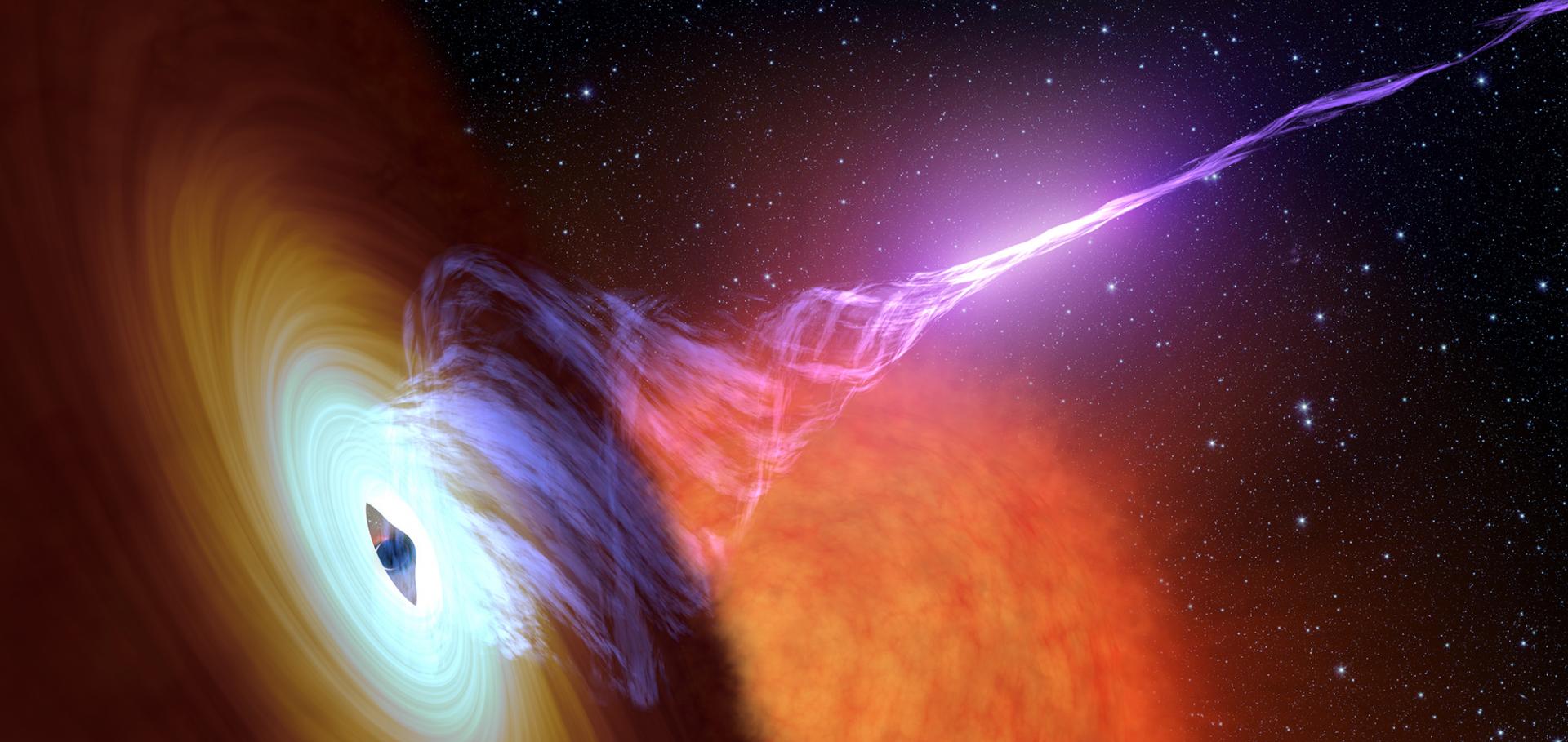
In the following paper, we present an internal shocks model, iShocks, for simulating a variety of relativistic jet scenarios; these scenarios can range from a single ejection event to an almost continuous jet, and are highly user configurable. Although the primary focus in the following paper is black hole X-ray binary jets, the model is scale and source independent and could be used for supermassive black holes in active galactic nuclei or other flows such as jets from neutron stars. Discrete packets of plasma (or 'shells') are used to simulate the jet volume. A two-shell collision gives rise to an internal shock, which acts as an electron re-energization mechanism. Using a pseudo-random distribution of the shell properties, the results show how for the first time it is possible to reproduce a flat/inverted spectrum (associated with compact radio jets) in a conical jet whilst taking the adiabatic energy losses into account. Previous models have shown that electron re-acceleration is essential in order to obtain a flat spectrum from an adiabatic conical jet: multiple internal shocks prove to be efficient in providing this re-energization. We also show how the high-frequency turnover/break in the spectrum is correlated with the jet power, νInvestigating the disc-jet coupling in accreting compact objects using the black hole candidate Swift J1753.5-0127
Monthly Notices of the Royal Astronomical Society 406:3 (2010) 1471-1486
Abstract:
In studies of accreting black holes in binary systems, empirical relations have been proposed to quantify the coupling between accretion processes and ejection mechanisms. These processes are probed, respectively, by means of X-ray and radio/optical-infrared observations. The relations predict, given certain accretion conditions, the expected energy output in the form of a jet. We investigated this coupling by studying the black hole candidate Swift J. 1753.5-0127, via multiwavelength-coordinated observations over a period of ∼4 yr. We present the results of our campaign showing that, all along the outburst, the source features a jet that is fainter than expected from the empirical correlation between the radio and the X-ray luminosities in a hard spectral state. Because the jet is so weak in this system the near-infrared emission is, unusually for this state and luminosity, dominated by thermal emission from the accretion disc. We briefly discuss the importance and the implications of a precise determination of both the slope and the normalization of the correlations, listing some possible parameters that broad-band jet models should take into account to explain the population of sources characterized by a dim jet. We also investigate whether our data can give any hint on the nature of the compact object in the system, since its mass has not been dynamically measured. © 2010 The Authors. Journal compilation © 2010 RAS.LOFAR-UK
Proceedings of Science 125 (2010)
Abstract:
The LOFAR-UK station at Chilbolton has recently been completed and significantly increases the angular resolution of the International LOFAR Telescope, as well as providing a unique training site and testbed for british experience with next-generation software telescopes. The station has been funded primarily through the LOFAR-UK, the largest astronomy collaboration in Britain, as well as via the South East Physics Network (SEPNET) and STFC. In this brief paper we discuss the history and organisation of LOFAR-UK, provide a technical description of the Chilbolton site, and discuss how LOFAR stations can be augmented by the addition of extra local processing capabilities such as ARTEMIS.Limits on the quiescent radio emission from the black hole binaries GRO J1655-40 and XTE J1550-564
Monthly Notices of the Royal Astronomical Society 409:2 (2010) 839-845
Abstract:
We present the results of radio observations of the black hole binaries GRO J1655-40 and XTE J1550-564 in quiescence, with the upgraded Australia Telescope Compact Array. Neither system was detected. Radio flux density upper limits (3σ) of 26 μJy (at 5.5 GHz), 47 μJy (at 9 GHz) for GRO J1655-40 and 1.4 mJy (at 1.75 GHz), 27 μJy (at 5.5 GHz), 47 μJy (at 9 GHz) for XTE J1550-564 were measured. In conjunction with quasi-simultaneous Chandra X-ray observations (in the case of GRO J1655-40) and Faulkes Telescope optical observations (XTE J1550-564) we find that these systems provide the first evidence of relatively 'radio-quiet' black hole binaries at low luminosities, indicating that the scatter observed in the hard state X-ray-radio correlation at higher luminosities may also extend towards quiescent levels. © 2010 The Authors. Journal compilation © 2010 RAS.No evidence for black hole spin powering of jets in X-ray binaries
Monthly Notices of the Royal Astronomical Society 406:3 (2010) 1425-1434