

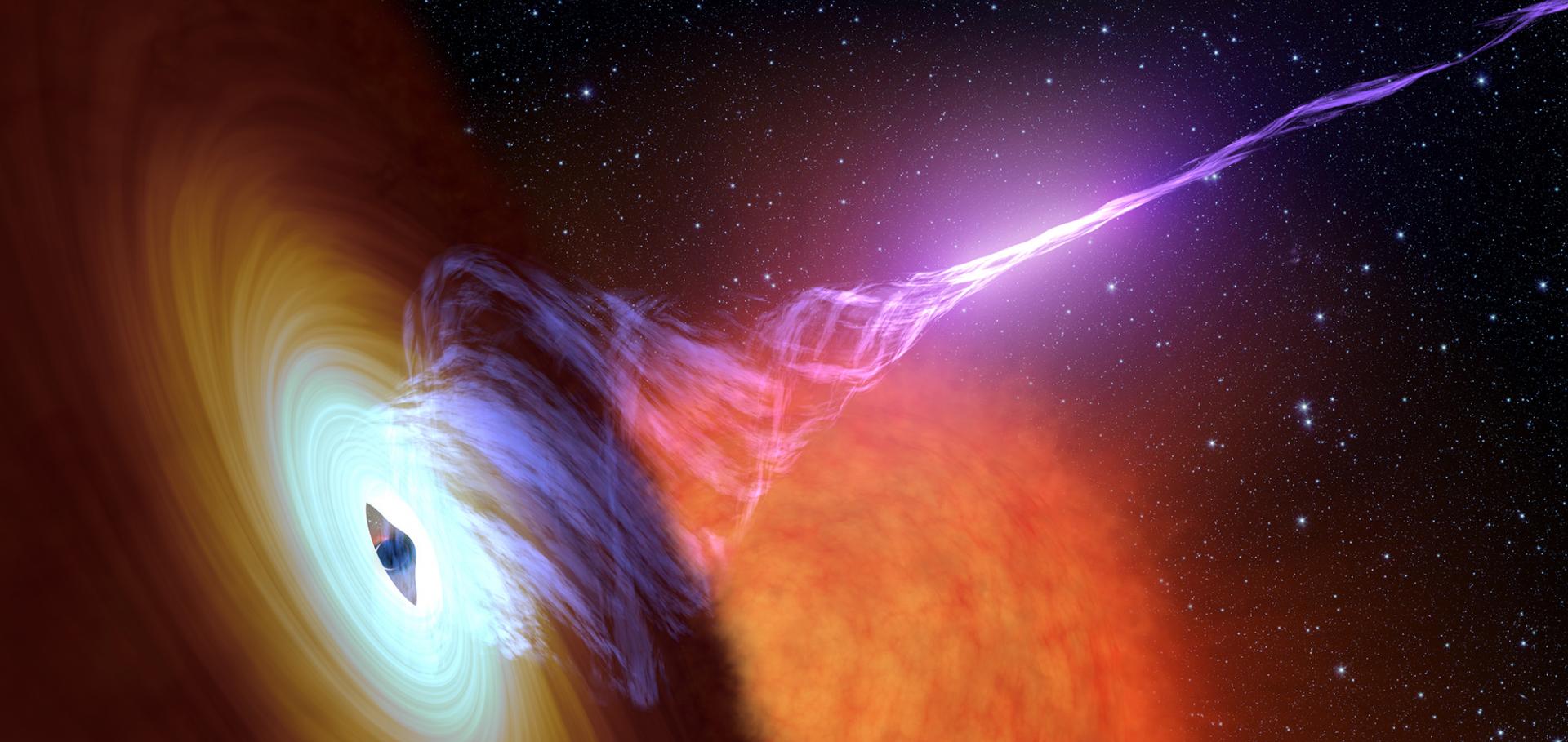

Constraining the physical properties of large-scale jets from black hole X-ray binaries and their impact on the local environment with blast-wave dynamical models
Monthly Notices of the Royal Astronomical Society Oxford University Press 533:4 (2024) 4188-4209
Abstract:
Relativistic discrete ejecta launched by black hole X-ray binaries (BH XRBs) can be observed to propagate up to parsec-scales from the central object. Observing the final deceleration phase of these jets is crucial to estimate their physical parameters and to reconstruct their full trajectory, with implications for the jet powering mechanism, composition, and formation. In this paper, we present the results of the modelling of the motion of the ejecta from three BH XRBs: MAXI J1820+070, MAXI J1535–571, and XTE J1752–223, for which high-resolution radio and X-ray observations of jets propagating up to ~15 arcsec (~0.6 pc at 3 kpc) from the core have been published in the recent years. For each jet, we modelled its entire motion with a dynamical blast-wave model, inferring robust values for the jet Lorentz factor, inclination angle and ejection time. Under several assumptions associated to the ejection duration, the jet opening angle and the available accretion power, we are able to derive stringent constraints on the maximum jet kinetic energy for each source (between 1043 and 1044 erg, including also H1743–322), as well as placing interesting upper limits on the density of the ISM through which the jets are propagating (from nism≲0.4 cm−3 cm down to nism≲10−4 cm−3). Overall, our results highlight the potential of applying models derived from gamma-ray bursts to the physics of jets from BH XRBs and support the emerging picture of these sources as preferentially embedded in low-density environments.Radio observations of the 2022 outburst of the transitional Z-Atoll source XTE J1701−462
Monthly Notices of the Royal Astronomical Society Oxford University Press (OUP) 533:2 (2024) 1800-1807
Swift J1727.8–1613 Has the Largest Resolved Continuous Jet Ever Seen in an X-Ray Binary
The Astrophysical Journal Letters American Astronomical Society 971:1 (2024) L9
Abstract:
Multiwavelength polarimetry and radio observations of Swift J1727.8–1613 at the beginning of its recent 2023 outburst suggested the presence of a bright compact jet aligned in the north–south direction, which could not be confirmed without high-angular-resolution images. Using the Very Long Baseline Array and the Long Baseline Array, we imaged Swift J1727.8–1613 during the hard/hard-intermediate state, revealing a bright core and a large, two-sided, asymmetrical, resolved jet. The jet extends in the north–south direction, at a position angle of −0.60° ± 0.07° east of north. At 8.4 GHz, the entire resolved jet structure is ∼110(d/2.7kpc)/sini au long, with the southern approaching jet extending ∼80(d/2.7kpc)/sini au from the core, where d is the distance to the source and i is the inclination of the jet axis to the line of sight. These images reveal the most resolved continuous X-ray binary jet, and possibly the most physically extended continuous X-ray binary jet ever observed. Based on the brightness ratio of the approaching and receding jets, we put a lower limit on the intrinsic jet speed of β ≥ 0.27 and an upper limit on the jet inclination of i ≤ 74°. In our first observation we also detected a rapidly fading discrete jet knot 66.89 ± 0.04 mas south of the core, with a proper motion of 0.66 ± 0.05 mas hr−1, which we interpret as the result of a downstream internal shock or a jet–interstellar medium interaction, as opposed to a transient relativistic jet launched at the beginning of the outburst.Radio observations of the 2022 outburst of the transitional Z-Atoll source XTE J1701-462
(2024)
A Radio Flare in the Long-lived Afterglow of the Distant Short GRB 210726A: Energy Injection or a Reverse Shock from Shell Collisions?
The Astrophysical Journal American Astronomical Society 970:2 (2024) 139