



Molecular dynamics simulations of grain interactions in shock-compressed highly textured columnar nanocrystals
Abstract:
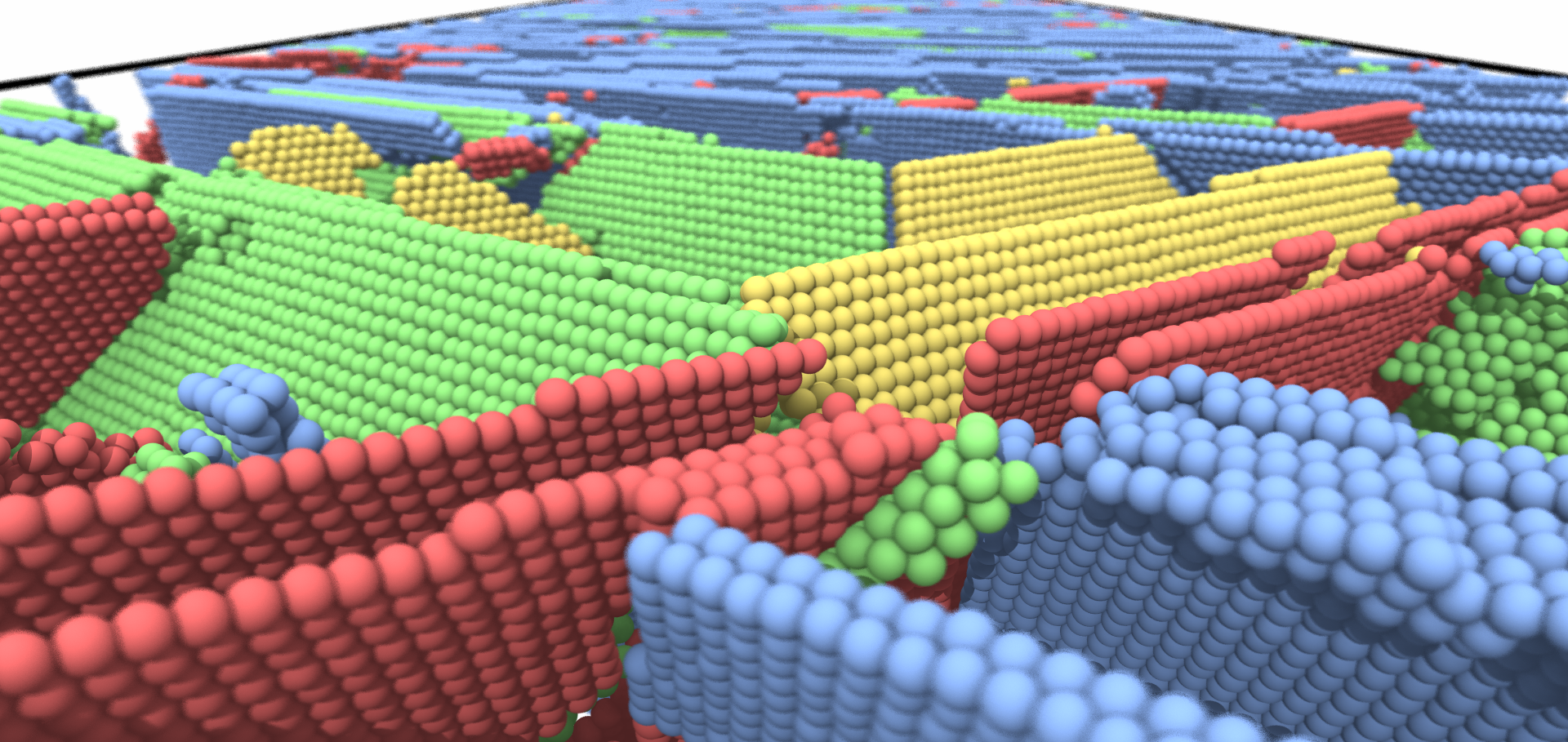
While experimental and computational studies abound demonstrating the diverse range of phenomena caused by grain interactions under quasistatic loading conditions, far less attention has been given to these interactions under the comparatively dramatic conditions of shock compression. The consideration of grain interactions is essential within the context of contemporary shock-compression experiments that exploit the distinctive x-ray diffraction patterns of highly textured (and therefore strongly anisotropic) targets in order to interrogate local structural evolution. We present here a study of grain interaction effects in shock-compressed, body-centered cubic tantalum nanocrystals characterized by a columnar geometry and a strong fiber texture using large-scale molecular dynamics simulations. Our study reveals that contiguous grains deform cooperatively in directions perpendicular to the shock, driven by the gigapascal-scale stress gradients induced over their boundaries by the uniaxial compression, and in so doing are able to reach a state of reduced transverse shear stress. We compare the extent of this relaxation for two different columnar geometries (distinguished by their square or hexagonal cross-sections), and quantify the attendant change in the transverse elastic strains. We further show that cooperative deformation is able to replace ordinary plastic deformation mechanisms at lower shock pressures, and, under certain conditions, activate new mechanisms at higher pressures.Femtosecond x-ray diffraction studies of the reversal of the microstructural effects of plastic deformation during shock release of tantalum
Abstract:
We have used femtosecond x-ray diffraction to study laser-shocked fiber-textured polycrystalline tantalum targets as the 37–253 GPa shock waves break out from the free surface. We extract the time and depth-dependent strain profiles within the Ta target as the rarefaction wave travels back into the bulk of the sample. In agreement with molecular dynamics simulations, the lattice rotation and the twins that are formed under shock compression are observed to be almost fully eliminated by the rarefaction process.Diffuse scattering from dynamically compressed single-crystal zirconium following the pressure-induced alpha-to-omega phase transition
Abstract:
The prototypical α → ω phase transition in zirconium is an ideal test-bed for our understanding of polymorphism under extreme loading conditions. After half a century of study, a consensus had emerged that the transition is realized via one of two distinct displacive mechanisms, depending on the nature of the compression path. However, recent dynamic-compression experiments equipped with in situ diffraction diagnostics performed in the past few years have revealed new transition mechanisms, demonstrating that our understanding of the underlying atomistic dynamics and transition kinetics is in fact far from complete. We present classical molecular dynamics simulations of the α → ω phase transition in single-crystal zirconium shock-compressed along the [0001] axis using a machine-learning-class potential. The transition is predicted to proceed primarily via a modified version of the two-stage Usikov-Zilberstein mechanism, whereby the high-pressure ω-phase heterogeneously nucleates at boundaries between grains of an intermediate β-phase. We further observe the fomentation of atomistic disorder at the junctions between β grains, leading to the formation of highly defective interstitial material between the ω grains. We directly compare synthetic x-ray diffraction patterns generated from our simulations with those obtained using femtosecond diffraction in recent dynamic-compression experiments, and show that the simulations produce the same unique, anisotropic diffuse scattering signal unlike any previously seen from an elemental metal. Our simulations suggest that the diffuse signal arises from a combination of thermal diffuse scattering, nanoparticle-like scattering from residual kinetically stabilized α and β grains, and scattering from interstitial defective structures.Shock and release of tantalum studied via molecular dynamics and femtosecond x-ray diffraction
Abstract:
The response of solid matter to shock compression is complexified considerably by its strength, or its ability to withstand shear stress. Strength is challenging to measure experimentally under shock conditions and even harder to model, due to its being an extremely complicated function of the loading conditions. Our understanding of material strength and the way it manifests under dynamic loading thus remains, to a great extent, incomplete. This work presents studies of two phenomena arising from strength under the conditions of shock compression and release by means of multimillion-atom molecular dynamics simulations and femtosecond x-ray diffraction. The role of shock-induced grain interactions is first explored via simulations of elementary polycrystals. Such interactions are found to control the plasticity mechanisms activated under shock compression and the limiting shear stress state to which the polycrystal settles in the wake of the shock. A combined experimental-computational study of plastic-work heating under the conditions of shock release is then presented. An algorithm for extracting the temperature of released samples from their diffraction image is derived and verified on synthetic data. When applied to experimental data, the algorithm shows that the temperatures of shock-released tantalum foils vastly exceed those expected from a conventional isentropic release. The underlying microphysical processes responsible for the heating are then interrogated via large-scale simulations of crystals under shock and release. A heat equation is used to identify plastic-work heating owed to the sample’s exceptional strength during its rapid release as the culprit, thus challenging the conventional assumption that shock release is a universally isentropic process.