Home
Department Of Physics text logo
  • Research
    • Our research
    • Our research groups
    • Our research in action
    • Research funding support
    • Summer internships for undergraduates
  • Study
    • Undergraduates
    • Postgraduates
  • Engage
    • For alumni
    • For business
    • For schools
    • For the public
Menu
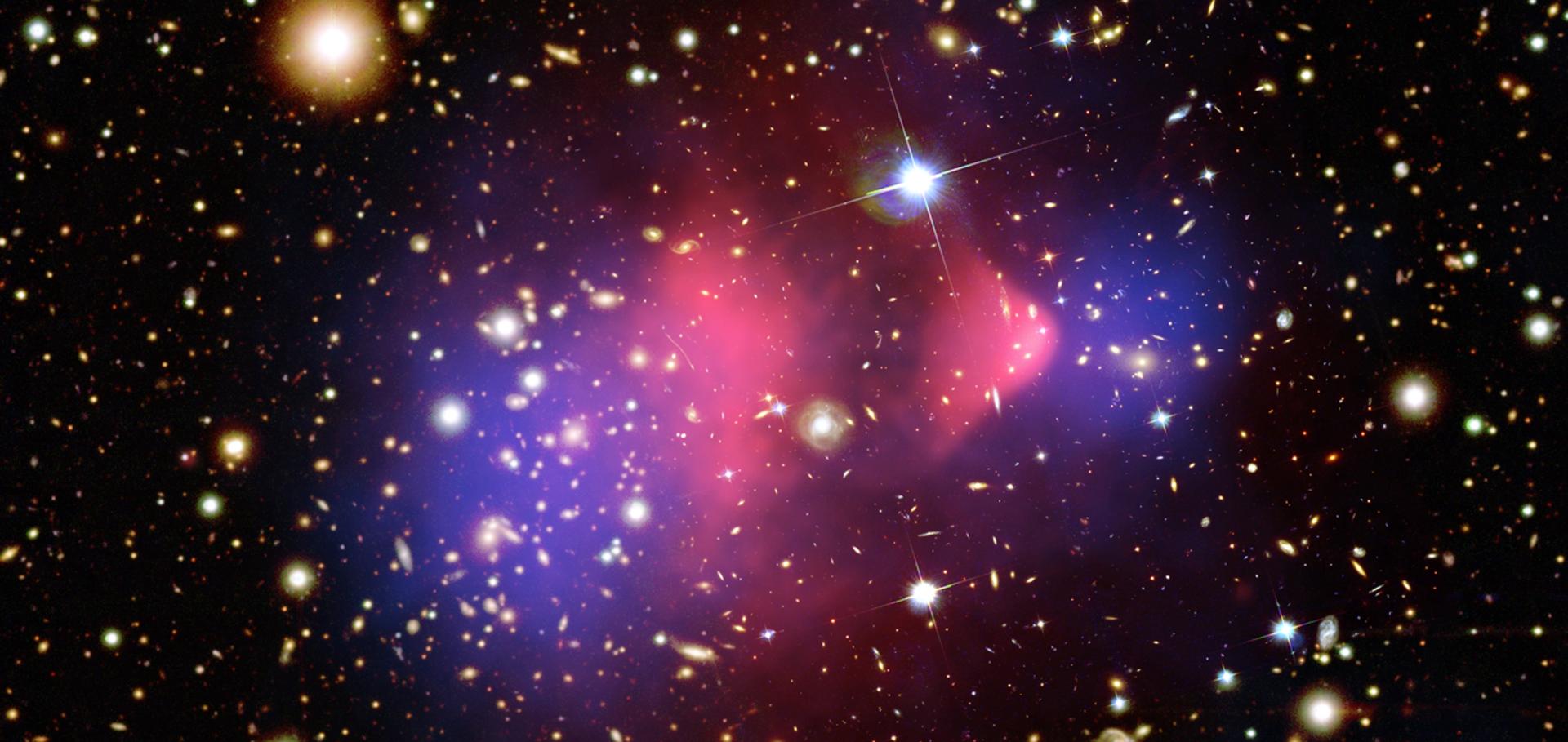
Bullet cluster image
Credit: Credit: X-ray: NASA/CXC/CfA/M.Markevitch et al.; Optical: NASA/STScI; Magellan/U.Arizona/D.Clowe et al.; Lensing Map: NASA/STScI

Professor Jocelyn Monroe

Professor of Particle Physics

Research theme

  • Particle astrophysics & cosmology

Sub department

  • Particle Physics
jocelyn.monroe@physics.ox.ac.uk
Telephone: 273317
en.wikipedia.org/wiki/Jocelyn_Monroe
  • About
  • Publications

Observation of the "head-tail" effect in nuclear recoils of low-energy neutrons

Nuclear Instruments and Methods in Physics Research Section A Accelerators Spectrometers Detectors and Associated Equipment 584:2-3 (2008) 327-333

Authors:

D Dujmic, H Tomita, M Lewandowska, S Ahlen, P Fisher, S Henderson, A Kaboth, G Kohse, R Lanza, J Monroe, A Roccaro, G Sciolla, N Skvorodnev, R Vanderspek, H Wellenstein, R Yamamoto

Abstract:

Directional detection of dark matter can provide unambiguous observation of dark matter interactions even in the presence of background. This article presents an experimental method to measure the direction tag ("head-tail") of the dark matter wind by detecting the scintillation light created by the elastic nuclear recoils in the scattering of dark matter particles with the detector material. The technique is demonstrated by tagging the direction of the nuclear recoils created in the scattering of low-energy neutrons with CF4 in a low-pressure time-projection chamber that is developed by the DMTPC collaboration. The measurement of the decreasing ionization rate along the recoil trajectory provides the direction tag of the incoming neutrons, and proves that the "head-tail" effect can be observed. © 2007 Elsevier B.V. All rights reserved.
More details from the publisher
More details

Improved measurement of the head-tail effect in nuclear recoils

Journal of Physics Conference Series 120:Part 4 (2008)

Authors:

D Dujmic, S Ahlen, P Fisher, S Henderson, A Kaboth, G Kohse, R Lanza, M Lewandowska, J Monroe, A Roccaro, G Sciolla, N Skvorodnev, H Tomita, R Vanderspek, H Wellenstein, R Yamamoto

Abstract:

We present new results with a prototype detector that is being developed by the DMTPC collaboration for the measurement of the direction tag (head-tail) of dark matter wind. We use neutrons from a 252Cf source to create low-momentum nuclear recoils in elastic scattering with the residual gas nuclei. The recoil track is imaged in low-pressure time-projection chamber with optical readout. We measure the ionization rate along the recoil trajectory, which allows us to determine the direction tag of the incoming neutrons.
More details from the publisher
More details

Neutrino backgrounds to dark matter searches

Physical Review D Particles Fields Gravitation and Cosmology 76:3 (2007)

Authors:

J Monroe, P Fisher

Abstract:

Neutrino coherent scattering cross sections can be as large as 10-39cm2, while current dark matter experiments have sensitivities to WIMP coherent scattering cross sections 5 orders of magnitude smaller; future experiments plan to have sensitivities to cross sections as small as 10-48cm2. With large target masses and few keV recoil energy detection thresholds, neutral current coherent scattering of solar neutrinos becomes an irreducible background in dark matter searches. In the current zero-background analysis paradigm, neutrino coherent scattering will limit the achievable sensitivity to dark matter scattering cross sections, at the level of 10-46cm2. © 2007 The American Physical Society.
More details from the publisher
More details

Search for Electron Neutrino Appearance at the Δm2∼1 eV2 Scale

Physical Review Letters American Physical Society (APS) 98:23 (2007) 231801

Authors:

AA Aguilar-Arevalo, AO Bazarko, SJ Brice, BC Brown, L Bugel, J Cao, L Coney, JM Conrad, DC Cox, A Curioni, Z Djurcic, DA Finley, BT Fleming, R Ford, FG Garcia, GT Garvey, C Green, JA Green, TL Hart, E Hawker, R Imlay, RA Johnson, P Kasper, T Katori, T Kobilarcik, I Kourbanis, S Koutsoliotas, EM Laird, JM Link, Y Liu, Y Liu, WC Louis, KBM Mahn, W Marsh, PS Martin, G McGregor, W Metcalf, PD Meyers, F Mills, GB Mills, J Monroe, CD Moore, RH Nelson, P Nienaber, S Ouedraogo, RB Patterson, D Perevalov, CC Polly, E Prebys, JL Raaf, H Ray, BP Roe, AD Russell, V Sandberg, R Schirato, D Schmitz, MH Shaevitz, FC Shoemaker, D Smith, M Sorel, P Spentzouris, I Stancu, RJ Stefanski, M Sung, HA Tanaka, R Tayloe, M Tzanov, R Van de Water, MO Wascko, DH White, MJ Wilking, HJ Yang, GP Zeller, ED Zimmerman
More details from the publisher
More details
More details

Charged current quasi-elastic interactions at MiniBooNE confront cross section Monte Carlos

Nuclear Physics B Proceedings Supplements 139:1-3 SPEC. ISS. (2005) 59-65

Abstract:

Neutrino oscillations have been established in solar and atmospheric neutrinos, but a third signal from the LSND experiment is incompatible with three Standard Model neutrinos. The MiniBooNE experiment can confirm or refute the LSND oscillation signal with 1 × 10²¹ protons on target. While working towards the oscillation result, MiniBooNE will accumulate more than 1 × 10⁶ neutrino interactions in the 0 to 2 GeV range which will greatly increase the world's knowledge of neutrino cross sections in this energy regime. Preliminary results on the MiniBooNE νμ charged current quasi-elastic analysis are presented and compared to the NUANCE, NEUT, and NEUGEN cross section Monte Carlos. © 2004 Published by Elsevier B.V.
More details from the publisher
More details

Pagination

  • First page First
  • Previous page Prev
  • …
  • Page 17
  • Page 18
  • Page 19
  • Page 20
  • Page 21
  • Page 22
  • Page 23
  • Current page 24
  • Page 25
  • Next page Next
  • Last page Last

Footer Menu

  • Contact us
  • Giving to the Dept of Physics
  • Work with us
  • Media

User account menu

  • Log in

Follow us

FIND US

Clarendon Laboratory,

Parks Road,

Oxford,

OX1 3PU

CONTACT US

Tel: +44(0)1865272200

University of Oxfrod logo Department Of Physics text logo
IOP Juno Champion logo Athena Swan Silver Award logo

© University of Oxford - Department of Physics

Cookies | Privacy policy | Accessibility statement

Built by: Versantus

  • Home
  • Research
  • Study
  • Engage
  • Our people
  • News & Comment
  • Events
  • Our facilities & services
  • About us
  • Giving to Physics
  • Current students
  • Staff intranet