Home
Department Of Physics text logo
  • Research
    • Our research
    • Our research groups
    • Our research in action
    • Research funding support
    • Summer internships for undergraduates
  • Study
    • Undergraduates
    • Postgraduates
  • Engage
    • For alumni
    • For business
    • For schools
    • For the public
  • Support
Menu
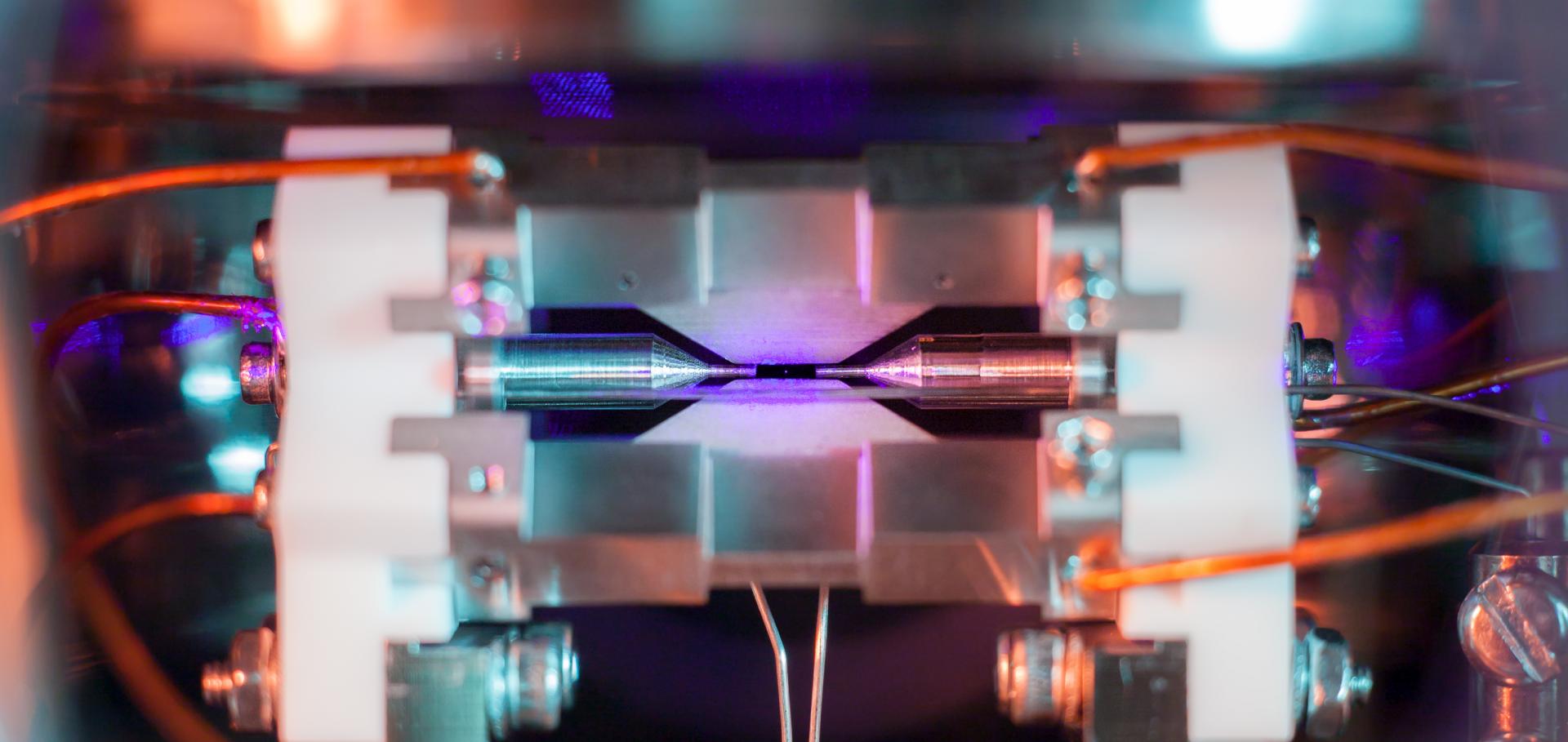
Single strontium atom in an ion trap
Credit: David Nadlinger, University of Oxford

Dr David Nadlinger

Senior Researcher

Research theme

  • Quantum information and computation

Sub department

  • Atomic and Laser Physics

Research groups

  • Ion trap quantum computing
david.nadlinger@physics.ox.ac.uk
Telephone: 01865 (2)72265,01865 (2)72346
Programming blog
College profile
  • About
  • Publications

Low cross-talk optical addressing of trapped-ion qubits using a novel integrated photonic chip

Light: Science & Applications Springer Nature [academic journals on nature.com] 13:1 (2024) 199

Authors:

Ana S Sotirova, Bangshan Sun, Jamie D Leppard, Andong Wang, Mohan Wang, Andres Vazquez-Brennan, David P Nadlinger, Simon Moser, Alexander Jesacher, Chao He, Fabian Pokorny, Martin J Booth, Christopher J Ballance

Abstract:

Individual optical addressing in chains of trapped atomic ions requires the generation of many small, closely spaced beams with low cross-talk. Furthermore, implementing parallel operations necessitates phase, frequency, and amplitude control of each individual beam. Here, we present a scalable method for achieving all of these capabilities using a high-performance integrated photonic chip coupled to a network of optical fibre components. The chip design results in very low cross-talk between neighbouring channels even at the micrometre-scale spacing by implementing a very high refractive index contrast between the channel core and cladding. Furthermore, the photonic chip manufacturing procedure is highly flexible, allowing for the creation of devices with an arbitrary number of channels as well as non-uniform channel spacing at the chip output. We present the system used to integrate the chip within our ion trap apparatus and characterise the performance of the full individual addressing setup using a single trapped ion as a light-field sensor. Our measurements showed intensity cross-talk below ~10–3 across the chip, with minimum observed cross-talk as low as ~10–5.
More details from the publisher
Details from ORA
More details
More details

Verifiable blind quantum computing with trapped ions and single photons

Physical Review Letters American Physical Society 132:15 (2024) 150604

Authors:

P Drmota, Dp Nadlinger, D Main, Bc Nichol, Em Ainley, D Leichtle, A Mantri, E Kashefi, R Srinivas, G Araneda, Cj Ballance, Dm Lucas

Abstract:

We report the first hybrid matter-photon implementation of verifiable blind quantum computing. We use a trapped-ion quantum server and a client-side photonic detection system networked via a fiber-optic quantum link. The availability of memory qubits and deterministic entangling gates enables interactive protocols without postselection—key requirements for any scalable blind server, which previous realizations could not provide. We quantify the privacy at ≲0.03 leaked classical bits per qubit. This experiment demonstrates a path to fully verified quantum computing in the cloud.

More details from the publisher
Details from ORA
More details
More details

Fast, High-Fidelity Addressed Single-Qubit Gates Using Efficient Composite Pulse Sequences

Physical Review Letters American Physical Society (APS) 131:12 (2023) 120601

Authors:

AD Leu, MF Gely, MA Weber, MC Smith, DP Nadlinger, DM Lucas
More details from the publisher
More details
More details

Entanglement-Enhanced Frequency Comparison of Two Optical Atomic Clocks

Institute of Electrical and Electronics Engineers (IEEE) 00 (2023) 1-1

Authors:

BC Nichol, R Srinivas, DP Nadlinger, P Drmota, D Main, G Araneda, CJ Ballance, DM Lucas
More details from the publisher

Robust quantum memory in a trapped-ion quantum network node

Physical Review Letters American Physical Society 130 (2023) 090803

Authors:

Peter Drmota, Dougal Main, David P Nadlinger, Bethan Nichol, Marius A Weber, Ellis M Ainley, Ayush Agrawal, Raghavendra Srinivas, Gabriel Araneda, Chris J Ballance, David Lucas

Abstract:

We integrate a long-lived memory qubit into a mixed-species trapped-ion quantum network node. Ion-photon entanglement first generated with a network qubit in 88Sr+ is transferred to 43Ca+ with 0.977(7) fidelity, and mapped to a robust memory qubit. We then entangle the network qubit with another photon, which does not affect the memory qubit. We perform quantum state tomography to show that the fidelity of ion-photon entanglement decays ∼ 70 times slower on the memory qubit. Dynamical decoupling further extends the storage time; we measure an ion-photon entanglement fidelity of 0.81(4) after 10 s.
More details from the publisher
Details from ORA
More details
More details

Pagination

  • First page First
  • Previous page Prev
  • Page 1
  • Current page 2
  • Page 3
  • Page 4
  • Page 5
  • Next page Next
  • Last page Last

Footer Menu

  • Contact us
  • Giving to the Dept of Physics
  • Work with us
  • Media

User account menu

  • Log in

Follow us

FIND US

Clarendon Laboratory,

Parks Road,

Oxford,

OX1 3PU

CONTACT US

Tel: +44(0)1865272200

University of Oxfrod logo Department Of Physics text logo
IOP Juno Champion logo Athena Swan Silver Award logo

© University of Oxford - Department of Physics

Cookies | Privacy policy | Accessibility statement

Built by: Versantus

  • Home
  • Research
  • Study
  • Engage
  • Our people
  • News & Comment
  • Events
  • Our facilities & services
  • About us
  • Giving to Physics
  • Current students
  • Staff intranet