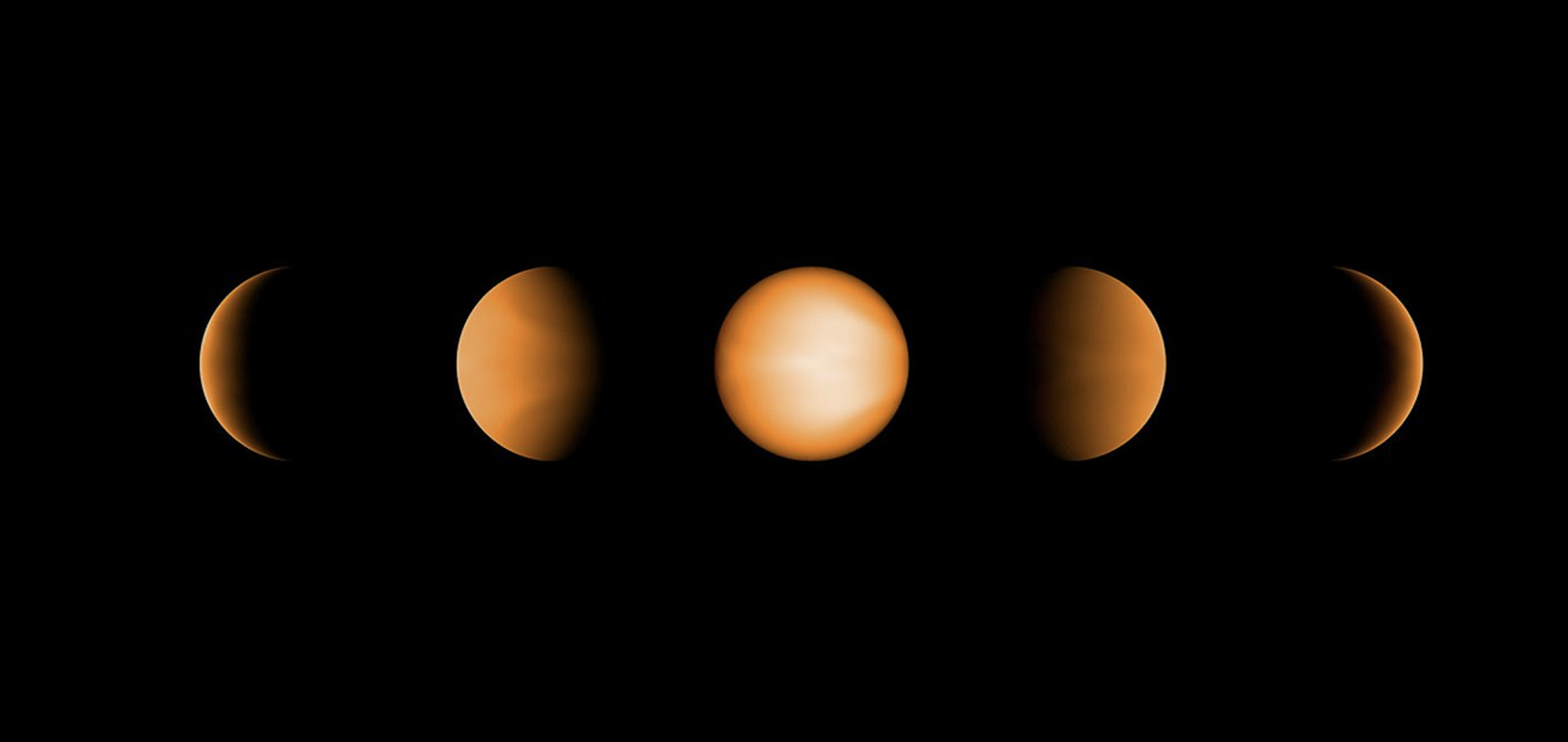
The climate and compositional variation of the highly eccentric planet HD 80606 b – the rise and fall of carbon monoxide and elemental sulfur
Monthly Notices of the Royal Astronomical Society Oxford University Press 520:3 (2023) 3867-3886
Abstract:
The gas giant HD 80606 b has a highly eccentric orbit (e ∼ 0.93). The variation due to the rapid shift of stellar irradiation provides a unique opportunity to probe the physical and chemical timescales and to study the interplay between climate dynamics and atmospheric chemistry. In this work, we present integrated models to study the atmospheric responses and the underlying physical and chemical mechanisms of HD 80606 b. We first run 3D general circulation models (GCMs) to establish the atmospheric thermal and dynamical structures for different atmospheric metallicities and internal heat. Based on the GCM output, we then adopted a 1D time-dependent photochemical model to investigate the compositional variation along the eccentric orbit. The transition of the circulation patterns of HD 80606 b matched the dynamics regimes in previous works. Our photochemical models show that efficient vertical mixing leads to deep quench levels of the major carbon and nitrogen species and the quenching behaviour does not change throughout the eccentric orbit. Instead, photolysis is the main driver of the time-dependent chemistry. While CH4 dominates over CO through most of the orbits, a transient state of [CO]/[CH4] > 1 after periastron is confirmed for all metallicity and internal heat cases. The upcoming JWST Cycle 1 GO program will be able to track this real-time CH4–CO conversion and infer the chemical timescale. Furthermore, sulfur species initiated by sudden heating and photochemical forcing exhibit both short-term and long-term cycles, opening an interesting avenue for detecting sulfur on exoplanets.Is the Hot, Dense Sub-Neptune TOI-824 b an Exposed Neptune Mantle? Spitzer Detection of the Hot Dayside and Reanalysis of the Interior Composition
The Astrophysical Journal American Astronomical Society 941:1 (2022) 89
A strong H− opacity signal in the near-infrared emission spectrum of the ultra-hot Jupiter KELT-9b
Astronomy & Astrophysics EDP Sciences 668 (2022) l1
Identification of carbon dioxide in an exoplanet atmosphere
Nature Nature Research 614:7949 (2022) 649-652
Abstract:
Carbon dioxide (CO2) is a key chemical species that is found in a wide range of planetary atmospheres. In the context of exoplanets, CO2 is an indicator of the metal enrichment (that is, elements heavier than helium, also called ‘metallicity’)1,2,3, and thus the formation processes of the primary atmospheres of hot gas giants4,5,6. It is also one of the most promising species to detect in the secondary atmospheres of terrestrial exoplanets7,8,9. Previous photometric measurements of transiting planets with the Spitzer Space Telescope have given hints of the presence of CO2, but have not yielded definitive detections owing to the lack of unambiguous spectroscopic identification10,11,12. Here we present the detection of CO2 in the atmosphere of the gas giant exoplanet WASP-39b from transmission spectroscopy observations obtained with JWST as part of the Early Release Science programme13,14. The data used in this study span 3.0–5.5 micrometres in wavelength and show a prominent CO2 absorption feature at 4.3 micrometres (26-sigma significance). The overall spectrum is well matched by one-dimensional, ten-times solar metallicity models that assume radiative–convective–thermochemical equilibrium and have moderate cloud opacity. These models predict that the atmosphere should have water, carbon monoxide and hydrogen sulfide in addition to CO2, but little methane. Furthermore, we also tentatively detect a small absorption feature near 4.0 micrometres that is not reproduced by these modelsDesign and testing of a low-resolution NIR spectrograph for the EXoplanet Climate Infrared TElescope
Proceedings of SPIE--the International Society for Optical Engineering SPIE, the international society for optics and photonics 12184 (2022) 1218429-1218429-10