Home
Department Of Physics text logo
  • Research
    • Our research
    • Our research groups
    • Our research in action
    • Research funding support
    • Summer internships for undergraduates
  • Study
    • Undergraduates
    • Postgraduates
  • Engage
    • For alumni
    • For business
    • For schools
    • For the public
Menu
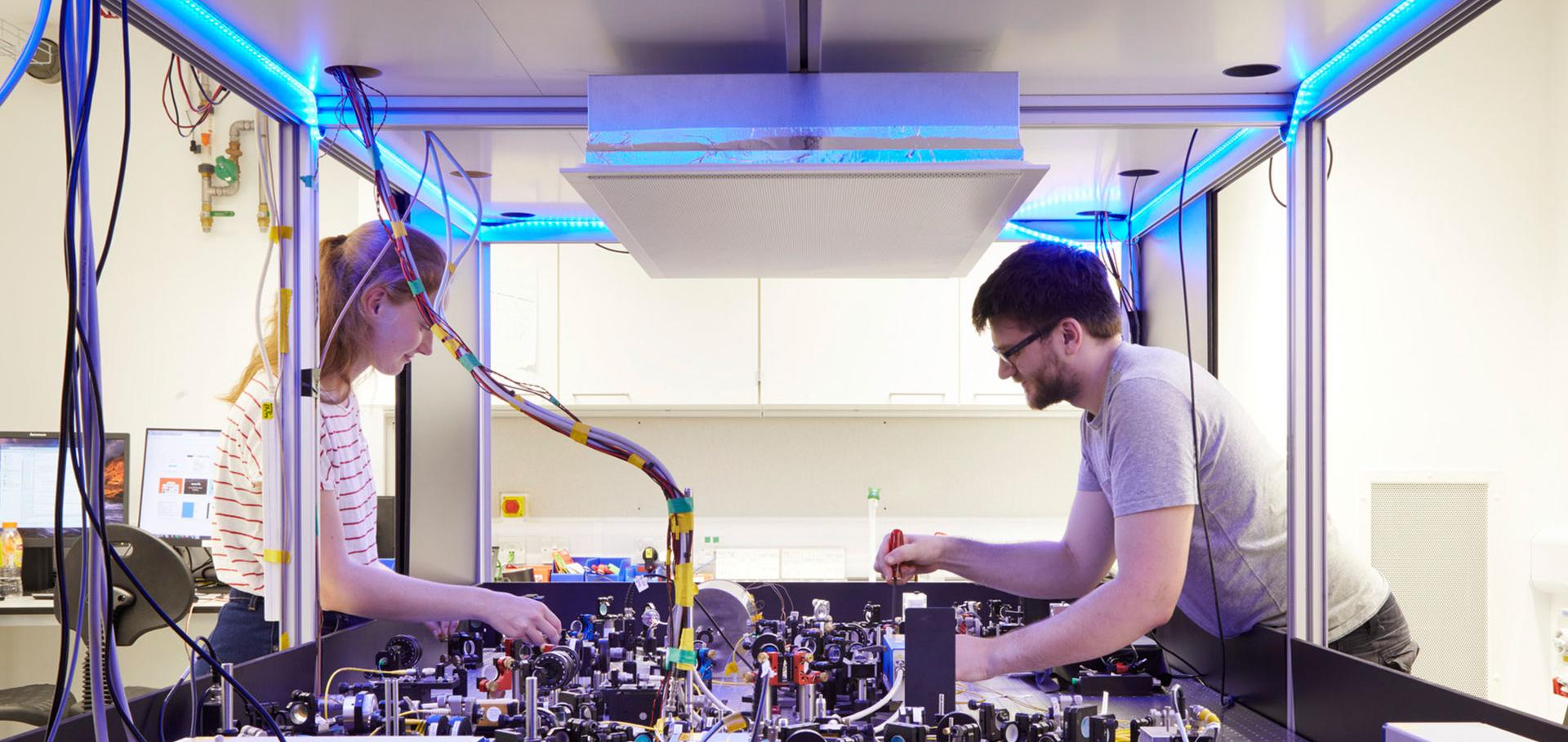
Atomic and Laser Physics
Credit: Jack Hobhouse

Prof Christopher Ramsey

Professor of Archaeological Science

Research theme

  • Accelerator physics
  • Climate physics
  • Instrumentation

Sub department

  • Atomic and Laser Physics
christopher.ramsey@physics.ox.ac.uk
Telephone: 01865285215
School of Archaeology
  • About
  • Publications

Human agency and infection rates: Implications for social distancing during epidemics

PLoS One Public Library of Science 15:12 (2020) e0243699

Abstract:

Social distancing is an important measure in controlling epidemics. This paper presents a simple theoretical model focussed on the implications of the wide range in interaction rates between individuals, both within the workplace and in social settings. The model is based on well-mixed populations and so is not intended for studying geographic spread. The model shows that epidemic growth rate is largely determined by the upper interactivity quantiles of society, implying that the most efficient methods of epidemic control are interaction capping approaches rather than overall reductions in interaction. The theoretical model can also be applied to look at aspects of the dynamics of epidemic progression under various scenarios. The theoretical model suggests that with no intervention herd immunity would be achieved with a lower overall infection rate than if variation in interaction rate is ignored, because by this stage almost all the most interactive members of society would have had the infection; however the overall mortality with such an approach is very high. Scenarios for mitigation and suppression suggest that, by using interactivity capping, it should be possible to control an epidemic without extreme sanctions on the majority of the population if R0 of the uncontrolled infection is 2.4. However to control the infection rate to a specific level will always require measures to be switched on and off and for this reason elimination is likely to be a less costly policy in the long run. While social distancing alone can be used for elimination, it would not on its own be an efficient mechanism to prevent reinfection. The use of robust testing, quarantining, and contact tracing would strengthen any social distancing measures, speed up elimination, and be a better tool for the prevention of infection or reinfection. Because the analysis presented here is theoretical, and not data-driven, it is intended to be a stimulus for further data-collection, particularly on individual interactivity levels, and for more comprehensive modelling which takes account of the type of heterogeneity discussed here. While there are some clear lessons from the simple model presented here, policy makers should have these tested and validated by epidemiological specialists before acting on them.
More details from the publisher
Details from ORA
More details
More details

Tempo of a Mega-henge: A New Chronology for Mount Pleasant, Dorchester, Dorset

Proceedings of the Prehistoric Society Cambridge University Press (CUP) 86 (2020) 199-236

Authors:

Susan Greaney, Zoë Hazell, Alistair Barclay, Christopher Bronk Ramsey, Elaine Dunbar, Irka Hajdas, Paula Reimer, Joshua Pollard, Niall Sharples, Peter Marshall
More details from the publisher

The chronology of Glastonbury Lake Village

Antiquity Antiquity Publications 94:378 (2020) 1464-1481

Authors:

Peter Marshall, Richard Brunning, Stephen Minnitt, Christopher Bronk Ramsey, Elaine Dunbar, Paula J Reimer
More details from the publisher

SISALv2: a comprehensive speleothem isotope database with multiple age–depth models

Earth System Science Data Copernicus Publications 12:4 (2020) 2579-2606

Authors:

Laia Comas-Bru, Kira Rehfeld, Carla Roesch, Sahar Amirnezhad-Mozhdehi, Sandy P Harrison, Kamolphat Atsawawaranunt, Syed Masood Ahmad, Yassine Ait Brahim, Andy Baker, Matthew Bosomworth, Sebastian FM Breitenbach, Yuval Burstyn, Andrea Columbu, Michael Deininger, Attila Demény, Bronwyn Dixon, Jens Fohlmeister, István Gábor Hatvani, Jun Hu, Nikita Kaushal, Zoltán Kern, Inga Labuhn, Franziska A Lechleitner, Andrew Lorrey, Belen Martrat, Valdir Felipe Novello, Jessica Oster, Carlos Pérez-Mejías, Denis Scholz, Nick Scroxton, Nitesh Sinha, Brittany Marie Ward, Sophie Warken, Haiwei Zhang, SISAL Working Group members
More details from the publisher
More details

Findings from an in-Depth Annual Tree-Ring Radiocarbon Intercomparison

Radiocarbon: An International Journal of Cosmogenic Isotope Research Cambridge University Press 62:4 (2020) 873-882

Authors:

L Wacker, EM Scott, A Bayliss, D Brown, E Bard, S Bollhalder, M Friedrich, M Capano, A Cherkinsky, D Chivall, BJ Culleton, MW Dee, R Friedrich, GWL Hodgins, A Hogg, DJ Kennett, TDJ Knowles, M Kuitems, TE Lange, F Miyake, M-J Nadeau, T Nakamura, JP Naysmith, J Olsen, T Omori, F Petchey, B Philippsen, C Bronk Ramsey, GV Ravi Prasad, M Seiler, J Southon, R Staff, T Tuna

Abstract:

The radiocarbon calibration curve so far contains annually resolved data only for a short period of time. With accelerator mass spectrometry (AMS) matching the precision of decay counting, it is now possible to efficiently produce large datasets of annual resolution for calibration purposes using small amounts of wood. The radiocarbon inter-comparison on single-year tree-ring samples presented here is the first to investigate specifically possible offsets between AMS laboratories at high precision. The results show that AMS laboratories are capable of measuring samples of Holocene age with an accuracy and precision that is comparable or even goes beyond what is possible with decay counting, even though they require a thousand times less wood. It also shows that not all AMS laboratories always produce results that are consistent with their stated uncertainties. The long-term benefits of studies of this kind are more accurate radiocarbon measurements with, in the future, better quantified uncertainties.Additional co-authors: Douglas J Kennett, Timothy D J Knowles, Margot Kuitems, Todd E Lange, Fusa Miyake, Marie-Josée Nadeau, Toshio Nakamura, J Philip Naysmith, Jesper Olsen, Takayuki Omori, Fiona Petchey, Bente Philippsen, Christopher Bronk Ramsey, G V Ravi Prasad, Martin Seiler, John Southon, Richard Staff, Thibault Tun
More details from the publisher
Details from ORA
More details

Pagination

  • First page First
  • Previous page Prev
  • …
  • Page 6
  • Page 7
  • Page 8
  • Page 9
  • Current page 10
  • Page 11
  • Page 12
  • Page 13
  • Page 14
  • …
  • Next page Next
  • Last page Last

Footer Menu

  • Contact us
  • Giving to the Dept of Physics
  • Work with us
  • Media

User account menu

  • Log in

Follow us

FIND US

Clarendon Laboratory,

Parks Road,

Oxford,

OX1 3PU

CONTACT US

Tel: +44(0)1865272200

University of Oxfrod logo Department Of Physics text logo
IOP Juno Champion logo Athena Swan Silver Award logo

© University of Oxford - Department of Physics

Cookies | Privacy policy | Accessibility statement

Built by: Versantus

  • Home
  • Research
  • Study
  • Engage
  • Our people
  • News & Comment
  • Events
  • Our facilities & services
  • About us
  • Giving to Physics
  • Current students
  • Staff intranet