Home
Department Of Physics text logo
  • Research
    • Our research
    • Our research groups
    • Our research in action
    • Research funding support
    • Summer internships for undergraduates
  • Study
    • Undergraduates
    • Postgraduates
  • Engage
    • For alumni
    • For business
    • For schools
    • For the public
Menu
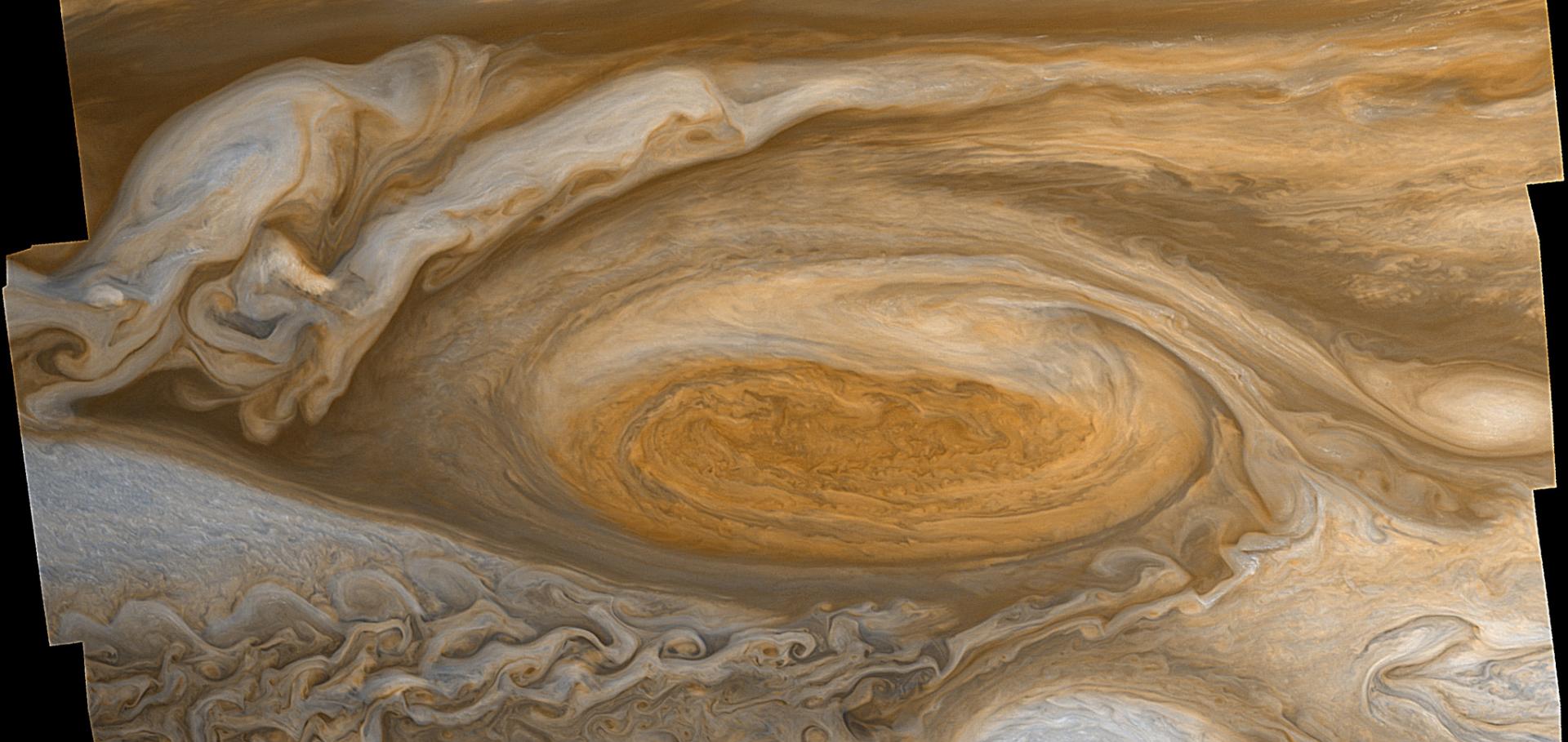
Image of Jupiter's Great Red Spot from Voyager 1

Image of Jupiter's Great Red Spot, obtained during the fly-by of Jupiter by NASA's Voyager 1 spacecraft in 1979.

Credit: NASA/JPL

Prof. Peter Read

Emeritus/researcher

Research theme

  • Climate physics
  • Exoplanets and planetary physics

Sub department

  • Atmospheric, Oceanic and Planetary Physics

Research groups

  • Geophysical and Astrophysical Fluid Dynamics
  • Planetary Climate Dynamics
Peter.Read@physics.ox.ac.uk
Telephone: 01865 (2)72082
Atmospheric Physics Clarendon Laboratory, room 210
  • About
  • Publications

The solsticial pause on Mars: 2 modelling and investigation of causes

Icarus 264 (2015) 465-477

Authors:

DP Mulholland, SR Lewis, PL Read, JB Madeleine, F Forget

Abstract:

The martian solsticial pause, presented in a companion paper (. Lewis et al., 2016), was investigated further through a series of model runs using the UK version of the LMD/UK Mars Global Climate Model. It was found that the pause could not be adequately reproduced if radiatively active water ice clouds were omitted from the model. When clouds were used, along with a realistic time-dependent dust opacity distribution, a substantial minimum in near-surface transient eddy activity formed around solstice in both hemispheres. The net effect of the clouds in the model is, by altering the thermal structure of the atmosphere, to decrease the vertical shear of the westerly jet near the surface around solstice, and thus reduce baroclinic growth rates. A similar effect was seen under conditions of large dust loading, implying that northern midlatitude eddy activity will tend to become suppressed after a period of intense flushing storm formation around the northern cap edge. Suppression of baroclinic eddy generation by the barotropic component of the flow and via diabatic eddy dissipation were also investigated as possible mechanisms leading to the formation of the solsticial pause but were found not to make major contributions. Zonal variations in topography were found to be important, as their presence results in weakened transient eddies around winter solstice in both hemispheres, through modification of the near-surface flow. The zonal topographic asymmetry appears to be the primary reason for the weakness of eddy activity in the southern hemisphere relative to the northern hemisphere, and the ultimate cause of the solsticial pause in both hemispheres. The meridional topographic gradient was found to exert a much weaker influence on near-surface transient eddies.
More details from the publisher

The EChO science case

(2015)

Authors:

Giovanna Tinetti, Pierre Drossart, Paul Eccleston, Paul Hartogh, Kate Isaak, Martin Linder, Christophe Lovis, Giusi Micela, Marc Ollivier, Ludovic Puig, Ignasi Ribas, Ignas Snellen, Bruce Swinyard France Allard, Joanna Barstow, James Cho, Athena Coustenis, Charles Cockell, Alexandre Correia, Leen Decin, Remco de Kok, Pieter Deroo, Therese Encrenaz, Francois Forget, Alistair Glasse, Caitlin Griffith, Tristan Guillot, Tommi Koskinen, Helmut Lammer, Jeremy Leconte, Pierre Maxted, Ingo Mueller-Wodarg, Richard Nelson, Chris North, Enric Pallé, Isabella Pagano, Guseppe Piccioni, David Pinfield, Franck Selsis, Alessandro Sozzetti, Lars Stixrude, Jonathan Tennyson, Diego Turrini, Mariarosa Zapatero-Osorio Jean-Philippe Beaulieu, Denis Grodent, Manuel Guedel, David Luz, Hans Ulrik Nørgaard-Nielsen, Tom Ray, Hans Rickman, Avri Selig, Mark Swain Marek Banaszkiewicz, Mike Barlow, Neil Bowles, Graziella Branduardi-Raymont, Vincent Coudé du Foresto, Jean-Claude Gerard, Laurent Gizon, Allan Hornstrup, Christopher Jarchow, Franz Kerschbaum, Géza Kovacs, Pierre-Olivier Lagage, Tanya Lim, Mercedes Lopez-Morales, Giuseppe Malaguti, Emanuele Pace, Enzo Pascale, Bart Vandenbussche, Gillian Wright, Gonzalo Ramos Zapata Alberto Adriani, Ruymán Azzollini, Ana Balado, Ian Bryson, Raymond Burston, Josep Colomé, Vincent Coudé du Foresto, Martin Crook, Anna Di Giorgio, Matt Griffin, Ruud Hoogeveen, Roland Ottensamer, Ranah Irshad, Kevin Middleton, Gianluca Morgante, Frederic Pinsard, Mirek Rataj, Jean-Michel Reess, Giorgio Savini, Jan-Rutger Schrader, Richard Stamper, Berend Winter L Abe, M Abreu, N Achilleos, P Ade, V Adybekian, L Affer, C Agnor, M Agundez, C Alard, J Alcala, C Allende Prieto, FJ Alonso Floriano, F Altieri, CA Alvarez Iglesias, P Amado, A Andersen, A Aylward, C Baffa, G Bakos, P Ballerini, M Banaszkiewicz, RJ Barber, D Barrado, EJ Barton, V Batista, G Bellucci, JA Belmonte Avilés, D Berry, B Bézard, D Biondi, M Błęcka, I Boisse, B Bonfond, P Bordé, P Börner, H Bouy, L Brown, L Buchhave, J Budaj, A Bulgarelli, M Burleigh, A Cabral, MT Capria, A Cassan, C Cavarroc, C Cecchi-Pestellini, R Cerulli, J Chadney, S Chamberlain, S Charnoz, N Christian Jessen, A Ciaravella, A Claret, R Claudi, A Coates, R Cole, A Collura, D Cordier, E Covino, C Danielski, M Damasso, HJ Deeg, E Delgado-Mena, C Del Vecchio, O Demangeon, A De Sio, J De Wit, M Dobrijévic, P Doel, C Dominic, E Dorfi, S Eales, C Eiroa, M Espinoza Contreras, M Esposito, V Eymet, N Fabrizio, M Fernández, B Femenía Castella, P Figueira, G Filacchione, L Fletcher, M Focardi, S Fossey, P Fouqué, J Frith, M Galand, L Gambicorti, P Gaulme, RJ García López, A Garcia-Piquer, W Gear, J-C Gerard, L Gesa, E Giani, F Gianotti, M Gillon, E Giro, M Giuranna, H Gomez, I Gomez-Leal, J Gonzalez Hernandez, B González Merino, R Graczyk, D Grassi, J Guardia, P Guio, J Gustin, P Hargrave, J Haigh, E Hébrard, U Heiter, RL Heredero, E Herrero, F Hersant, D Heyrovsky, M Hollis, B Hubert, R Hueso, G Israelian, N Iro, P Irwin, S Jacquemoud, G Jones, H Jones, K Justtanont, T Kehoe, F Kerschbaum, E Kerins, P Kervella, D Kipping, T Koskinen, N Krupp, O Lahav, B Laken, N Lanza, E Lellouch, G Leto, J Licandro Goldaracena, C Lithgow-Bertelloni, SJ Liu, U Lo Cicero, N Lodieu, P Lognonné, M Lopez-Puertas, MA Lopez-Valverde, I Lundgaard Rasmussen, A Luntzer, P Machado, C MacTavish, A Maggio, J-P Maillard, W Magnes, J Maldonado, U Mall, J-B Marquette, P Mauskopf, F Massi, A-S Maurin, A Medvedev, C Michaut, P Miles-Paez, M Montalto, P Montañés Rodríguez, M Monteiro, D Montes, H Morais, JC Morales, M Morales-Calderón, G Morello, A Moro Martín, J Moses, A Moya Bedon, F Murgas Alcaino, E Oliva, G Orton, F Palla, M Pancrazzi, E Pantin, V Parmentier, H Parviainen, KY Peña Ramírez, J Peralta, S Perez-Hoyos, R Petrov, S Pezzuto, R Pietrzak, E Pilat-Lohinger, N Piskunov, R Prinja, L Prisinzano, I Polichtchouk, E Poretti, A Radioti, AA Ramos, T Rank-Lüftinger, P Read, K Readorn, R Rebolo López, J Rebordão, M Rengel, L Rezac, M Rocchetto, F Rodler, VJ Sánchez Béjar, A Sanchez Lavega, E Sanromá, N Santos, J Sanz Forcada, G Scandariato, F-X Schmider, A Scholz, S Scuderi, J Sethenadh, S Shore, A Showman, B Sicardy, P Sitek, A Smith, L Soret, S Sousa, A Stiepen, M Stolarski, G Strazzulla, HM Tabernero, P Tanga, M Tecsa, J Temple, L Terenzi, M Tessenyi, L Testi, S Thompson, H Thrastarson, BW Tingley, M Trifoglio, J Martín Torres, A Tozzi, D Turrini, R Varley, F Vakili, M de Val-Borro, ML Valdivieso, O Venot, E Villaver, S Vinatier, S Viti, I Waldmann, D Waltham, D Ward-Thompson, R Waters, C Watkins, D Watson, P Wawer, A Wawrzaszk, G White, T Widemann, W Winek, T Wiśniowski, R Yelle, Y Yung, SN Yurchenko
More details from the publisher

Polar vortices on Earth and Mars: A comparative study of the climatology and variability from reanalyses

Quarterly Journal of the Royal Meteorological Society Wiley 141:687 (2015) 550-562

Authors:

DM Mitchell, L Montabone, S Thomson, Peter Read

Abstract:

Polar vortices on Mars provide case-studies to aid understanding of geophysical vortex dynamics and may help to resolve long-standing issues regarding polar vortices on Earth. Due to the recent development of the first publicly available Martian reanalysis dataset (MACDA), for the first time we are able to characterise thoroughly the structure and evolution of the Martian polar vortices, and hence perform a systematic comparison with the polar vortices on Earth. The winter atmospheric circulations of the two planets are compared, with a specific focus on the structure and evolution of the polar vortices. The Martian residual meridional overturning circulation is found to be very similar to the stratospheric residual circulation on Earth during winter. While on Earth this residual circulation is very different from the Eulerian circulation, on Mars it is found to be very similar. Unlike on Earth, it is found that the Martian polar vortices are annular, and that the Northern Hemisphere vortex is far stronger than its southern counterpart. While winter hemisphere differences in vortex strength are also reported on Earth, the contrast is not as large. Distinctions between the two planets are also apparent in terms of the climatological vertical structure of the vortices, in that the Martian polar vortices are observed to decrease in size at higher altitudes, whereas on Earth the opposite is observed. Finally, it is found that the Martian vortices are less variable through the winter than on Earth, especially in terms of the vortex geometry. During one particular major regional dust storm on Mars (Martian year 26), an equatorward displacement of the vortex is observed, sharing some qualitative characteristics of sudden stratospheric warmings on Earth. © 2014 The Authors.
More details from the publisher
Details from ORA
More details
More details

Polar vortices on Earth and Mars: A comparative study of the climatology and variability from reanalyses

Quarterly Journal of the Royal Meteorological Society 141:687 (2015) 550-562

Authors:

DM Mitchell, L Montabone, S Thomson, PL Read

Abstract:

Polar vortices on Mars provide case-studies to aid understanding of geophysical vortex dynamics and may help to resolve long-standing issues regarding polar vortices on Earth. Due to the recent development of the first publicly available Martian reanalysis dataset (MACDA), for the first time we are able to characterise thoroughly the structure and evolution of the Martian polar vortices, and hence perform a systematic comparison with the polar vortices on Earth. The winter atmospheric circulations of the two planets are compared, with a specific focus on the structure and evolution of the polar vortices. The Martian residual meridional overturning circulation is found to be very similar to the stratospheric residual circulation on Earth during winter. While on Earth this residual circulation is very different from the Eulerian circulation, on Mars it is found to be very similar. Unlike on Earth, it is found that the Martian polar vortices are annular, and that the Northern Hemisphere vortex is far stronger than its southern counterpart. While winter hemisphere differences in vortex strength are also reported on Earth, the contrast is not as large. Distinctions between the two planets are also apparent in terms of the climatological vertical structure of the vortices, in that the Martian polar vortices are observed to decrease in size at higher altitudes, whereas on Earth the opposite is observed. Finally, it is found that the Martian vortices are less variable through the winter than on Earth, especially in terms of the vortex geometry. During one particular major regional dust storm on Mars (Martian year 26), an equatorward displacement of the vortex is observed, sharing some qualitative characteristics of sudden stratospheric warmings on Earth.
More details from the publisher

The thermally-driven rotating annulus: horizontal velocities in regular and weakly chaotic flow regimes

University of Oxford (2015)

Authors:

Wolf-Gerrit Früh, David Smith, Stephan H Risch

Abstract:

The dataset is documented in readme.pdf. The data files are in uncompressed .tar format. This dataset contains 11 1/2 hours of horizontal velocity measurements from four experiments using AOPP's 'small annulus' thermally-driven rotating annulus laboratory experiment. The experiments cover regular (2S, 3AV) and weakly chaotic (3SV) flow regimes. The apparatus consists of two concentric right circular cylinders with height 14.0cm and radii 2.5cm and 8.0cm, with a 17% glycerol / 83% water mixture (by volume) between them. The outer cylinder is heated and the inner cylinder cooled relative to the working fluid, with a temperature difference of approximately 4K, and the apparatus rotates about the co-incident axis of the two cylinders at rates between 0.75 and 3.1 rad/s. This setup mimics the main effects acting on a planetary atmosphere: gravity, rotation, and a heating gradient between low and high latitudes.
More details from the publisher
Details from ORA

Pagination

  • First page First
  • Previous page Prev
  • …
  • Page 15
  • Page 16
  • Page 17
  • Page 18
  • Current page 19
  • Page 20
  • Page 21
  • Page 22
  • Page 23
  • …
  • Next page Next
  • Last page Last

Footer Menu

  • Contact us
  • Giving to the Dept of Physics
  • Work with us
  • Media

User account menu

  • Log in

Follow us

FIND US

Clarendon Laboratory,

Parks Road,

Oxford,

OX1 3PU

CONTACT US

Tel: +44(0)1865272200

University of Oxfrod logo Department Of Physics text logo
IOP Juno Champion logo Athena Swan Silver Award logo

© University of Oxford - Department of Physics

Cookies | Privacy policy | Accessibility statement

Built by: Versantus

  • Home
  • Research
  • Study
  • Engage
  • Our people
  • News & Comment
  • Events
  • Our facilities & services
  • About us
  • Giving to Physics
  • Current students
  • Staff intranet