Home
Department Of Physics text logo
  • Research
    • Our research
    • Our research groups
    • Our research in action
    • Research funding support
    • Summer internships for undergraduates
  • Study
    • Undergraduates
    • Postgraduates
  • Engage
    • For alumni
    • For business
    • For schools
    • For the public
Menu
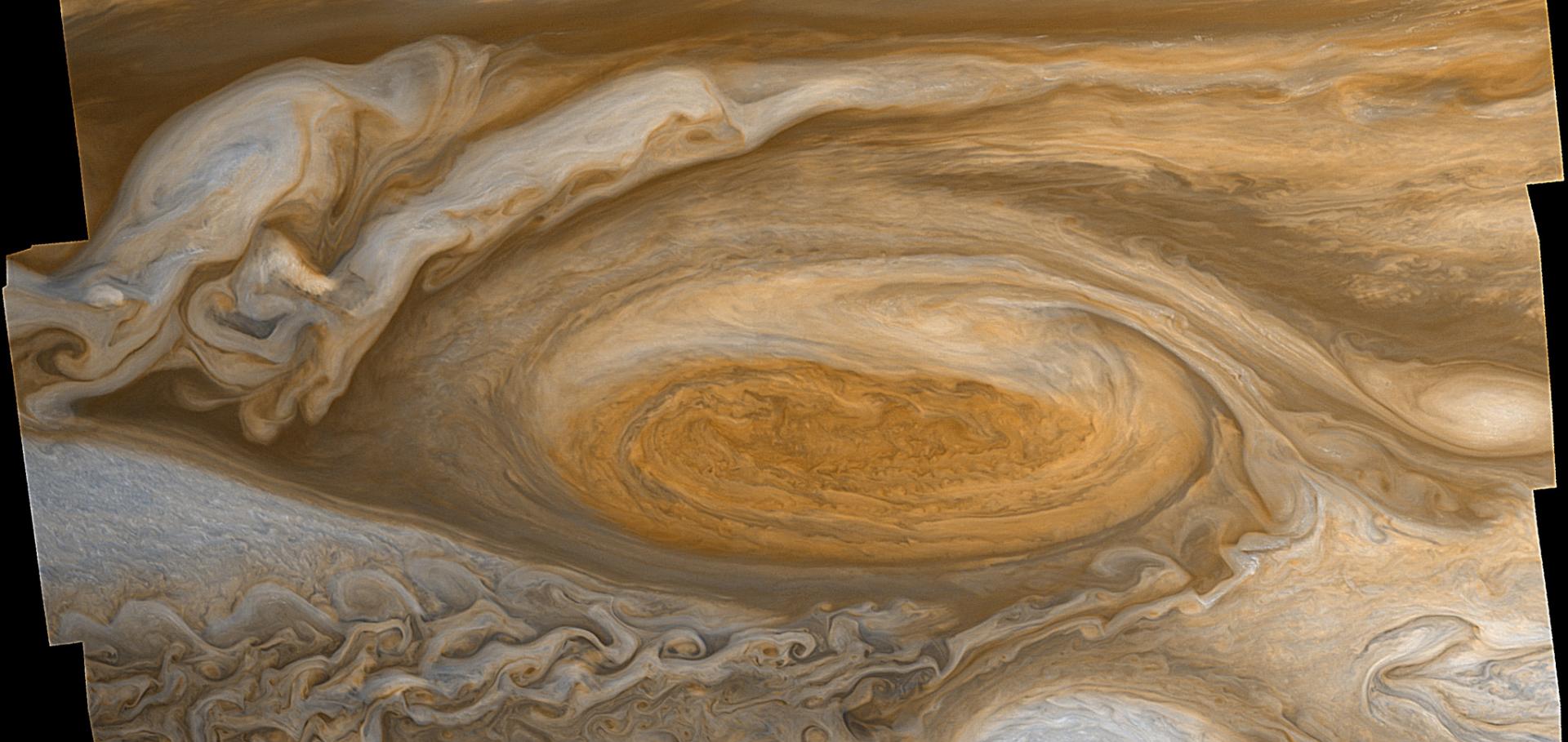
Image of Jupiter's Great Red Spot from Voyager 1

Image of Jupiter's Great Red Spot, obtained during the fly-by of Jupiter by NASA's Voyager 1 spacecraft in 1979.

Credit: NASA/JPL

Prof. Peter Read

Emeritus/researcher

Research theme

  • Climate physics
  • Exoplanets and planetary physics

Sub department

  • Atmospheric, Oceanic and Planetary Physics

Research groups

  • Geophysical and Astrophysical Fluid Dynamics
  • Planetary Climate Dynamics
Peter.Read@physics.ox.ac.uk
Telephone: 01865 (2)72082
Atmospheric Physics Clarendon Laboratory, room 210
  • About
  • Publications

A combined laboratory and numerical study of heat transport by baroclinic eddies and axisymmetric flows

JOURNAL OF FLUID MECHANICS 489 (2003) 301-323
More details from the publisher

Equatorial jets in the dusty Martian atmosphere

JOURNAL OF GEOPHYSICAL RESEARCH-PLANETS 108:E4 (2003) ARTN 5034

Authors:

SR Lewis, PL Read
More details from the publisher

Spontaneous generation and impact of inertia-gravity waves in a stratified, two-layer shear flow

GEOPHYSICAL RESEARCH LETTERS 30:24 (2003) ARTN 2255

Authors:

PD Williams, PL Read, TWN Haine
More details from the publisher

Modeling the Martian dust cycle 1. Representations of dust transport processes

Journal of Geophysical Research: Planets 107:12 (2002)

Authors:

CE Newman, SR Lewis, PL Read, F Forget

Abstract:

A dust transport scheme has been developed for a general circulation model of the Martian atmosphere. This enables radiatively active dust transport, with the atmospheric state responding to changes in the dust distribution via atmospheric heating, as well as dust transport being determined by atmospheric conditions. The scheme includes dust lifting, advection by model winds, atmospheric mixing, and gravitational sedimentation. Parameterizations of lifting initiated by (1) near-surface wind stress and (2) convective vortices known as dust devils are considered. Two parameterizations are defined for each mechanism and are first investigated offline using data previously output from the non-dust- transporting model. The threshold-insensitive parameterizations predict some lifting over most regions, varying smoothly in space and time. The threshold-sensitive parameterizations predict lifting only during extreme atmospheric conditions (such as exceptionally strong winds), so lifting is rarer and more confined to specific regions and times. Wind stress lifting is predicted to peak during southern summer, largely between latitudes 15° and 35°S, with maxima also in regions of strong slope winds or thermal contrast flows. These areas are consistent with observed storm onset regions and dark streak surface features. Dust devil lifting is also predicted to peak during southern summer, with a moderate peak during northern summer. The greatest dust devil lifting occurs in early afternoon, particularly in the Noachis, Arcadia/Amazonis, Sirenum, and Thaumasia regions. Radiatively active dust transport experiments reveal strong positive feedbacks on lifting by near-surface wind stress and negative feedbacks on lifting by dust devils.
More details from the publisher

Modeling the Martian dust cycle 2. Multiannual radiatively active dust transport simulations

Journal of Geophysical Research Planets 107:12 (2002) 1-15

Authors:

CE Newman, SR Lewis, PL Read, F Forget

Abstract:

Multiannual dust transport simulations have been performed using a Mars general circulation model containing a dust transport scheme which responds to changes in the atmospheric state. If the dust transport is "radiatively active," the atmospheric state also responds to changes in the dust distribution. This paper examines the suspended dust distribution obtained using different lifting parameterizations, including an analysis of dust storms produced spontaneously during these simulations. The lifting mechanisms selected are lifting by (1) near-surface wind stress and (2) convective vortices known as dust devils. Each mechanism is separated into two types of parameterization: threshold-sensitive and -insensitive. The latter produce largely unrealistic annual dust cycles and storms, and no significant interannual variability. The threshold-sensitive parameterizations produce more realistic annual and interannual behavior, as well as storms with similarities to observed events, thus providing insight into how real Martian dust storms may develop. Simulations for which dust devil lifting dominates are too dusty during northern summer. This suggests either that a removal mechanism (such as dust scavenging by water ice) reduces opacities at this time or that dust devils are not the primary mechanism for storm production. Simulations for which near-surface wind stress lifting dominates produce the observed low opacities during northern spring/ summer, yet appear unable to produce realistic global storms without storm decay being prevented by the occurrence of large-scale positive feedbacks on further lifting. Simulated dust levels are generally linked closely to the seasonal state of the atmosphere, and no simulation produces the observed amount of interannual variability.
More details from the publisher

Pagination

  • First page First
  • Previous page Prev
  • …
  • Page 46
  • Page 47
  • Page 48
  • Page 49
  • Current page 50
  • Page 51
  • Page 52
  • Page 53
  • Page 54
  • …
  • Next page Next
  • Last page Last

Footer Menu

  • Contact us
  • Giving to the Dept of Physics
  • Work with us
  • Media

User account menu

  • Log in

Follow us

FIND US

Clarendon Laboratory,

Parks Road,

Oxford,

OX1 3PU

CONTACT US

Tel: +44(0)1865272200

University of Oxfrod logo Department Of Physics text logo
IOP Juno Champion logo Athena Swan Silver Award logo

© University of Oxford - Department of Physics

Cookies | Privacy policy | Accessibility statement

Built by: Versantus

  • Home
  • Research
  • Study
  • Engage
  • Our people
  • News & Comment
  • Events
  • Our facilities & services
  • About us
  • Giving to Physics
  • Current students
  • Staff intranet