Home
Department Of Physics text logo
  • Research
    • Our research
    • Our research groups
    • Our research in action
    • Research funding support
    • Summer internships for undergraduates
  • Study
    • Undergraduates
    • Postgraduates
  • Engage
    • For alumni
    • For business
    • For schools
    • For the public
  • Support
Menu
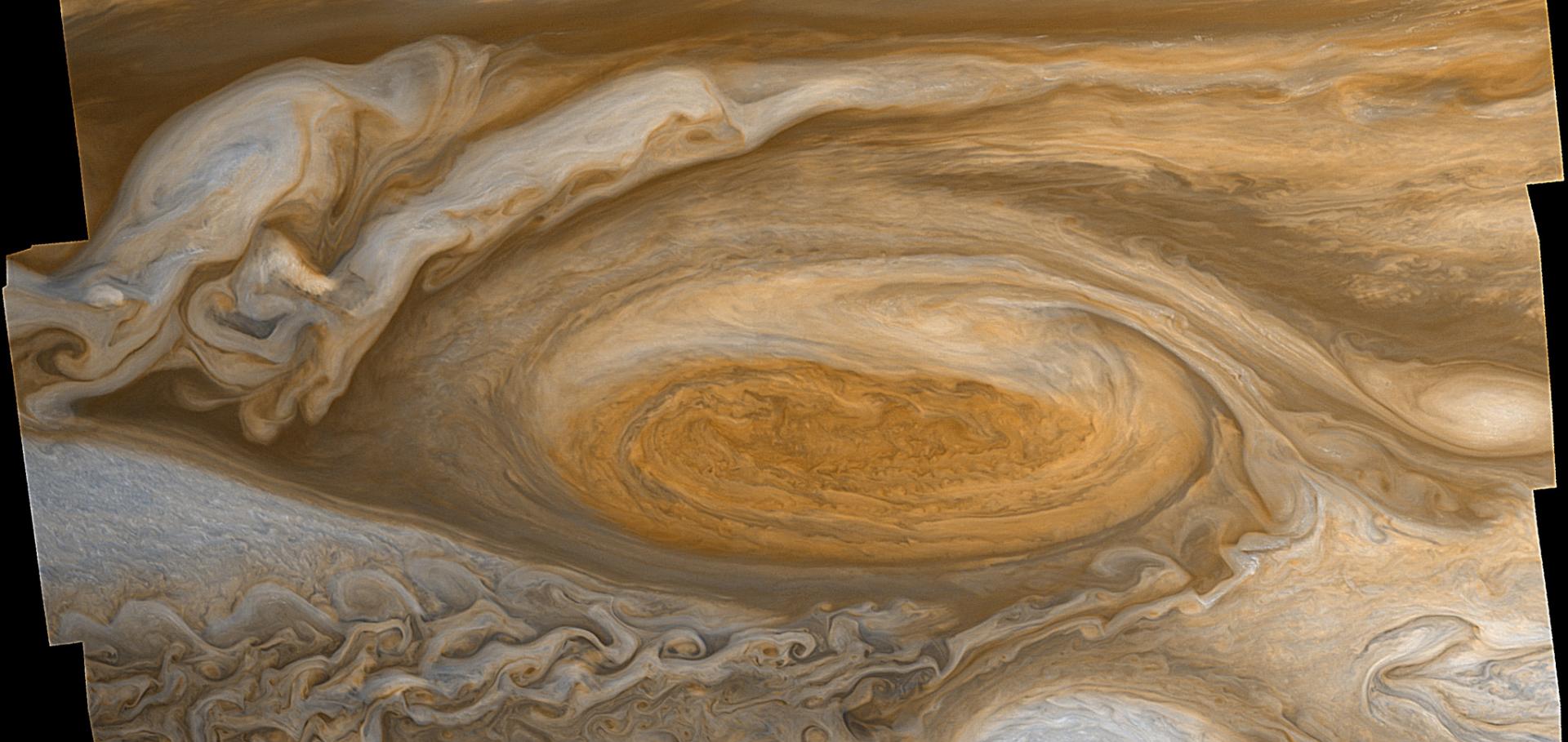
Image of Jupiter's Great Red Spot from Voyager 1

Image of Jupiter's Great Red Spot, obtained during the fly-by of Jupiter by NASA's Voyager 1 spacecraft in 1979.

Credit: NASA/JPL

Prof. Peter Read

Emeritus/researcher

Research theme

  • Climate physics
  • Exoplanets and planetary physics

Sub department

  • Atmospheric, Oceanic and Planetary Physics

Research groups

  • Geophysical and Astrophysical Fluid Dynamics
  • Planetary Climate Dynamics
Peter.Read@physics.ox.ac.uk
Telephone: 01865 (2)72082
Atmospheric Physics Clarendon Laboratory, room 210
  • About
  • Publications

Upper atmosphere of Mars up to 120 km:: Mars Global Surveyor accelerometer data analysis with the LMD general circulation model -: art. no. E01011

JOURNAL OF GEOPHYSICAL RESEARCH-PLANETS 109:E1 (2004) ARTN E01011

Authors:

MAI Coll, F Forget, MA López-Valverde, PL Read, SR Lewis
More details from the publisher

Equatorial jets in the dusty Martian atmosphere

Journal of Geophysical Research: Planets 108:4 (2003)

Authors:

SR Lewis, PL Read

Abstract:

We investigate the production of equatorial jets which demostrate strong local superrotation in an atmospheric general circulation model of Mars. These westerly jets are driven by diurnal thermal tides, and their strength is shown to be closely related to the amount of dust in the atmosphere. The superrotating jets are strongest near to equinox and under conditions of high atmospheric dust loading. If there is sufficient dust, in amounts corresponding to dust storm conditions, the westerly equatorial jets can occur at any time of year and reach speeds of over 40 m/s, peaking between 10 and 20 km altitude. For more moderate dust amounts, typical of background levels on Mars, the jets are still strong when the subsolar point is close to the equator and latitudinally symmetric tidal modes are forced. Strong easterly retrograde winds are also found high above the equator, and it is shown that the thermal tides play a major role in their formation. This process is especially relevant close to equinox when the cross-equatorial meridional circulation is weak.
More details from the publisher

A combined laboratory and numerical study of heat transport by baroclinic eddies and axisymmetric flows

JOURNAL OF FLUID MECHANICS 489 (2003) 301-323
More details from the publisher

Equatorial jets in the dusty Martian atmosphere

JOURNAL OF GEOPHYSICAL RESEARCH-PLANETS 108:E4 (2003) ARTN 5034

Authors:

SR Lewis, PL Read
More details from the publisher

Spontaneous generation and impact of inertia-gravity waves in a stratified, two-layer shear flow

GEOPHYSICAL RESEARCH LETTERS 30:24 (2003) ARTN 2255

Authors:

PD Williams, PL Read, TWN Haine
More details from the publisher

Pagination

  • First page First
  • Previous page Prev
  • …
  • Page 48
  • Page 49
  • Page 50
  • Page 51
  • Current page 52
  • Page 53
  • Page 54
  • Page 55
  • Page 56
  • …
  • Next page Next
  • Last page Last

Footer Menu

  • Contact us
  • Giving to the Dept of Physics
  • Work with us
  • Media

User account menu

  • Log in

Follow us

FIND US

Clarendon Laboratory,

Parks Road,

Oxford,

OX1 3PU

CONTACT US

Tel: +44(0)1865272200

University of Oxfrod logo Department Of Physics text logo
IOP Juno Champion logo Athena Swan Silver Award logo

© University of Oxford - Department of Physics

Cookies | Privacy policy | Accessibility statement

Built by: Versantus

  • Home
  • Research
  • Study
  • Engage
  • Our people
  • News & Comment
  • Events
  • Our facilities & services
  • About us
  • Giving to Physics
  • Current students
  • Staff intranet