Home
Department Of Physics text logo
  • Research
    • Our research
    • Our research groups
    • Our research in action
    • Research funding support
    • Summer internships for undergraduates
  • Study
    • Undergraduates
    • Postgraduates
  • Engage
    • For alumni
    • For business
    • For schools
    • For the public
  • Support
Menu
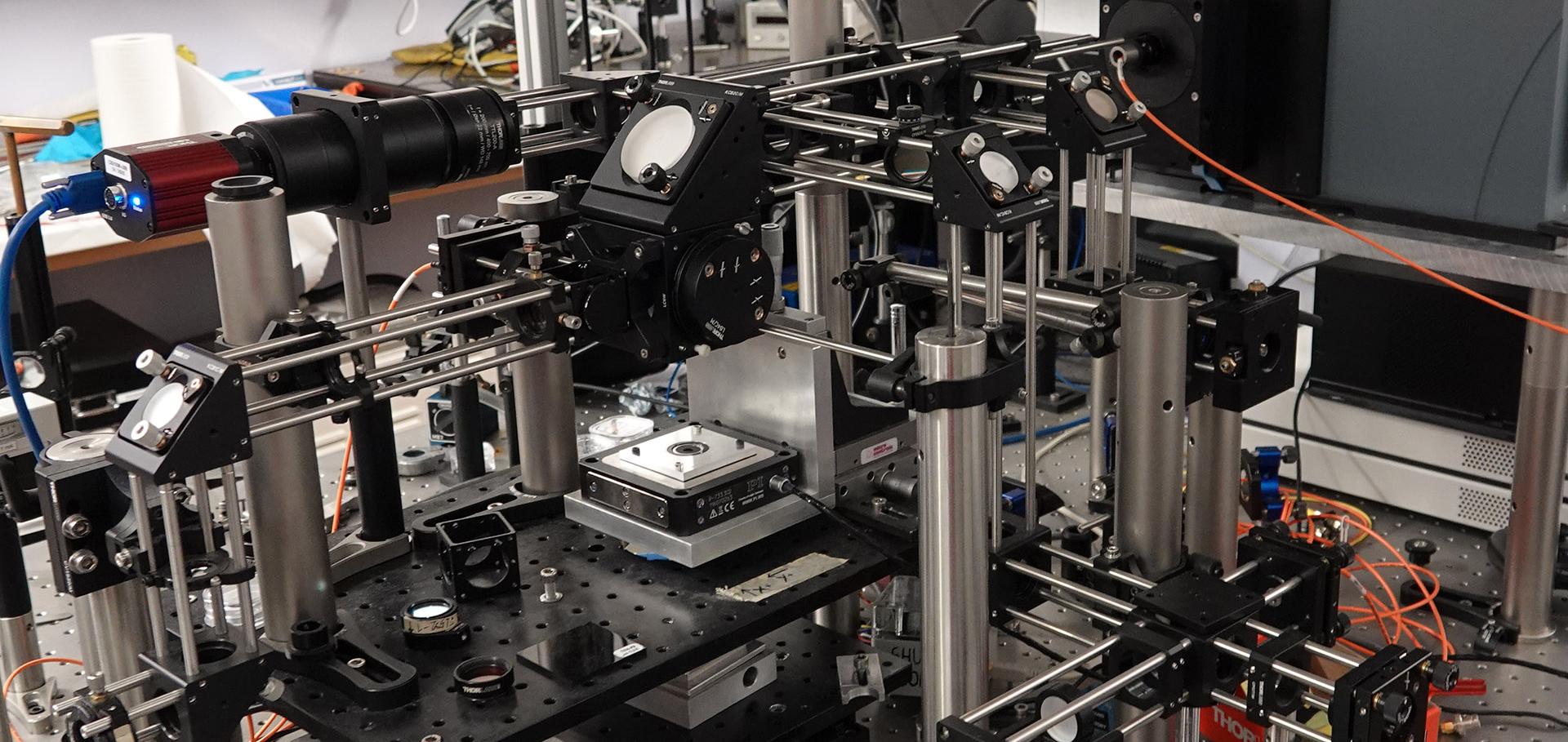
MicroPL optical setup

Professor Robert Taylor

Emeritus Professor of Condensed Matter Physics

Research theme

  • Photovoltaics and nanoscience

Sub department

  • Condensed Matter Physics

Research groups

  • Quantum Optoelectronics
Robert.Taylor@physics.ox.ac.uk
Telephone: 01865 (2)72230
Clarendon Laboratory, room 164
orcid.org/0000-0003-2578-9645
  • About
  • Teaching
  • Positions available
  • Publications

Lasing in perovskite nanocrystals

Image of transverse modes from lasing nanocrystals
Nano Research, 14, 108, 2021

Dependence of carrier localization in InGaN/GaN multiple-quantum wells on well thickness

Applied Physics Letters 89:25 (2006)

Authors:

JH Na, RA Taylor, KH Lee, T Wang, A Tahraoui, P Parbrook, AM Fox, SN Yi, YS Park, JW Choi, JS Lee

Abstract:

Carrier localization in InGaNGaN multiple-quantum wells (MQWs) with three different well thicknesses was investigated optically using time-integrated and time-resolved microphotoluminescence spectroscopy. An anomalous temperature dependence of the photoluminescence peak energy was observed, as a consequence of local potential fluctuations. The carrier localization was more prominent in the case of MQWs with wide well thickness. The results indicate that the degree of potential fluctuation increases with increasing well thickness. Emission from quantum-dot-like states only became apparent in MQWs with wide well thickness, which supports the assertion that carrier localization in InGaNGaN MQWs is due to the formation of quantum dots. © 2006 American Institute of Physics.
More details from the publisher

PL, magneto-PL and PLE of the trimetallic nitride template fullerene Er3N@C0

Physica Status Solidi B Basic Research 243:13 (2006) 3037-3041

Authors:

MAG Jones, JJL Morton, RA Taylor, A Ardavan, GAD Briggs

Abstract:

Er3N@C80 exhibits sharp optical emission lines in the near-infrared attributed to fluorescence from the Er3+ ion. Here we demonstrate that high magnetic fields cause this spectrum to split, corresponding to transitions from the lowest field-split Kramers doublet of the 4I13/2 manifold to the four lowest field-split levels of the 4I15/2 manifold. The internal structure of these fullerenes can be spatially aligned with a preferred orientation under high magnetic field; the effect of alignment is to reduce the broadening associated with the isotropic spatial averaging characteristic of powder or frozen-solution spectra. Using a tunable 1.5 μm laser, we directly observe non-cage-mediated optical interactions with the Er3 ion. This spectroscopic method provides the opportunity to map the energy level structure of the incarcerated ion and to coherently control its quantum state. These qualities suggest that rare-earth endohedral fullerenes have characteristics that could be employed as a readout pathway for fullerene-based quantum information processing. © 2006 WILEY-VCH Verlag GmbH & Co. KGaA.
More details from the publisher

The effects of nitrogen and boron doping on the optical emission and diameters of single-walled carbon nanotubes

Carbon 44:13 (2006) 2752-2757

Authors:

LJ Li, M Glerup, AN Khlobystov, JG Wiltshire, JL Sauvajol, RA Taylor, RJ Nicholas

Abstract:

Using TEM, absorption and photoluminescence-excitation spectroscopy we have shown that nitrogen and nitrogen/boron doping of single-walled carbon nanotubes produce significant changes in both the optical properties and the diameter distribution of nanotubes produced by the arc-discharge method. Smaller diameter tubes are preferentially formed in the presence of boron. In addition the presence of nitrogen is found to significantly affect the emission properties of the nanotube ensemble, causing a shift in the dominant emission to lower energies, possibly due to changes in the bundling structure of the nanotubes in solution, but only very small changes are observed in the emission energies for individual nanotubes. © 2006 Elsevier Ltd. All rights reserved.
More details from the publisher

PL, magneto-PL and PLE of the trimetallic nitride template fullerene Er3N@C-80

PHYS STATUS SOLIDI B 243:13 (2006) 3037-3041

Authors:

MAG Jones, JJL Morton, RA Taylor, A Ardavan, GAD Briggs

Abstract:

Er3N@C,, exhibits sharp optical emission lines in the near-infrared attributed to fluorescence from the Er3+ ion. Here we demonstrate that high magnetic fields cause this spectrum to split, corresponding to transitions from the lowest field-split Kramers doublet of the I-4(13/2) manifold to the four lowest field-split levels of the I-4(15/2) manifold. The internal structure of these fullerenes can be spatially aligned with a preferred orientation under high magnetic field; the effect of alignment is to reduce the broadening associated with the isotropic spatial averaging characteristic of powder or frozen-solution spectra. Using a tunable 1.5 mu m laser, we directly observe non-cage-mediated optical interactions with the Er3+ ion. This spectroscopic method provides the opportunity to map the energy level structure of the incarcerated ion and to coherently control its quantum state. These qualities suggest that rare-earth endohedral fullerenes have characteristics that could be employed as a readout pathway for fullerene-based quantum information processing.
More details from the publisher

The effects of nitrogen and boron doping on the optical emission and diameters of single-walled carbon nanotubes

Carbon Elsevier BV 44:13 (2006) 2752-2757

Authors:

Lain-Jong Li, M Glerup, AN Khlobystov, JG Wiltshire, J-L Sauvajol, RA Taylor, RJ Nicholas
More details from the publisher

Pagination

  • First page First
  • Previous page Prev
  • …
  • Page 56
  • Page 57
  • Page 58
  • Page 59
  • Current page 60
  • Page 61
  • Page 62
  • Page 63
  • Page 64
  • …
  • Next page Next
  • Last page Last

Footer Menu

  • Contact us
  • Giving to the Dept of Physics
  • Work with us
  • Media

User account menu

  • Log in

Follow us

FIND US

Clarendon Laboratory,

Parks Road,

Oxford,

OX1 3PU

CONTACT US

Tel: +44(0)1865272200

University of Oxfrod logo Department Of Physics text logo
IOP Juno Champion logo Athena Swan Silver Award logo

© University of Oxford - Department of Physics

Cookies | Privacy policy | Accessibility statement

Built by: Versantus

  • Home
  • Research
  • Study
  • Engage
  • Our people
  • News & Comment
  • Events
  • Our facilities & services
  • About us
  • Giving to Physics
  • Current students
  • Staff intranet