Home
Department Of Physics text logo
  • Research
    • Our research
    • Our research groups
    • Our research in action
    • Research funding support
    • Summer internships for undergraduates
  • Study
    • Undergraduates
    • Postgraduates
  • Engage
    • For alumni
    • For business
    • For schools
    • For the public
Menu
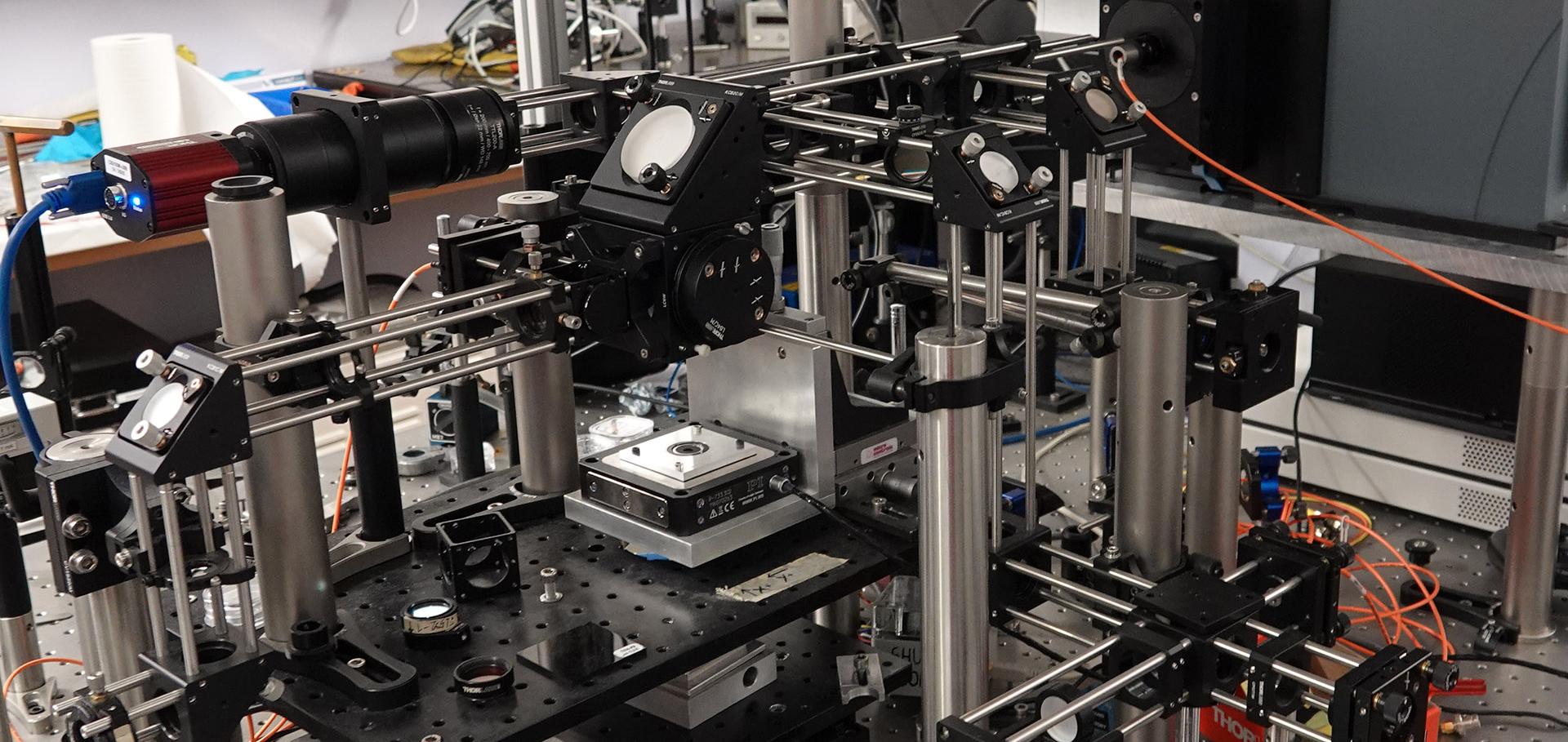
MicroPL optical setup

Professor Robert Taylor

Emeritus Professor of Condensed Matter Physics

Research theme

  • Photovoltaics and nanoscience

Sub department

  • Condensed Matter Physics

Research groups

  • Quantum Optoelectronics
Robert.Taylor@physics.ox.ac.uk
Telephone: 01865 (2)72230
Clarendon Laboratory, room 164
orcid.org/0000-0003-2578-9645
  • About
  • Teaching
  • Positions available
  • Publications

Lasing in perovskite nanocrystals

Image of transverse modes from lasing nanocrystals
Nano Research, 14, 108, 2021

Quantum dot emission from site-controlled InGaN/GaN micropyramid arrays

Applied Physics Letters 85:19 (2004) 4281-4283

Authors:

PR Edwards, RW Martin, IM Watson, C Liu, RA Taylor, JH Rice, JH Na, JW Robinson, JD Smith

Abstract:

InxGa1-xN quantum dots have been fabricated by the selective growth of GaN micropyramid arrays topped with InGaN/GaN quantum wells. The spatially, spectrally, and time-resolved emission properties of these structures were measured using cathodoluminescence hyperspectral imaging and low-temperature microphotoluminescence spectroscopy. The presence of InGaN quantum dots was confirmed directly by the observation of sharp peaks in the emission spectrum at the pyramid apices. These luminescence peaks exhibit decay lifetimes of approximately 0.5 ns, with linewidths down to 650 μeV (limited by the spectrometer resolution). © 2004 American Institute of Physics.
More details from the publisher

Time-resolved gain saturation dynamics in InGaN multi-quantum well structures

Physica Status Solidi C: Conferences 1:10 (2004) 2508-2511

Authors:

K Kyhm, JD Smith, RA Taylor, JF Ryan, Y Arakawa

Abstract:

Transient gain spectra were measured for an In0.02Ga 0.98N / In0.16Ga0.84N multiple quantum well using the variable stripe length method (VSLM) in combination with the ultrafast optical Kerr gate (OKG) technique. Gain dynamics were measured for a range of excitation lengths from short (50 μm) to long (350 μm) stripes with the sample under femtosecond photoexcitation. Analysis of the temporal behaviour of gain and chemical potential suggests that stimulated emission originates from a photoexcited electron-hole plasma at early times; at later times localized states dominate as the electron-hole plasma becomes exhausted. Gain reduction at early times is attributable to coupling of the electron-hole plasma with photons along the stripe, whilst localized states are less susceptible to gain saturation. © 2004 WILEY-VCH Verlag GmbH & Co. KGaA, Weinheim.
More details from the publisher

Photoluminescence studies of exciton recombination and dephasing in single InGaN quantum dots

IEEE Transactions on Nanotechnology 3:3 (2004) 343-347

Authors:

JH Rice, JW Robinson, JD Smith, A Jarjour, RA Taylor, RA Oliver, GAD Briggs, MJ Kappers, S Yasin, CJ Humphreys

Abstract:

This paper reports on time-integrated and time-resolved microphotoluminescence (μ-PL) measurements of single InGaN quantum dots (QDs). The linewidths of the μ-PL peaks originating from single metal-organic vapor phase expitaxy-grown III/V InGaN QDs are measured, implying dephasing times of at least 5 ps. Temporal fluctuations of the QD emission energy are observed, and these are explained in terms of randomly generated local electric fields inducing a Stark shift in the optical emission of the InGaN QDs. Time-resolved measurements demonstrate that decay dynamics from single InGaN QDs are exponential in nature. Measurements of the effect of temperature upon the recombination times in individual InGaN QDs have been performed from 4 to 60 K.
More details from the publisher

Sub-wavelength Al mask apertures for addressing individual InGaN quantum dots

Microelectronic Engineering Elsevier BV 73-74 (2004) 762-766
More details from the publisher

Sub-wavelength Al mask apertures for addressing individual InGaN quantum dots

MICROELECTRON ENG 73-74 (2004) 762-766

Authors:

S Yasin, MN Khalid, JH Rice, RA Taylor

Abstract:

We describe a lithographic process for the fabrication of small size optical apertures, together with large alignment marks to locate the aperture position during measurements in an optical cryostat. The aperture size is chosen to isolate a small number of dots from a dense self-assembled array of InGaN dots. The pattern was exposed in a chemically-amplified resist, UVIII and transferred to the underlying aluminium layer using reactive ion etching. Micro-photoluminescence measurements show sharp spectral lines of width similar to700 mueV at 4.2 K (limited by the spectral resolution of the monochromator), confirming the isolation of a single quantum dot. (C) 2004 Elsevier B.V. All rights reserved.
More details from the publisher

Pagination

  • First page First
  • Previous page Prev
  • …
  • Page 67
  • Page 68
  • Page 69
  • Page 70
  • Current page 71
  • Page 72
  • Page 73
  • Page 74
  • Page 75
  • …
  • Next page Next
  • Last page Last

Footer Menu

  • Contact us
  • Giving to the Dept of Physics
  • Work with us
  • Media

User account menu

  • Log in

Follow us

FIND US

Clarendon Laboratory,

Parks Road,

Oxford,

OX1 3PU

CONTACT US

Tel: +44(0)1865272200

University of Oxfrod logo Department Of Physics text logo
IOP Juno Champion logo Athena Swan Silver Award logo

© University of Oxford - Department of Physics

Cookies | Privacy policy | Accessibility statement

Built by: Versantus

  • Home
  • Research
  • Study
  • Engage
  • Our people
  • News & Comment
  • Events
  • Our facilities & services
  • About us
  • Giving to Physics
  • Current students
  • Staff intranet