Home
Department Of Physics text logo
  • Research
    • Our research
    • Our research groups
    • Our research in action
    • Research funding support
    • Summer internships for undergraduates
  • Study
    • Undergraduates
    • Postgraduates
  • Engage
    • For alumni
    • For business
    • For schools
    • For the public
Menu
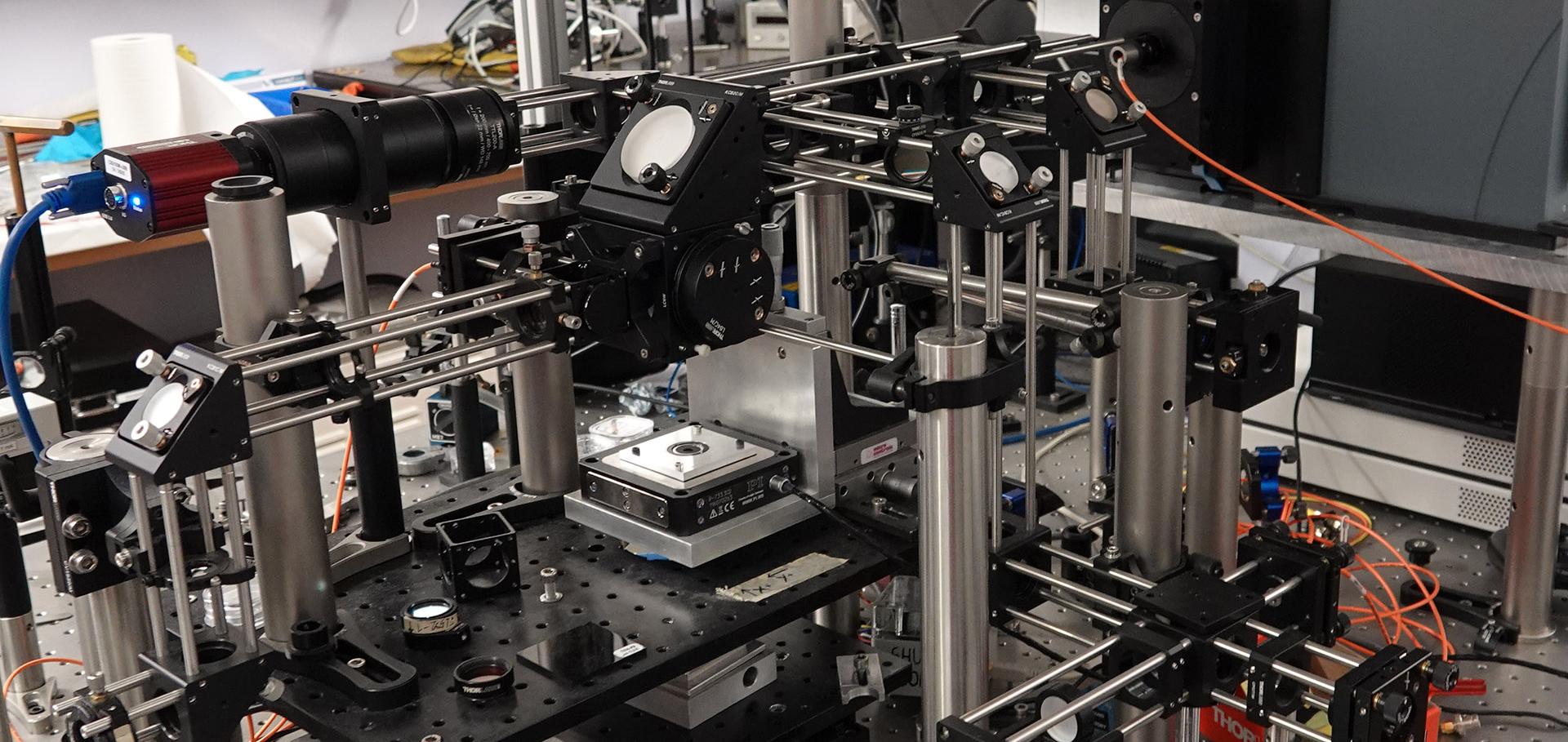
MicroPL optical setup

Professor Robert Taylor

Emeritus Professor of Condensed Matter Physics

Research theme

  • Photovoltaics and nanoscience

Sub department

  • Condensed Matter Physics

Research groups

  • Quantum Optoelectronics
Robert.Taylor@physics.ox.ac.uk
Telephone: 01865 (2)72230
Clarendon Laboratory, room 164
orcid.org/0000-0003-2578-9645
  • About
  • Teaching
  • Positions available
  • Publications

Lasing in perovskite nanocrystals

Image of transverse modes from lasing nanocrystals
Nano Research, 14, 108, 2021

Stimulated emission and excitonic bleaching in GaN epilayers under high-density excitation

PHYS STATUS SOLIDI B 216:1 (1999) 465-470

Authors:

RA Taylor, S Hess, K Kyhm, J Smith, JF Ryan, GP Yablonskii, EV Lutsenko, VN Pavlovskii, M Heuken

Abstract:

Measurements of edge emission on a GaN epilayer under N-2 laser excitation demonstrate stimulated emission and gain. The mechanisms involved are investigated by using laser pulses of 250 fs duration to measure simultaneously the photoluminescence and the time-resolved reflectance near the band edge, over a range of excitation densities. The excitons are bleached at high densities due to free carriers. A broad luminescence band is seen, extending similar to 100 meV below the low-density emission peak. We show that the onset of the stimulated emission coincides with the bleaching of the excitons (the Mott transition).
More details from the publisher

Hot carrier relaxation by extreme electron-LO phonon scattering in GaN

Physica Status Solidi (B) Basic Research 216:1 (1999) 51-55

Authors:

S Hess, RA Taylor, ED O'Sullivan, JF Ryan, NJ Cain, V Roberts, JS Roberts

Abstract:

Hot carrier relaxation has been investigated in GaN using non-resonant femtosecond excitation where electrons are excited above and below the LO phonon energy. We observe remarkably rapid electron relaxation; the electron distribution is non-thermal, with a "cut-off" occurring near ELO. In a preliminary Monte Carlo study we have simulations which reproduce the major experimental observations, confirming the development of a non-thermal electron distribution near ELO due to the strong electron-LO phonon interaction. Hot phonon effects are pronounced at high carrier densities.
More details from the publisher

Dynamics of resonantly excited excitons in GaN

Physical Review B American Physical Society (APS) 58:24 (1998) R15973-R15976

Authors:

S Hess, F Walraet, RA Taylor, JF Ryan, B Beaumont, P Gibart
More details from the publisher

Optical gain in GaN epilayers

Applied Physics Letters 73:2 (1998) 199-201

Authors:

S Hess, RA Taylor, JF Ryan, B Beaumont, P Gibart

Abstract:

We present optical gain and loss spectra measured over a range of carrier densities at low temperature in hexagonal GaN epilayers. We have determined the optical loss directly to be ∼80 cm-1. Photoluminescence spectra show that stimulated emission in our samples arises from electron-hole plasma recombination. © 1998 American Institute of Physics.
More details from the publisher

Photoluminescence studies of Mg-doped and Si-doped gallium nitride epilayers

PHYS STATUS SOLIDI B 210:2 (1998) 465-470

Authors:

S Hess, RA Taylor, JF Ryan, NJ Cain, V Roberts, J Roberts

Abstract:

We present time-, temperature- and intensity-dependent photoluminescence measurements of undoped, n-type and p-type GaN epilayers. In the nominally undoped samples we observe at low temperatures the trapping of free excitons by neutral donors and subsequent radiative recombination. In the n-type Si-doped samples bound-exciton luminescence is dominant over a wide range of temperatures. The luminescence from p-type Mg-doped samples is dominated by shallow-donor-shallow-acceptor pair recombination and by a deep blue centres at 3.0 eV. These two emission bands show identical temperature and linear intensity dependence.
More details from the publisher

Pagination

  • First page First
  • Previous page Prev
  • …
  • Page 76
  • Page 77
  • Page 78
  • Page 79
  • Current page 80
  • Page 81
  • Page 82
  • Page 83
  • Page 84
  • …
  • Next page Next
  • Last page Last

Footer Menu

  • Contact us
  • Giving to the Dept of Physics
  • Work with us
  • Media

User account menu

  • Log in

Follow us

FIND US

Clarendon Laboratory,

Parks Road,

Oxford,

OX1 3PU

CONTACT US

Tel: +44(0)1865272200

University of Oxfrod logo Department Of Physics text logo
IOP Juno Champion logo Athena Swan Silver Award logo

© University of Oxford - Department of Physics

Cookies | Privacy policy | Accessibility statement

Built by: Versantus

  • Home
  • Research
  • Study
  • Engage
  • Our people
  • News & Comment
  • Events
  • Our facilities & services
  • About us
  • Giving to Physics
  • Current students
  • Staff intranet