Home
Department Of Physics text logo
  • Research
    • Our research
    • Our research groups
    • Our research in action
    • Research funding support
    • Summer internships for undergraduates
  • Study
    • Undergraduates
    • Postgraduates
  • Engage
    • For alumni
    • For business
    • For schools
    • For the public
  • Support
Menu
Atomic and Laser Physics
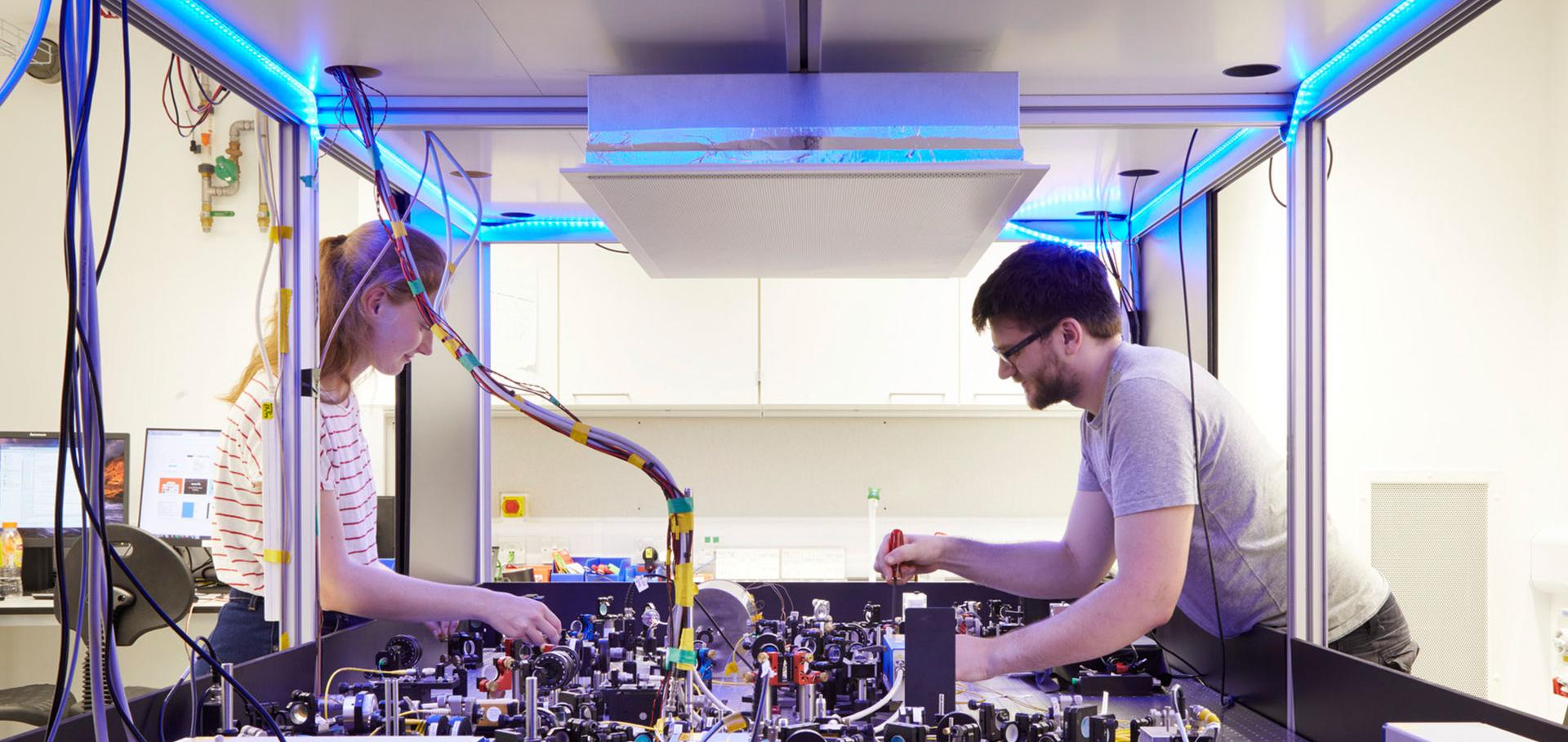
Credit: Jack Hobhouse

Prof Vlatko Vedral FInstP

Professor of Quantum Information Science

Sub department

  • Atomic and Laser Physics

Research groups

  • Frontiers of quantum physics
vlatko.vedral@physics.ox.ac.uk
Telephone: 01865 (2)72389
Clarendon Laboratory, room 241.8
  • About
  • Publications

The Elusive Source of Quantum Speedup

Foundations of Physics 40:8 (2010) 1141-1154

Abstract:

We discuss two qualities of quantum systems: various correlations existing between their subsystems and the distinguishability of different quantum states. This is then applied to analysing quantum information processing. While quantum correlations, or entanglement, are clearly of paramount importance for efficient pure state manipulations, mixed states present a much richer arena and reveal a more subtle interplay between correlations and distinguishability. The current work explores a number of issues related with identifying the important ingredients needed for quantum information processing. We discuss the Deutsch-Jozsa algorithm, the Shor algorithm, the Grover algorithm and the power of a single qubit class of algorithms. In the latter, a quantity called discord is seen to be more important than entanglement. One section is dedicated to cluster states where entanglement is crucial, but its precise role is highly counter-intuitive. Here we see that the notion of distinguishability becomes a more useful concept. © 2010 Springer Science+Business Media, LLC.
More details from the publisher
More details

Comment on "Quantum Correlation without Classical Correlations" Reply

PHYSICAL REVIEW LETTERS 104:6 (2010) ARTN 068902

Authors:

Dagomir Kaszlikowski, Aditi Sen(De), Ujjwal Sen, Vlatko Vedral, Andreas Winter
More details from the publisher

Quantum physics meets biology

HFSP Journal 3:6 (2009) 386-400

Authors:

M Arndt, T Juffmann, V Vedral

Abstract:

Quantum physics and biology have long been regarded as unrelated disciplines, describing nature at the inanimate microlevel on the one hand and living species on the other hand. Over the past decades the life sciences have succeeded in providing ever more and refined explanations of macroscopic phenomena that were based on an improved understanding of molecular structures and mechanisms. Simultaneously, quantum physics, originally rooted in a world-view of quantum coherences, entanglement, and other nonclassical effects, has been heading toward systems of increasing complexity. The present perspective article shall serve as a "pedestrian guide" to the growing interconnections between the two fields. We recapitulate the generic and sometimes unintuitive characteristics of quantum physics and point to a number of applications in the life sciences. We discuss our criteria for a future "quantum biology," its current status, recent experimental progress, and also the restrictions that nature imposes on bold extrapolations of quantum theory to macroscopic phenomena. © HFSP Publishing.
More details from the publisher

Quantum physics meets biology.

HFSP J 3:6 (2009) 386-400

Authors:

Markus Arndt, Thomas Juffmann, Vlatko Vedral

Abstract:

Quantum physics and biology have long been regarded as unrelated disciplines, describing nature at the inanimate microlevel on the one hand and living species on the other hand. Over the past decades the life sciences have succeeded in providing ever more and refined explanations of macroscopic phenomena that were based on an improved understanding of molecular structures and mechanisms. Simultaneously, quantum physics, originally rooted in a world-view of quantum coherences, entanglement, and other nonclassical effects, has been heading toward systems of increasing complexity. The present perspective article shall serve as a "pedestrian guide" to the growing interconnections between the two fields. We recapitulate the generic and sometimes unintuitive characteristics of quantum physics and point to a number of applications in the life sciences. We discuss our criteria for a future "quantum biology," its current status, recent experimental progress, and also the restrictions that nature imposes on bold extrapolations of quantum theory to macroscopic phenomena.
More details from the publisher
More details

Unified View of Quantum and Classical Correlations

(2009)

Authors:

Kavan Modi, Tomasz Paterek, Wonmin Son, Vlatko Vedral, Mark Williamson
More details from the publisher

Pagination

  • First page First
  • Previous page Prev
  • …
  • Page 96
  • Page 97
  • Page 98
  • Page 99
  • Current page 100
  • Page 101
  • Page 102
  • Page 103
  • Page 104
  • …
  • Next page Next
  • Last page Last

Footer Menu

  • Contact us
  • Giving to the Dept of Physics
  • Work with us
  • Media

User account menu

  • Log in

Follow us

FIND US

Clarendon Laboratory,

Parks Road,

Oxford,

OX1 3PU

CONTACT US

Tel: +44(0)1865272200

University of Oxfrod logo Department Of Physics text logo
IOP Juno Champion logo Athena Swan Silver Award logo

© University of Oxford - Department of Physics

Cookies | Privacy policy | Accessibility statement

Built by: Versantus

  • Home
  • Research
  • Study
  • Engage
  • Our people
  • News & Comment
  • Events
  • Our facilities & services
  • About us
  • Giving to Physics
  • Current students
  • Staff intranet