

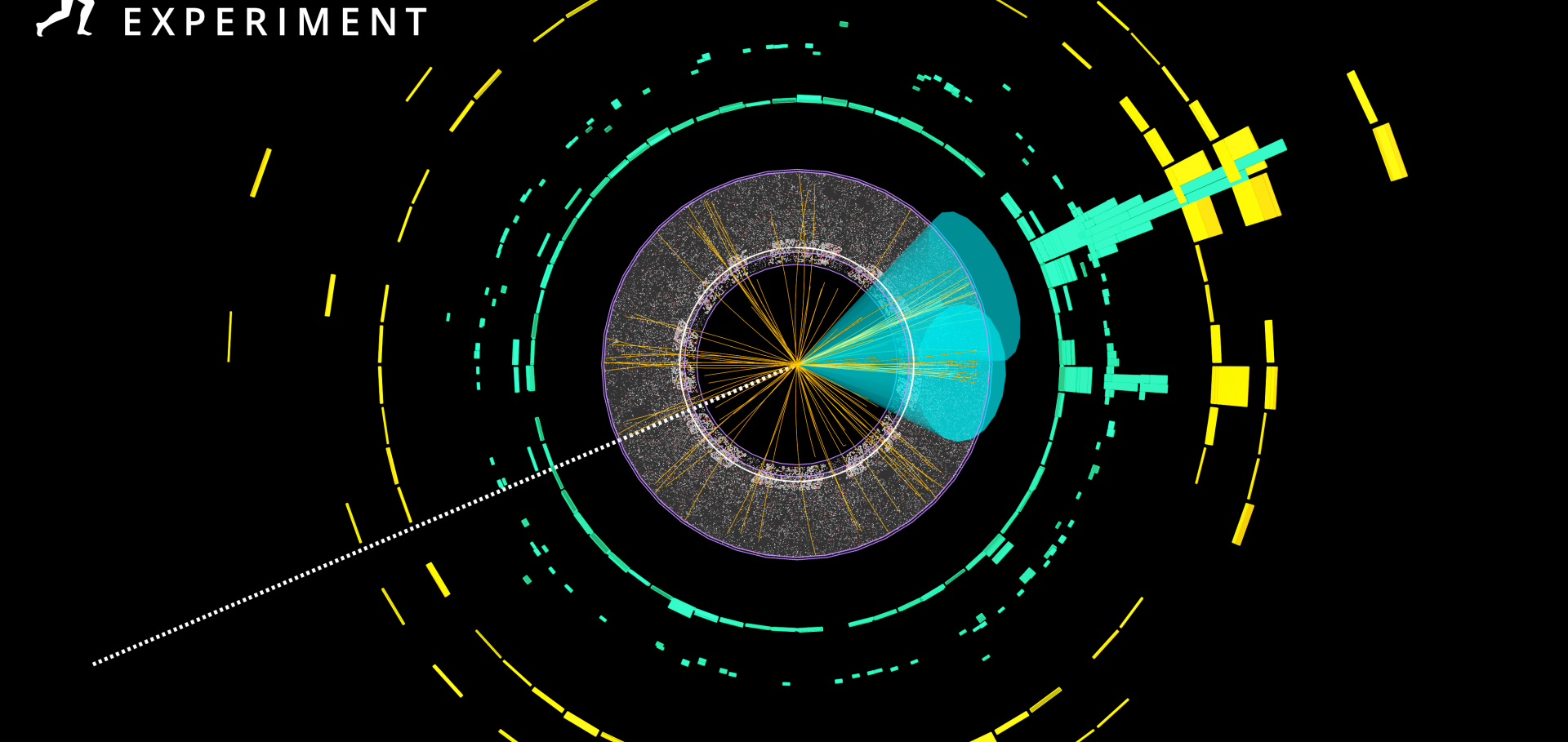
Measurements of WH and ZH production with Higgs boson decays into bottom quarks and direct constraints on the charm Yukawa coupling in 13 TeV pp collisions with the ATLAS detector
Journal of High Energy Physics Springer 2025:4 (2025) 75
Abstract:
A study of the Higgs boson decaying into bottom quarks (H → bb¯) and charm quarks (H → cc¯) is performed, in the associated production channel of the Higgs boson with a W or Z boson, using 140 fb−1 of proton-proton collision data at s = 13 TeV collected by the ATLAS detector. The individual production of WH and ZH with H → bb¯ is established with observed (expected) significances of 5.3 (5.5) and 4.9 (5.6) standard deviations, respectively. Differential cross-section measurements of the gauge boson transverse momentum within the simplified template cross-section framework are performed in a total of 13 kinematical fiducial regions. The search for the H → cc¯ decay yields an observed (expected) upper limit at 95% confidence level of 11.5 (10.6) times the Standard Model prediction. The results are also used to set constraints on the charm coupling modifier, resulting in |κc| < 4.2 at 95% confidence level. Combining the H → bb¯ and H → cc¯ measurements constrains the absolute value of the ratio of Higgs-charm and Higgs-bottom coupling modifiers (|κc/κb|) to be less than 3.6 at 95% confidence level.Measurement of high-mass $t\bar{t}\ell^{+}\ell^{-}$ production and lepton flavour universality-inspired effective field theory interpretations at $\sqrt{s}=13$ TeV with the ATLAS detector
ArXiv 2504.05919 (2025)
Measurement of substructure-dependent suppression of large-radius jets with charged particles in Pb+Pb collisions with ATLAS
ArXiv 2504.04805 (2025)
Characterization of nuclear breakup as a function of hard-scattering kinematics using dijets measured by ATLAS in $p$+Pb collisions
ArXiv 2504.02638 (2025)
Measuring the ATLAS ITk pixel detector material via multiple scattering of positrons at the CERN PS
The European Physical Journal C SpringerOpen 85:4 (2025) 381