

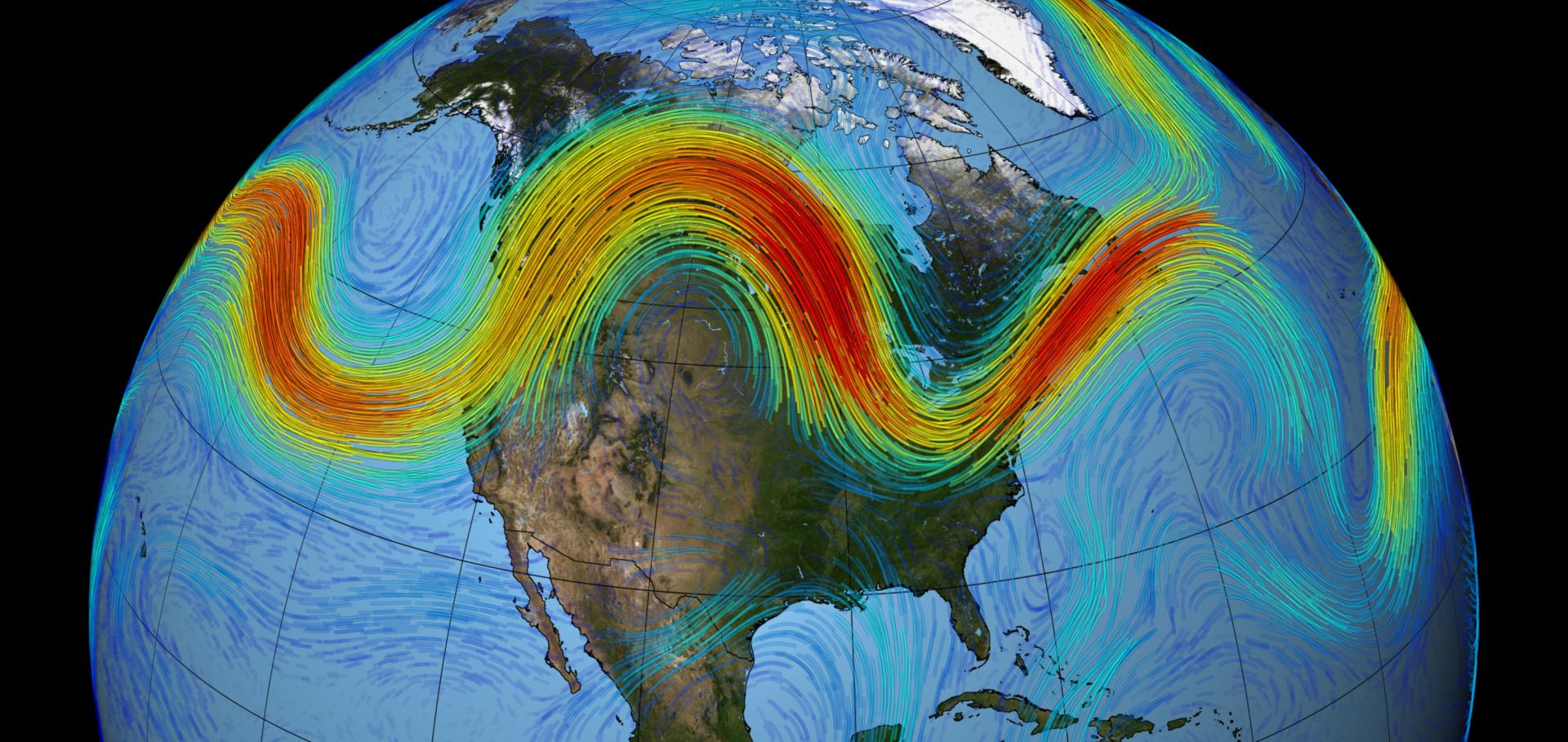
Evidence for the chaotic origin of Northern Annular Mode variability
Geophysical Research Letters 38:15 (2011)
Abstract:
Exponential spectra are found to characterize variability of the Northern Annular Mode (NAM) for periods less than 36 days. This corresponds to the observed rounding of the autocorrelation function at lags of a few days. The characteristic persistence timescales during winter and summer is found to be ∼5 days for these high frequencies. Beyond periods of 36 days the characteristic decorrelation timescale is ∼20 days during winter and ∼6 days in summer. We conclude that the NAM cannot be described by autoregressive models for high frequencies; the spectra are more consistent with low-order chaos. We also propose that the NAM exhibits regime behaviour, however the nature of this has yet to be identified. Copyright 2011 by the American Geophysical Union.High- and low-frequency 11-year solar cycle signatures in the Southern Hemispheric winter and spring
Quarterly Journal of the Royal Meteorological Society 137:659 (2011) 1641-1656
Abstract:
We have studied the characterization of the 11-year solar cycle (SC) signals in the Southern Hemisphere (SH) during the winter and spring using European Centre for Medium-Range Weather Forecasts (ECMWF) daily and monthly data from 1979 to 2009. By separating the response into high (<6 months) and low (>36 months) frequency domains, we have found that spatially different 11-year SC signals exist for high- and low-frequency domains. In the stratosphere, the high- and low-frequency responses tend to enhance each other near the Equator and Subtropics, while they oppose one another at high latitudes. The high-frequency response is marked by a strengthened stratospheric jet during winter and the response is not static but tracks with the centre of the polar vortex. In the lower stratosphere, the positive response of temperature to the 11-year SC is dominated by its low-frequency component, which extends from the North Pole to the South Pole. The low-frequency tropospheric response is latitudinally symmetrical about the Equator and consistent with the modelled responses to temperature perturbation in the lower stratosphere. The signals are found to be sensitive to contamination from the 2002 sudden stratospheric warming event and major volcanic eruptions but the general spatial pattern of the responses remains similar. A significant projection of the 11-year SC onto the Southern Annular Mode (SAM) can only be detected in the stratosphere and in the high-frequency component. The signature is marked by a strengthening of the stratospheric SAM during winter and a weakening of the SAM in the uppermost stratosphere during spring. © 2011 Royal Meteorological Society.Some fine points on radiative forcing
Physics Today AIP Publishing 64:7 (2011) 12-12
Evaluation of cloud convection and tracer transport in a three-dimensional chemical transport model
Atmospheric Chemistry and Physics Copernicus Publications 11:12 (2011) 5783-5803
HYDROGEN GREENHOUSE PLANETS BEYOND THE HABITABLE ZONE
The Astrophysical Journal Letters American Astronomical Society 734:1 (2011) l13