

Characterizing the variability and extremes of the stratospheric polar vortices using 2D moment analysis
Journal of the Atmospheric Sciences 68:6 (2011) 1194-1213
Abstract:
The mean state, variability, and extreme variability of the stratospheric polar vortices, with an emphasis on the Northern Hemisphere (NH) vortex, are examined using two-dimensional moment analysis and extreme value theory (EVT). The use of moments as an analysis tool gives rise to information about the vortex area, centroid latitude, aspect ratio, and kurtosis. The application of EVT to these moment-derived quantities allows the extreme variability of the vortex to be assessed. The data used for this study are 40-yr ECMWFRe-Analysis (ERA-40) potential vorticity fields on interpolated isentropic surfaces that range from 450 to 1450 K. Analyses show that the most extreme vortex variability occurs most commonly in late January and early February, consistent with when most planetary wave driving from the troposphere is observed. Composites around sudden stratospheric warming (SSW) events reveal that the moment diagnostics evolve in statistically different ways between vortex splitting events and vortex displacement events, in contrast to the traditional diagnostics. Histograms of the vortex diagnostics on the 850-K (~10 hPa) surface over the 1958-2001 period are fitted with parametric distributions and show that SSW events constitute the majority of data in the tails of the distributions. The distribution of each diagnostic is computed on various surfaces throughout the depth of the stratosphere; it shows that in general the vortex becomes more circular with higher filamentation at the upper levels. The Northern and Southern Hemisphere (SH) vortices are also compared through the analysis of their respective vortex diagnostics, confirming that the SH vortex is less variable and lacks extreme events compared to the NH vortex. Finally, extreme value theory is used to statistically model the vortex diagnostics and make inferences about the underlying dynamics of the polar vortices. © 2011 American Meteorological Society.Climate of the Neoproterozoic
Annual Review of Earth and Planetary Sciences Annual Reviews 39:1 (2011) 417-460
Bistability of the Atlantic overturning circulation in a global climate model and links to ocean freshwater transport
Geophysical Research Letters 38:10 (2011)
Abstract:
The possibility of a rapid collapse in the strength of the Atlantic meridional overturning circulation (AMOC), with associated impacts on climate, has long been recognized. The suggested basis for this risk is the existence of two stable regimes of the AMOC (on and off), and such bistable behaviour has been identified in a range of simplified climate models. However, up to now, no state-of-the-art atmosphere-ocean coupled global climate model (AOGCM) has exhibited such behaviour, leading to the interpretation that the AMOC is more stable than simpler models indicate. Here we demonstrate AMOC bistability in the response to freshwater perturbations in the FAMOUS AOGCM - the most complex AOGCM to exhibit such behaviour to date. The results also support recent suggestions that the direction of the net freshwater transport at the southern boundary of the Atlantic by the AMOC may be a useful physical indicator of the existence of bistability. We also present new estimates for this net freshwater transport by the AMOC from a range of ocean reanalyses which suggest that the Atlantic AMOC is currently in a bistable regime, although with large uncertainties. More accurate observational constraints, and an improved physical understanding of this quantity, could help narrow uncertainty in the future evolution of the AMOC and to assess the risk of a rapid AMOC collapse. Copyright 2011 by the American Geophysical Union.Dynamical evolution of North Atlantic ridges and Poleward Jet stream displacements
Journal of the Atmospheric Sciences 68:5 (2011) 954-963
Abstract:
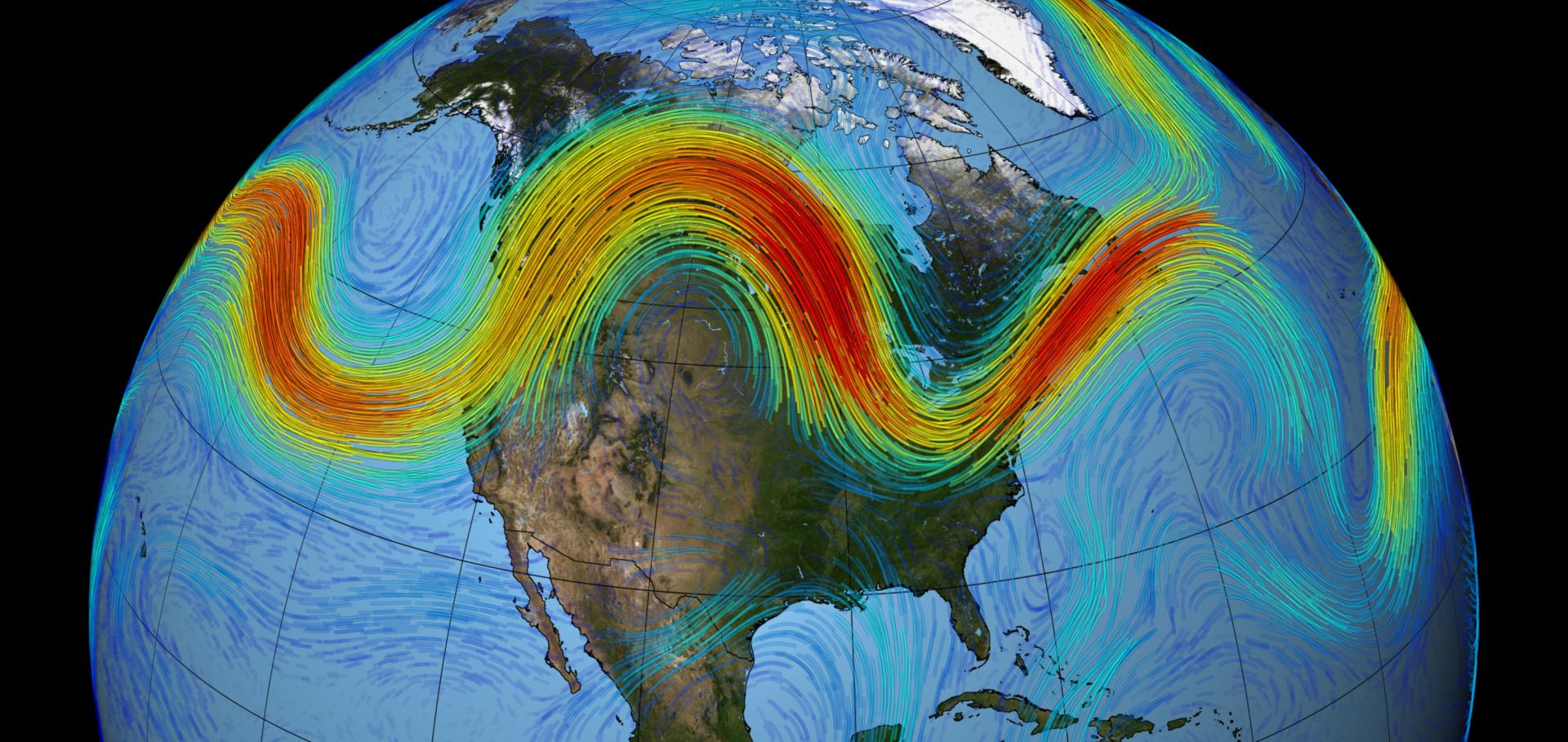
The development of a particular wintertime atmospheric circulation regime over the North Atlantic, comprising a northward shift of the North Atlantic eddy-driven jet stream and an associated strong and persistent ridge in the subtropics, is investigated. Several different methods of analysis are combined to describe the temporal evolution of the events and relate it to shifts in the phase of the North Atlantic Oscillation and East Atlantic pattern. First, the authors identify a close relationship between northward shifts of the eddy-driven jet, the establishment and maintenance of strong and persistent ridges in the subtropics, and the occurrence of upper-tropospheric anticyclonic Rossby wave breaking over Iberia. Clear tropospheric precursors are evident prior to the developmentof the regime, suggesting a preconditioning of the Atlantic jet stream and an upstream influence via a large-scale Rossby wave train from the North Pacific. Transient (2-6 days) eddy forcing plays a dual role, contributing to both the initiation and then the maintenance of the circulation anomalies. During the regime there is enhanced occurrence of anticyclonic Rossby wave breaking, which may be described as low-latitude blocking-like events over the southeastern North Atlantic. A strong ridge is already established at the time of wave-breaking onset, suggesting that the role of wave-breaking events is to amplify the circulation anomalies rather than to initiate them. Wave breaking also seems to enhance the persistence, since it is unlikely that a persistent ridge event occurs without being also accompanied by wave breaking. © 2011 American Meteorological Society.Stratosphere-resolving Models in CMIP5
Clivar Exchanges International CLIVAR Project Office 16 (2011) 2