

Band gaps of the lead-free halide double perovskites Cs2BiAgCl6 and Cs2BiAgBr6 from theory and experiment
Journal of Physical Chemistry Letters American Chemical Society 7:13 (2016) 2579-2585
Abstract:
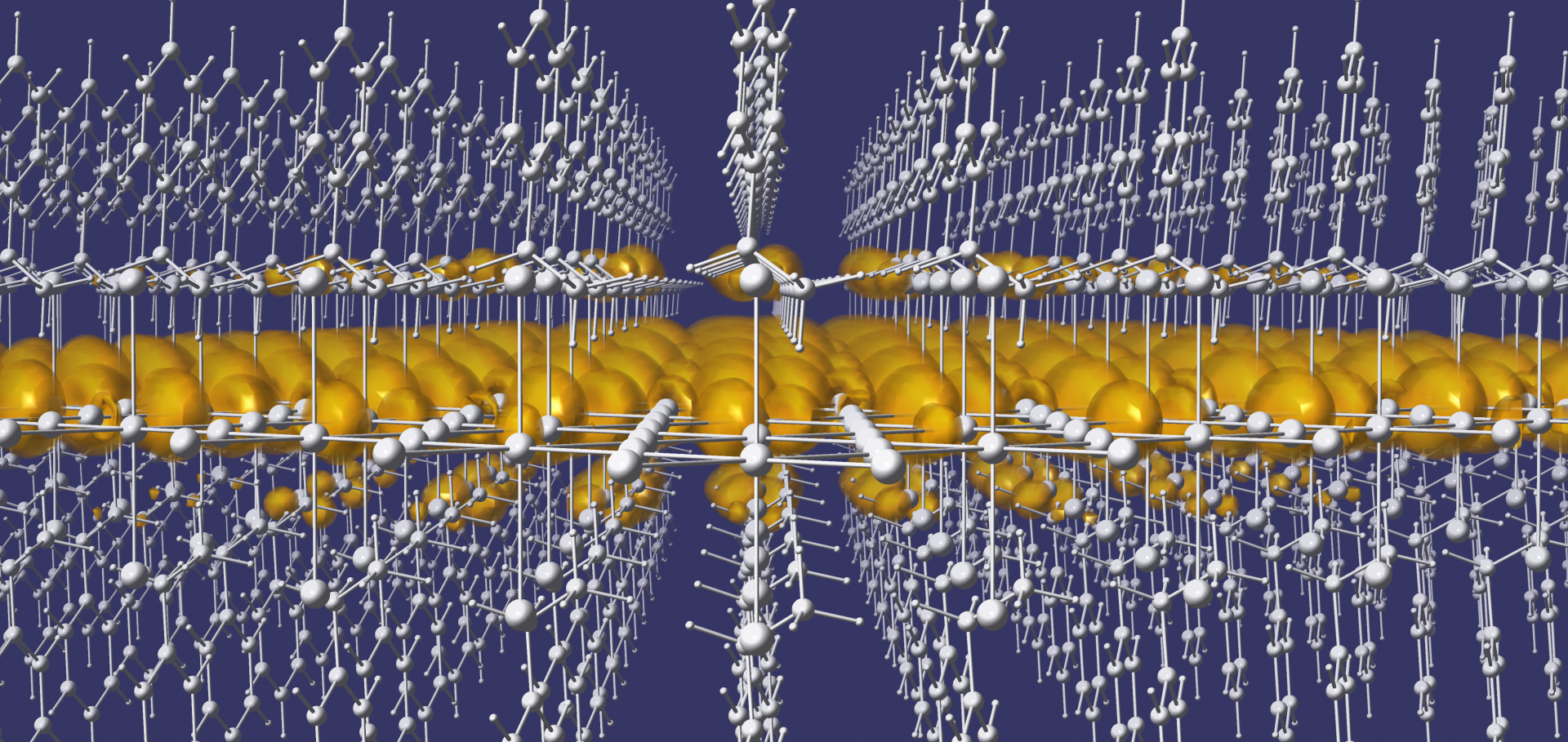
The recent discovery of lead-free halide double perovskites with band gaps in the visible represents an important step forward in the design of environmentally friendly perovskite solar cells. Within this new family of semiconductors, Cs2BiAgCl6 and Cs2BiAgBr6 are stable compounds crystallizing in the elpasolite structure. Following the recent computational discovery and experimental synthesis of these compounds, a detailed investigation of their electronic properties is warranted in order to establish their potential as optoelectronic materials. In this work, we perform many-body perturbation theory calculations and obtain high accuracy band gaps for both compounds. In addition, we report on the synthesis of Cs2BiAgBr6 single crystals, which are stable in ambient conditions. From our complementary theoretical and experimental analysis, we are able to assign the indirect character of the band gaps and obtain both experimental and theoretical band gaps of these novel semiconductors that are in close agreement.Reproducibility in density functional theory calculations of solids
Science American Association for the Advancement of Science (AAAS) 351:6280 (2016) aad3000
Abstract:
Lead-free halide double perovskites via heterovalent substitution of noble metals
Journal of Physical Chemistry Letters American Chemical Society 7:7 (2016) 1254-1259
Abstract:
Lead-based halide perovskites are emerging as the most promising class of materials for next-generation optoelectronics; however, despite the enormous success of lead-halide perovskite solar cells, the issues of stability and toxicity are yet to be resolved. Here we report on the computational design and the experimental synthesis of a new family of Pb-free inorganic halide double perovskites based on bismuth or antimony and noble metals. Using first-principles calculations we show that this hitherto unknown family of perovskites exhibits very promising optoelectronic properties, such as tunable band gaps in the visible range and low carrier effective masses. Furthermore, we successfully synthesize the double perovskite Cs2BiAgCl6, perform structural refinement using single-crystal X-ray diffraction, and characterize its optical properties via optical absorption and photoluminescence measurements. This new perovskite belongs to the Fm3̅m space group and consists of BiCl6 and AgCl6 octahedra alternating in a rock-salt face-centered cubic structure. From UV–vis and photoluminescence measurements we obtain an indirect gap of 2.2 eV.Lead-Free Halide Double Perovskites via Heterovalent Substitution of Noble Metals
(2016)
Computational Screening of Homovalent Lead Substitution in Organic–Inorganic Halide Perovskites
The Journal of Physical Chemistry C American Chemical Society (ACS) 120:1 (2016) 166-173