

Excited-state properties of organic inorganic halide perovskites from first-principles
Abstract:
In this thesis, we employ state-of-the-art first-principles calculations to understand optoelectronic properties and excited states in perovskite-based materials. We primarily focus on three groups of perovskites - mixed iodide/bromide perovskites, layered perovskites, and perovskite-intergrowth heterostructures.For mixed halide CsPb perovskites (Br𝑥 I1−𝑥)3, we applied the virtual crystal approximation (VCA) within density functional theory (DFT), the 𝐺𝑊 approximation, and the Bethe-Salpeter equation (BSE) to calculate structural, vibrational, and optoelectronic properties for a series of mixed halide perovskites. We show that the VCA incorporated with 𝐺𝑊+BSE framework can accurately reproduce experimental trends across the full halide mixing range. The study demonstrates that mixed iodide/bromide perovskites can be modelled as homovalent alloys, and local structural distortions do not play a significant role for the properties of these uniformly mixed systems.
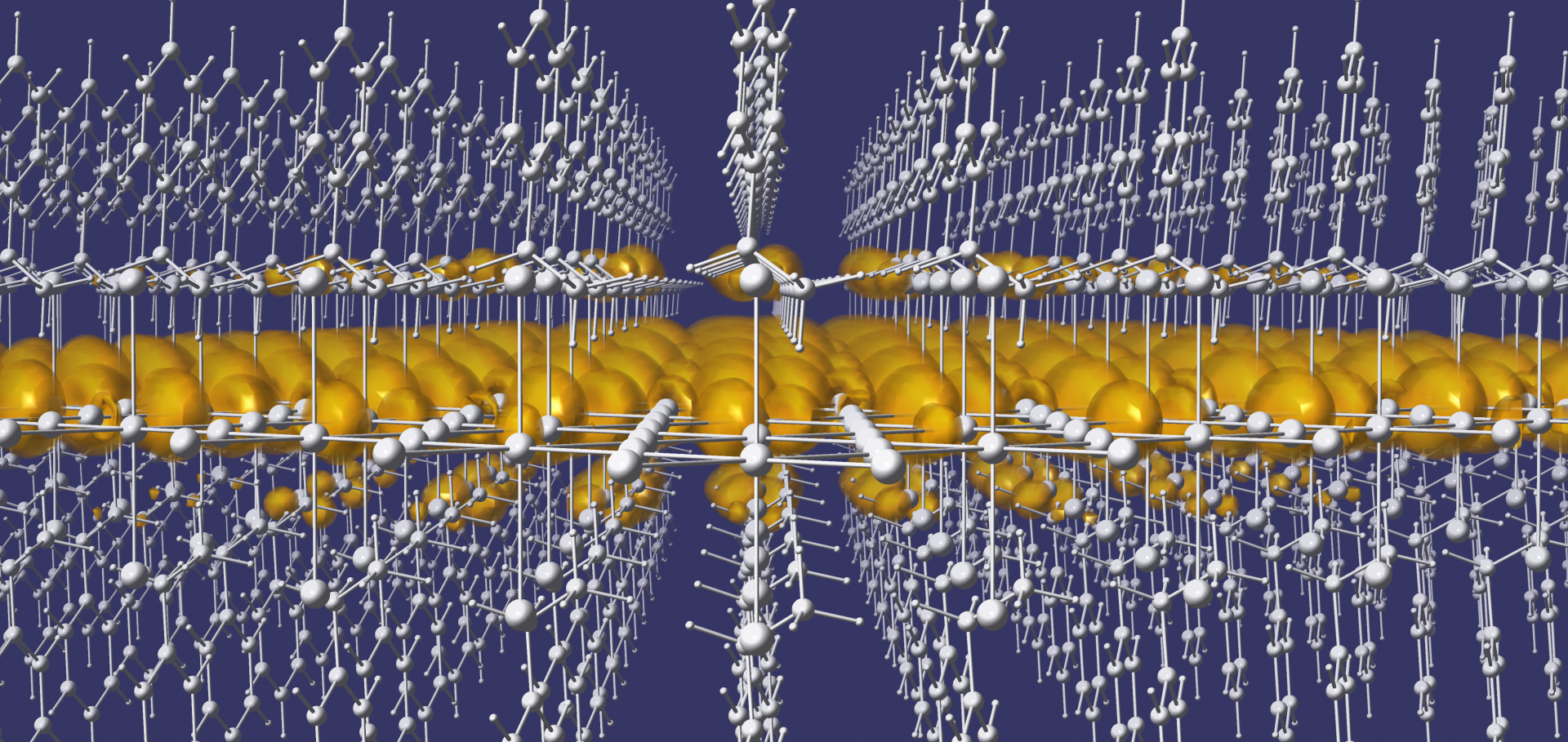
Layered organic-inorganic halide perovskites exhibit remarkable structural and chemical diversity. In these materials, excitons are primarily believed to be strongly confined within the inorganic metal halide layers, and the interlayer coupling generally suppressed by the organic cations. We present a systematic approach to study the energy and spatial distribution of the lowest-energy excitons in layered organic-inorganic halide perovskites from first-principles many-body perturbation theory. We find that the quasiparticle band structures, absorption spectra, and exciton binding energies depend strongly on the distance between and the alignment of adjacent metal halide perovskite layers. Furthermore, we show that exciton delocalisation can be tuned by changing the interlayer distance and alignment, both parameters determined by the chemical composition and size of the organic cations. The calculations presented in Chapter 4 establish the general intuition needed to engineer excitonic properties in novel halide perovskite nanostructures.
Finally, we extend our exciton analysis approach to perovskite-intergrowth heterostructures by systematically constructing hypothetical molecular components (𝑖.𝑒. AMTP, ATP, and HMA) in a series of lead halide perovskites-intergrowth heterostructures. We observe a change from Type I to Type II band alignment in these materials and see a clear correlation between the band alignment and the absence of inter/intralayer excitons. Several dark interlayer excitons can be found in Type II heterostructures below the absorption spectra onset. Such correlation can also be found when comparing the experimentally realised materials (1-Na and 1-Li) as presented in Chapter 5.
By systematically investigating the band structures, the optical absorption spectra, exciton decompositions and localisation, charge-density and potential landscapes in these heterostructures, we uncover the structural and electrostatic origin of the band alignment change. We have shown that even subtle structural modifications, such as the repositioning of charged ions, can alter the electrostatic energy landscape between the layers, which in turn influences the band alignment and consequently, exciton localisation.
These insights highlight the power of structural and molecular engineering in tuning the optoelectronic and excited-state properties of perovskite-based materials. The research presented in the thesis provides a robust theoretical foundation for studying excitons and designing advanced functional materials with tunable properties, and devices across a wide range of applications, including solar cells and light-emitting diodes.