

Resolving star formation on subkiloparsec scales in the high-redshift galaxy SDP.11 using gravitational lensing
Astrophysical Journal American Astronomical Society 867:2 (2018) 140
Abstract:
We investigate the properties of the interstellar medium, star formation, and the current-day stellar population in the strongly lensed star-forming galaxy H-ATLAS J091043.1-000321 (SDP.11), at z = 1.7830, using new Herschel and Atacama Large Millimeter/submillimeter Array (ALMA) observations of far-infrared fine-structure lines of carbon, oxygen, and nitrogen. We report detections of the [O iii] 52 μm, [N iii] 57 μm, and [O i] 63 μm lines from Herschel/PACS, and present high-resolution imaging of the [C ii] 158 μm line, and underlying continuum, using ALMA. We resolve the [C ii] line emission into two spatially offset Einstein rings, tracing the red and blue velocity components of the line, in the ALMA/Band 9 observations at 0farcs2 resolution. The values seen in the [C ii]/far-infrared (FIR) ratio map, as low as ~0.02% at the peak of the dust continuum, are similar to those of local ULIRGs, suggesting an intense starburst in this source. This is consistent with the high intrinsic FIR luminosity (~3 × 10¹² L ⊙), ~16 Myr gas depletion timescale, and lesssim8 Myr timescale since the last starburst episode, estimated from the hardness of the UV radiation field. By applying gravitational lensing models to the visibilities in the uv-plane, we find that the lensing magnification factor varies by a factor of two across SDP.11, affecting the observed line profiles. After correcting for the effects of differential lensing, a symmetric line profile is recovered, suggesting that the starburst present here may not be the result of a major merger, as is the case for local ULIRGs, but instead could be powered by star formation activity spread across a 3–5 kpc rotating disk.Exoplanet phase curves: Observations and theory
Chapter in Handbook of Exoplanets, (2018) 1419-1440
Abstract:
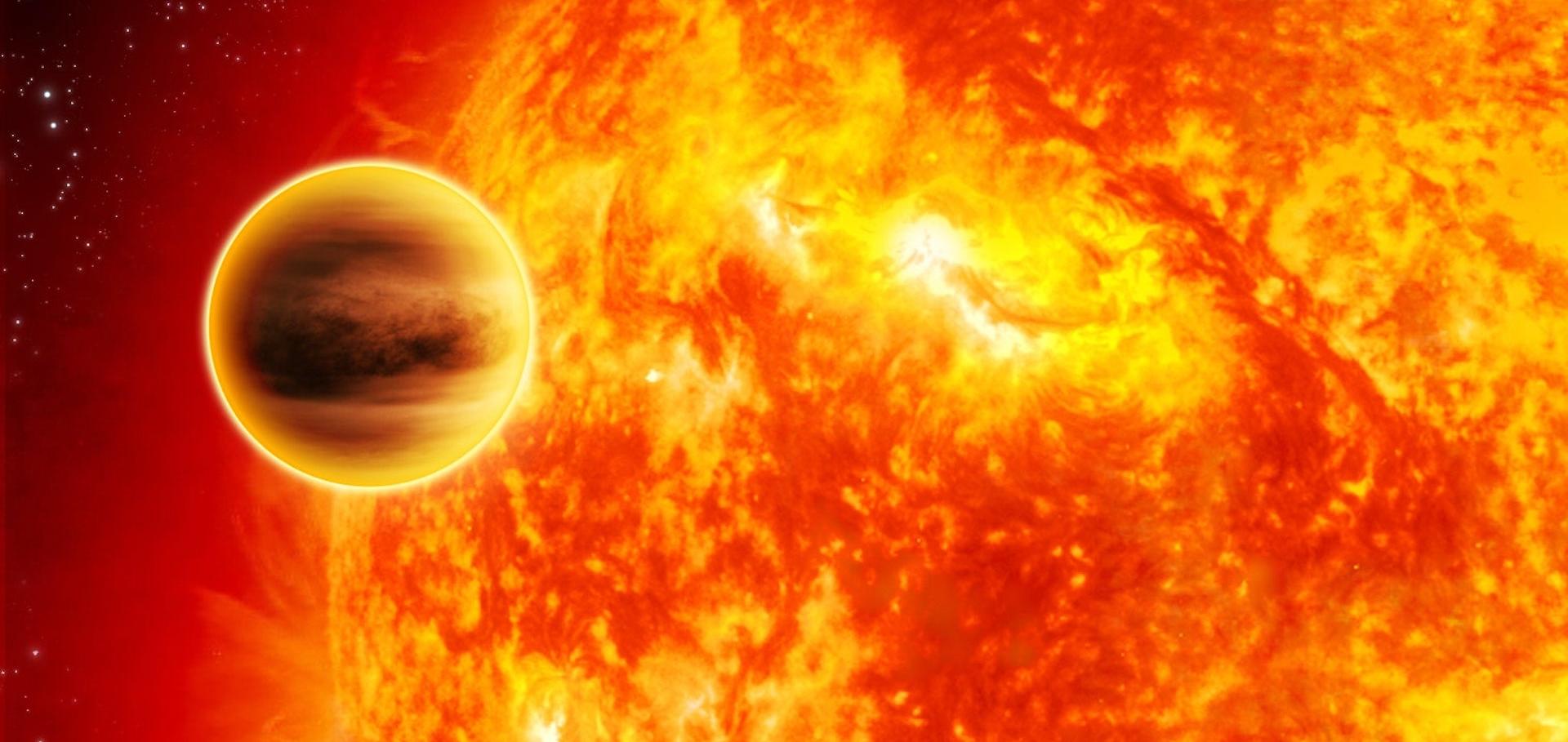
Phase curves are the best technique to probe the three-dimensional structure of exoplanets' atmospheres. In this chapter we first review current exoplanets' phase curve observations and the particular challenges they face. We then describe the different physical mechanisms shaping the atmospheric phase curves of highly irradiated tidally locked exoplanets. Finally, we discuss the potential for future missions to further advance our understanding of these new worlds.Data calibration for the MASCARA and bRing instruments★
Astronomy & Astrophysics EDP Sciences 619 (2018) a154
TESS’s first planet
Astronomy & Astrophysics EDP Sciences 619 (2018) l10
Global or local pure-condensible atmospheres: Importance of horizontal latent heat transport
Astrophysical Journal Institute of Physics Publishing, Inc 867:54 (2018)