

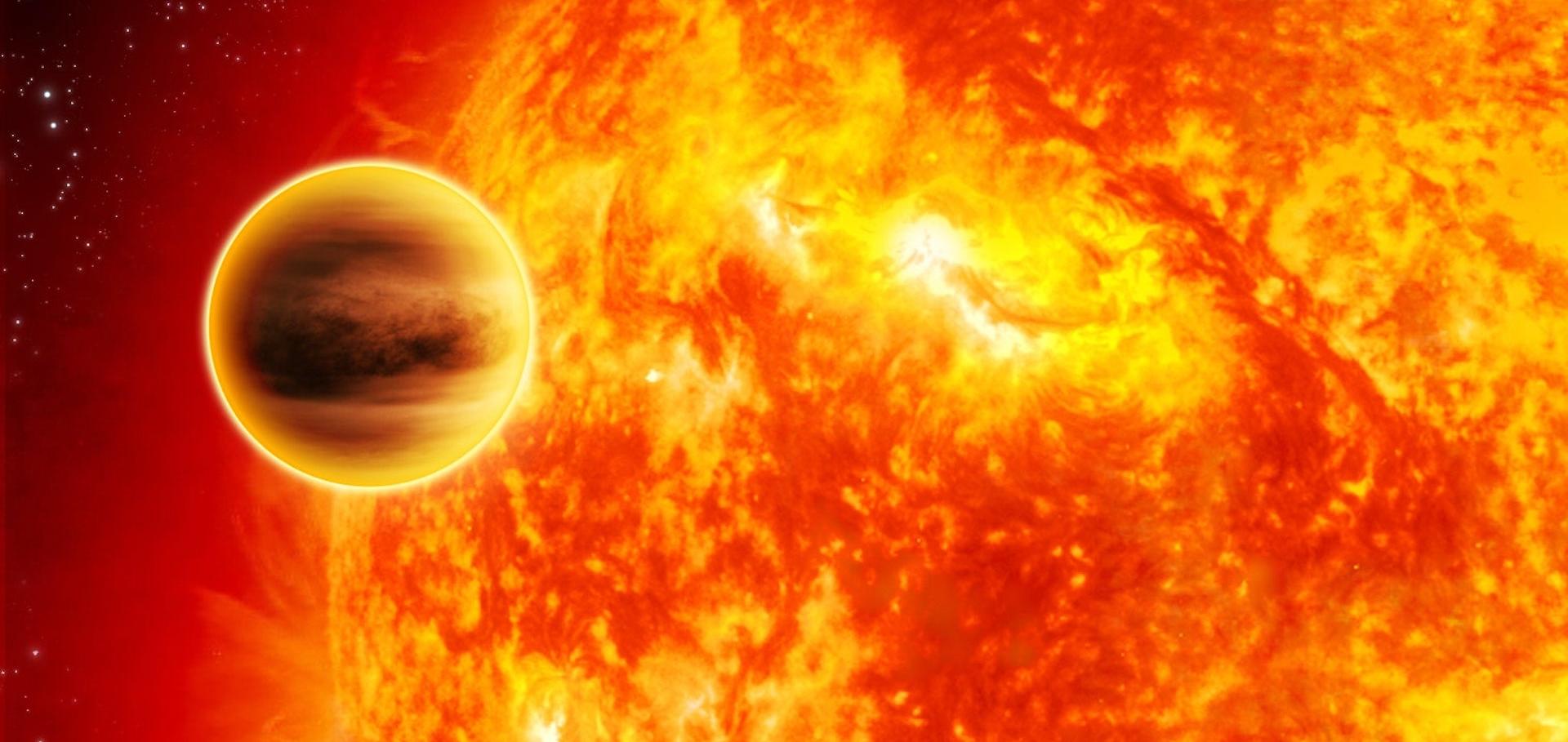
The Peculiar Atmospheric Chemistry of KELT-9b
The Astrophysical Journal American Astronomical Society 863:2 (2018) 183
Community targets of JWST's early release science program: Evaluation of WASP-63b
Astronomical Journal IOP Publishing 156:3 (2018) 103
Abstract:
We present observations of WASP-63b by the Hubble Space Telescope (HST) as part of "A Preparatory Program to Identify the Single Best Transiting Exoplanet for James Webb Space Telescope (JWST) Early Release Science (ERS)." WASP-63b is one of the community targets under consideration for the JWST ERS program. We present a spectrum derived from a single observation by HST Wide Field Camera 3 in the near-infrared. We engaged groups across the transiting exoplanet community to participate in the analysis of the data and present results from each. Extraction of the transmission spectrum by several independent analyses find an H2O absorption feature with varying degrees of significance ranging from 1σ to 3σ. The feature, in all cases, is muted in comparison to a clear atmosphere at solar composition. The reasons for the muting of this feature are ambiguous due to a degeneracy between clouds and composition. The data does not yield robust detections of any molecular species other than H2O. The group was motivated to perform an additional set of retrieval exercises to investigate an apparent bump in the spectrum at ~1.55 μm. We explore possible disequilibrium chemistry and find this feature is consistent with super-solar HCN abundance but it is questionable if the required mixing ratio of HCN is chemically and physically plausible. The ultimate goal of this study is to vet WASP-63b as a potential community target to best demonstrate the capabilities and systematics of JWST instruments for transiting exoplanet science. In the case of WASP-63b, the presence of a detectable water feature indicates that WASP-63b remains a plausible target for JWST observations.44 Validated Planets from K2 Campaign 10
The Astronomical Journal American Astronomical Society 156:2 (2018) 78
The Exoplanet Climate Infrared TElescope (EXCITE)
Ground-based and Airborne Instrumentation for Astronomy VII SPIE (2018) 199-199
Meat consumption, health, and the environment.
Science 361:6399 (2018)