

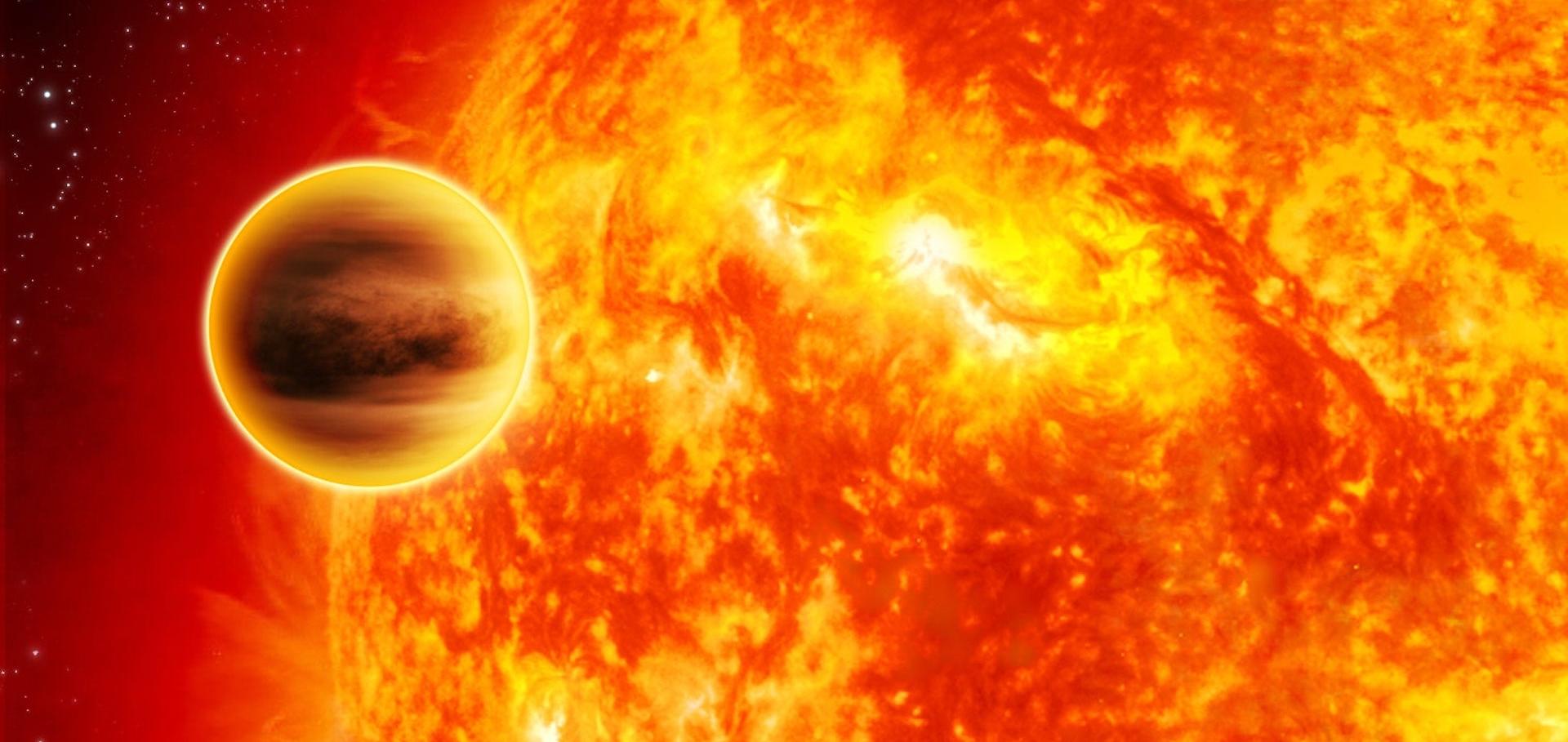
Exoplanet Atmospheres at High Spectral Resolution
(2018)
Abstract:
The spectrum of an exoplanet reveals the physical, chemical, and biological processes that have shaped its history and govern its future. However, observations of exoplanet spectra are complicated by the overwhelming glare of their host stars. This review chapter focuses on high resolution spectroscopy (HRS; R=25,000-100,000), which helps to disentangle and isolate the exoplanet's spectrum. At high spectral resolution, molecular features are resolved into a dense forest of individual lines in a pattern that is unique for a given molecule. For close-in planets, the spectral lines undergo large Doppler shifts during the planet's orbit, while the host star and Earth's spectral features remain essentially stationary, enabling a velocity separation of the planet. For slower-moving, wide-orbit planets, HRS aided by high contrast imaging instead isolates their spectra using their spatial separation. The lines in the exoplanet spectrum are detected by comparing them with high resolution spectra from atmospheric modelling codes; essentially a form of fingerprinting for exoplanet atmospheres. This measures the planet's orbital velocity, and helps define its true mass and orbital inclination. Consequently, HRS can detect both transiting and non-transiting planets. It also simultaneously characterizes the planet's atmosphere due to its sensitivity to the depth, shape, and position of the planet's spectral lines. These are altered by the planet's atmospheric composition, structure, clouds, and dynamics, including day-to-night winds and its rotation period. This chapter describes the HRS technique in detail, highlighting its successes in exoplanet detection and characterization, and concludes with the future prospects of using HRS to identify biomarkers on nearby rocky worlds, and map features in the atmospheres of giant exoplanets.Formation of Silicate and Titanium Clouds on Hot Jupiters
The Astrophysical Journal American Astronomical Society 860:1 (2018) 18-18
A Universal Spin-Mass Relation for Brown Dwarfs and Planets
Astrophysical Journal 859:2 (2018)
Abstract:
© 2018. The American Astronomical Society. All rights reserved. While brown dwarfs show similarities to stars early in their lives, their spin evolutions are much more akin to those of planets. We have used light curves from the K2 mission to measure new rotation periods for 18 young brown dwarfs in the Taurus star-forming region. Our sample spans masses from 0.02 to 0.08 Moand has been characterized extensively in the past. To search for periods, we utilize three different methods (autocorrelation, periodogram, Gaussian processes). The median period for brown dwarfs with disks is twice as long as for those without (3.1 versus 1.6 days), a signature of rotational braking by the disk, albeit with small numbers. With an overall median period of 1.9 days, brown dwarfs in Taurus rotate slower than their counterparts in somewhat older (3-10 Myr) star-forming regions, consistent with spin-up of the latter due to contraction and angular momentum conservation, a clear sign that disk braking overall is inefficient and/or temporary in this mass domain. We confirm the presence of a linear increase of the typical rotation period as a function of mass in the substellar regime. The rotational velocities, when calculated forward to the age of the solar system, assuming angular momentum conservation, fit the known spin-mass relation for solar system planets and extra-solar planetary-mass objects. This spin-mass trend holds over six orders of magnitude in mass, including objects from several different formation paths. Our result implies that brown dwarfs by and large retain their primordial angular momentum through the first few Myr of their evolution.The K2 M67 Study: Establishing the Limits of Stellar Rotation Period Measurements in M67 with K2 Campaign 5 Data
ASTROPHYSICAL JOURNAL 859:2 (2018) ARTN 167
The K2 M67 Study: Establishing the Limits of Stellar Rotation Period Measurements in M67 with K2 Campaign 5 Data
(2018)