

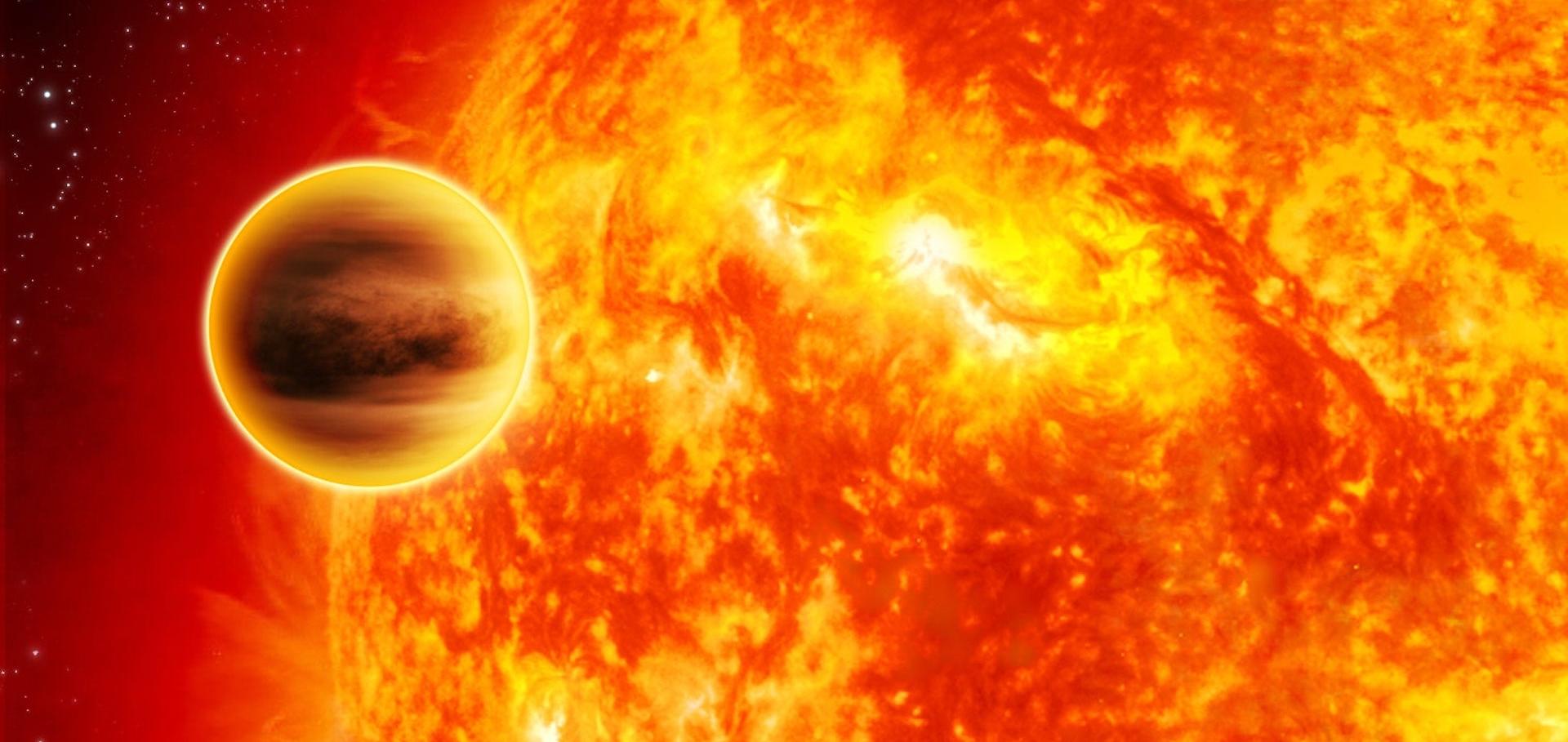
Transiting exoplanets from the CoRoT space mission: XII. CoRoT-12b: A short-period low-density planet transiting a solar analog star
Astronomy and Astrophysics 520:14 (2010)
Abstract:
We report the discovery by the CoRoT satellite of a new transiting giant planet in a 2.83 days orbit about a V = 15.5 solar analog star (M * = 1.08±0.08 M⊙, R* = 1.1±0.1 R⊙, Teff = 5675±80 K). This new planet, CoRoT-12b, has a mass of 0.92±0.07 MJup and a radius of 1.44±0.13 RJup. Its low density can be explained by standard models for irradiated planets. © ESO 2010.Photospheric activity, rotation, and radial velocity variations of the planet-hosting star CoRoT-7
Astronomy and Astrophysics 520:9 (2010)
Abstract:
Context. The CoRoT satellite has recently discovered the transits of an Earth-like planet across the disc of a late-type magnetically active star dubbed CoRoT-7, while a second planet was detected after filtering out the radial velocity (hereafter RV) variations due to stellar activity. Aims. We investigate the magnetic activity of CoRoT-7 and use the results for a better understanding of the impact of magnetic activity on stellar RV variations. Methods. We derived the longitudinal distribution of active regions on CoRoT-7 from a maximum entropy spot model of the CoRoT lightcurve. Assuming that each active region consists of dark spots and bright faculae in a fixed proportion, we synthesized the expected RV variations. Results. Active regions are mainly located at three active longitudes that appear to migrate at different rates, probably as a consequence of surface differential rotation, for which a lower limit of ΔΩ/Ω = 0.058 ± 0.017 is found. The synthesized activity-induced RV variations reproduce the amplitude of the observed RV curve and are used to study the impact of stellar activity on planetary detection. Conclusions. In spite of the non-simultaneous CoRoT and HARPS observations, our study confirms the validity of the method previously adopted to filter out RV variations induced by stellar activity. We find a false-alarm probability <10-4 that the RV oscillations attributed to CoRoT-7b and CoRoT-7c are spurious effects of noise and activity. Additionally, our model suggests that other periodicities found in the observed RV curve of CoRoT-7 could be explained by active regions whose visibility is modulated by a differential stellar rotation with periods ranging from 23.6 to 27.6 days. © 2010 ESO.Transiting exoplanets from the CoRoT space mission. XV. CoRoT-15b: a brown dwarf transiting companion
(2010)
Transiting exoplanets from the CoRoT space mission XIV. CoRoT-11b: a transiting massive "hot-Jupiter" in a prograde orbit around a rapidly rotating F-type star
(2010)
The Gemini Nici Planet-Finding Campaign: Discovery of a close substellar companion to the young debris disk star PZ TEL
Astrophysical Journal Letters 720:1 PART 2 (2010)