

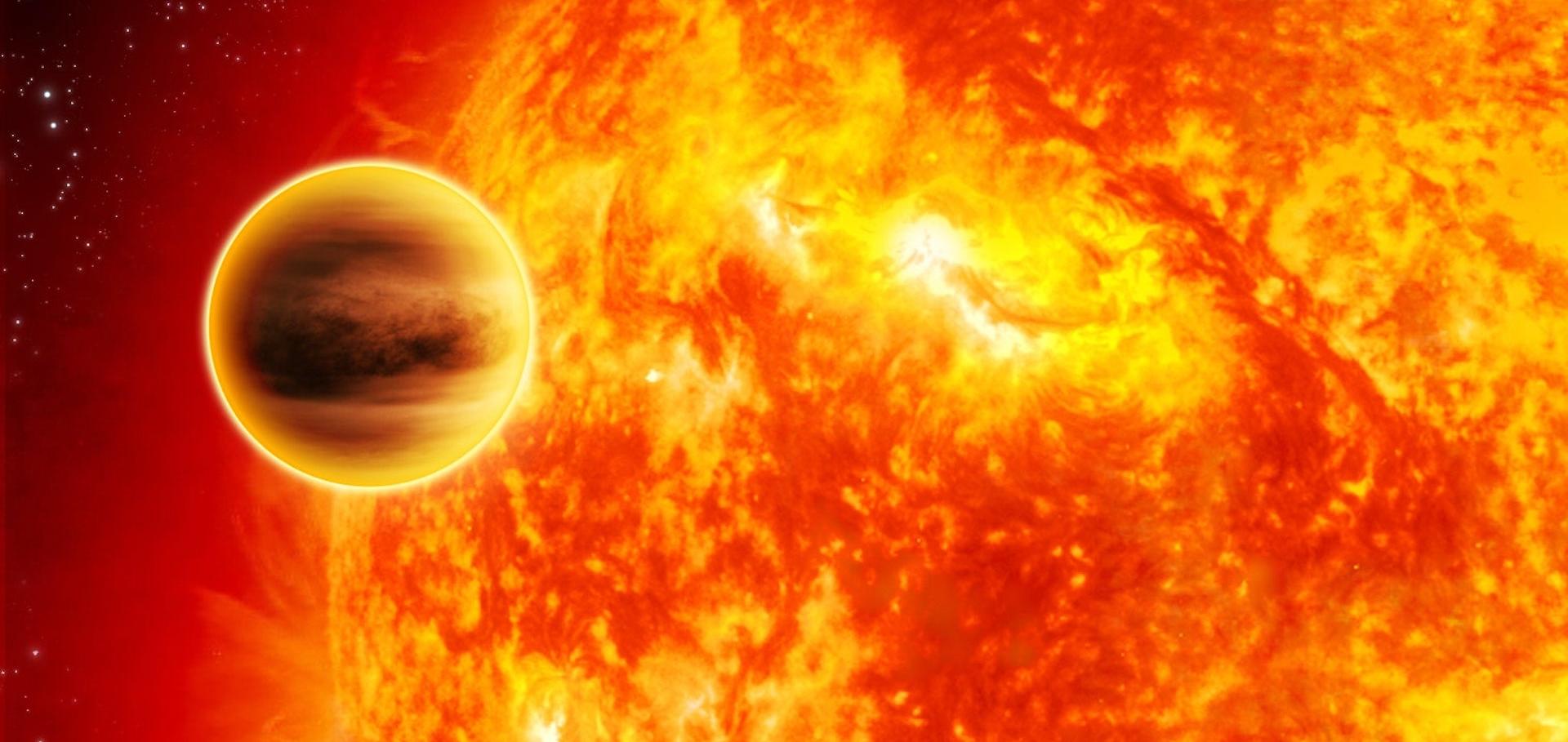
The CoRoT exoplanet programme: exploring the gas-giant/terrestrial planet transition
(2007)
Examples of new evolved planetary nebulae from the SuperCOSMOS H-alpha survey
Anglo-Australian Observatory Epping Newsletter 111 (2007) 22-22
Efficient identification of exoplanetary transit candidates from SuperWASP light curves
Monthly Notices of the Royal Astronomical Society 380:3 (2007) 1230-1244
Abstract:
Transiting extrasolar planets constitute only a small fraction of the range of stellar systems found to display periodic, shallow dimmings in wide-field surveys employing small-aperture camera arrays. Here we present an efficient selection strategy for follow-up observations, derived from analysis of the light curves of a sample of 67 SuperWASP targets that passed the selection tests we used in earlier papers, but which have subsequently been identified either as planet hosts or as astrophysical false positives. We determine the system parameters using Markov-chain Monte Carlo analysis of the SuperWASP light curves. We use a constrained optimization of χ2 combined with a Bayesian prior based on the main-sequence mass and radius expected from the Two Micron All Sky Survey J - H colour. The Bayesian nature of the analysis allows us to quantify both the departure of the host star from the main-sequence mass-radius relation and the probability that the companion radius is less than 1.5 Jupiter radii. When augmented by direct light-curve analyses that detect binaries with unequal primary and secondary eclipses, and objects with aperture blends that are resolved by SuperWASP, we find that only 13 of the original 67 stars, including the three known planets in the sample, would qualify for follow-up. This suggests that planet discovery 'hit rates' better than one-in-five should be achievable. In addition, the stellar binaries that qualify are likely to have astrophysically interesting stellar or substellar secondaries. © 2007 RAS.On the potential of transit surveys in star clusters: Impact of correlated noise and radial velocity follow-up
Monthly Notices of the Royal Astronomical Society 378:2 (2007) 741-752
Abstract:
We present an extension of the formalism recently proposed by Pepper and Gaudi to evaluate the yield of transit surveys in homogeneous stellar systems, incorporating the impact of correlated noise on transit time-scales on the detectability of transits, and simultaneously incorporating the magnitude limits imposed by the need for radial velocity (RV) follow-up of transit candidates. New expressions are derived for the different contributions to the noise budget on transit time-scales and the least-squares detection statistic for box-shaped transits, and their behaviour as a function of stellar mass is re-examined. Correlated noise that is constant with apparent stellar magnitude implies a steep decrease in detection probability at the high-mass end which, when considered jointly with the RV requirements, can severely limit the potential of otherwise promising surveys in star clusters. However, we find that small-aperture, wide-field surveys may detect hot Neptunes whose RV signal can be measured with present-day instrumentation in very nearby (<100 pc) clusters. © 2007 RAS.Reconstruction of the transit signal in the presence of stellar variability
Proceedings of the International Astronomical Union 3:S249 (2007) 89-92