

How does thermal scattering shape the infrared spectra of cloudy exoplanets? A theoretical framework and consequences for atmospheric retrievals in the JWST era
Monthly Notices of the Royal Astronomical Society Oxford University Press (OUP)
Abstract:
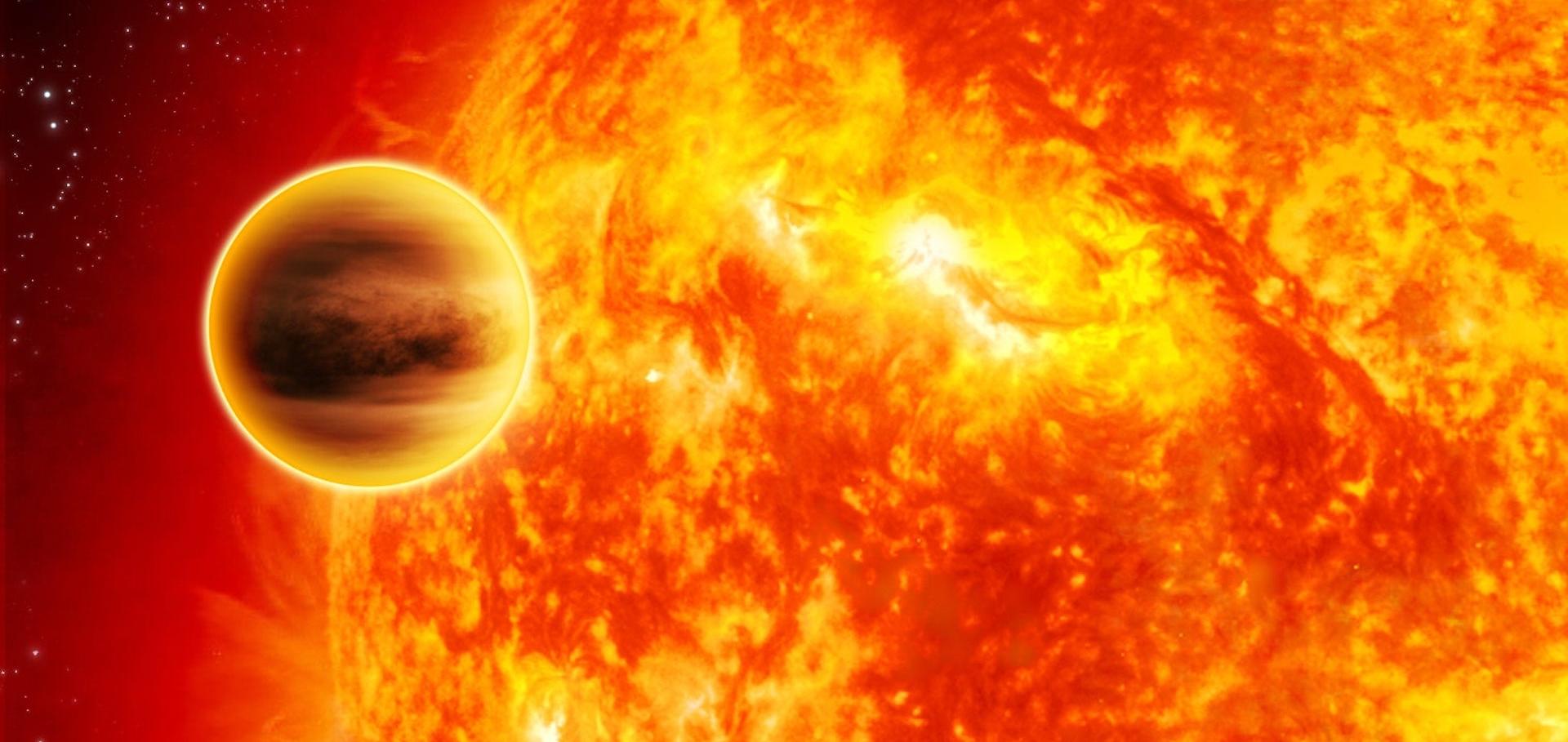
Observational studies of exoplanets are suggestive of an ubiquitous presence of clouds. The current modelling techniques used in emission to account for the clouds tend to require prior knowledge of the cloud condensing species and often do not consider the scattering effects of the cloud. We explore the effects that thermal scattering has on the emission spectra by modelling a suite of hot Jupiter atmospheres with varying cloud single-scattering albedos (SSAs) and temperature profiles. We examine cases ranging from simple isothermal conditions to more complex structures and physically driven cloud modelling. We show that scattering from nightside clouds would lead to brightness temperatures that are cooler than the real atmospheric temperature, if scattering is unaccounted for. We show that scattering can produce spectral signatures in the emission spectrum even for isothermal atmospheres. We identify the retrieval degeneracies and biases that arise in the context of simulated JWST spectra when the scattering from the clouds dominates the spectral shape. Finally, we propose a novel method of fitting the SSA spectrum of the cloud in emission retrievals, using a technique that does not require any prior knowledge of the cloud chemical or physical properties.Ice-shelf damming in the glacial Arctic Ocean: dynamical regimes of a basin-covering kilometre thick ice shelf
Inferring probabilistic stellar rotation periods using Gaussian processes
Monthly Notices of the Royal Astronomical Society Blackwell Publishing Inc.
Abstract:
Variability in the light curves of spotted, rotating stars is often non-sinusoidal and quasi-periodic --- spots move on the stellar surface and have finite lifetimes, causing stellar flux variations to slowly shift in phase. A strictly periodic sinusoid therefore cannot accurately model a rotationally modulated stellar light curve. Physical models of stellar surfaces have many drawbacks preventing effective inference, such as highly degenerate or high-dimensional parameter spaces. In this work, we test an appropriate effective model: a Gaussian Process with a quasi-periodic covariance kernel function. This highly flexible model allows sampling of the posterior probability density function of the periodic parameter, marginalising over the other kernel hyperparameters using a Markov Chain Monte Carlo approach. To test the effectiveness of this method, we infer rotation periods from 333 simulated stellar light curves, demonstrating that the Gaussian process method produces periods that are more accurate than both a sine-fitting periodogram and an autocorrelation function method. We also demonstrate that it works well on real data, by inferring rotation periods for 275 Kepler stars with previously measured periods. We provide a table of rotation periods for these 1132 Kepler objects of interest and their posterior probability density function samples. Because this method delivers posterior probability density functions, it will enable hierarchical studies involving stellar rotation, particularly those involving population modelling, such as inferring stellar ages, obliquities in exoplanet systems, or characterising star-planet interactions. The code used to implement this method is available online.K2 photometry and HERMES spectroscopy of the blue supergiant rho Leo: rotational wind modulation and low-frequency waves
Monthly Notices of the Royal Astronomical Society: Letters Blackwell Publishing