

First light of a holographic aperture mask: Observation at the Keck OSIRIS Imager
Published in A&A (2021)
Abstract:
We report on the design, construction, and commissioning of a prototype aperture masking technology implemented at the Keck OSIRIS Imager: the holographic aperture mask. Holographic aperture masking (HAM) aims at (i) increasing the throughput of sparse aperture masking (SAM) by selectively combining all subapertures across a telescope pupil in multiple interferograms using a phase mask, and (ii) adding low-resolution spectroscopic capabilities. Using liquid-crystal geometric phase patterns, we manufacture a HAM mask that uses an 11-hole SAM design as the central component and a holographic component comprising 19 different subapertures. Thanks to a multilayer liquid-crystal implementation, the mask has a diffraction efficiency higher than 96% from 1.1 to 2.5 micron. We create a pipeline that extracts monochromatic closure phases from the central component as well as multiwavelength closure phases from the holographic component. We test the performance of the HAM mask in the laboratory and on-sky. The holographic component yields 26 closure phases with spectral resolutions between R∼6.5 and R∼15. On April 19, 2019, we observed the binary star HDS 1507 in the Hbb filter (λ0=1638 nm and Δλ=330 nm) and retrieved a constant separation of 120.9 ±0.5 mas for the independent wavelength bins, which is in excellent agreement with literature values. For both the laboratory measurements and the observations of unresolved reference stars, we recorded nonzero closure phases -- a potential source of systematic error that we traced to polarization leakage of the HAM optic. We propose a future upgrade that improves the performance, reducing this effect to an acceptable level. Holographic aperture masking is a simple upgrade of SAM with increased throughput and a new capability of simultaneous low-resolution spectroscopy that provides new differential observables.
Full Stokes magnetometry of the active M dwarfs AU Mic and EV Lac with SPIRou
Astronomy & Astrophysics, Volume 700, id.A122, 14 pp.
Abstract:
We report in this paper circularly and linearly polarized observations of the young active M dwarfs AU Mic and EV Lac with the near-infrared SPIRou spectropolarimeter at the Canada–France–Hawaii Telescope, collected from August to October 2023 over a few rotation cycles of both stars. Applying Least-Squares Deconvolution (LSD) to our spectra, we detected Zeeman signatures in circular (Stokes V) and linear (Stokes QU) polarization, and Zeeman broadening in unpolarized (Stokes I) LSD profiles, all exhibiting clear rotational modulation. Using the stellar surface tomographic technique of Zeeman-Doppler imaging on our sets of observations, along with a simple parametric description of how the small-scale and large-scale fields relate to each other, we recovered the magnetic topologies of AU Mic and EV Lac successively from LSD Stokes V, Stokes IV and Stokes IVQU profiles, to investigate how the reconstructed maps evolve as we provide more information, and ultimately infer reliable magnetic maps of both stars. We find that AU Mic hosts a fairly simple and mostly poloidal large-scale field aligned with the rotation axis within about 10°, whereas that of EV Lac is more complex, stronger and less axisymmetric. Both stars feature intense small-scale fields, of about 4 kG for AU Mic and 6 kG for EV Lac when averaged over the whole stellar surface. Stokes QU Zeeman signatures allow one to reconstruct stellar magnetic fields more reliably, and are especially useful for stars with more complex fields and low υ sin i like EV Lac.
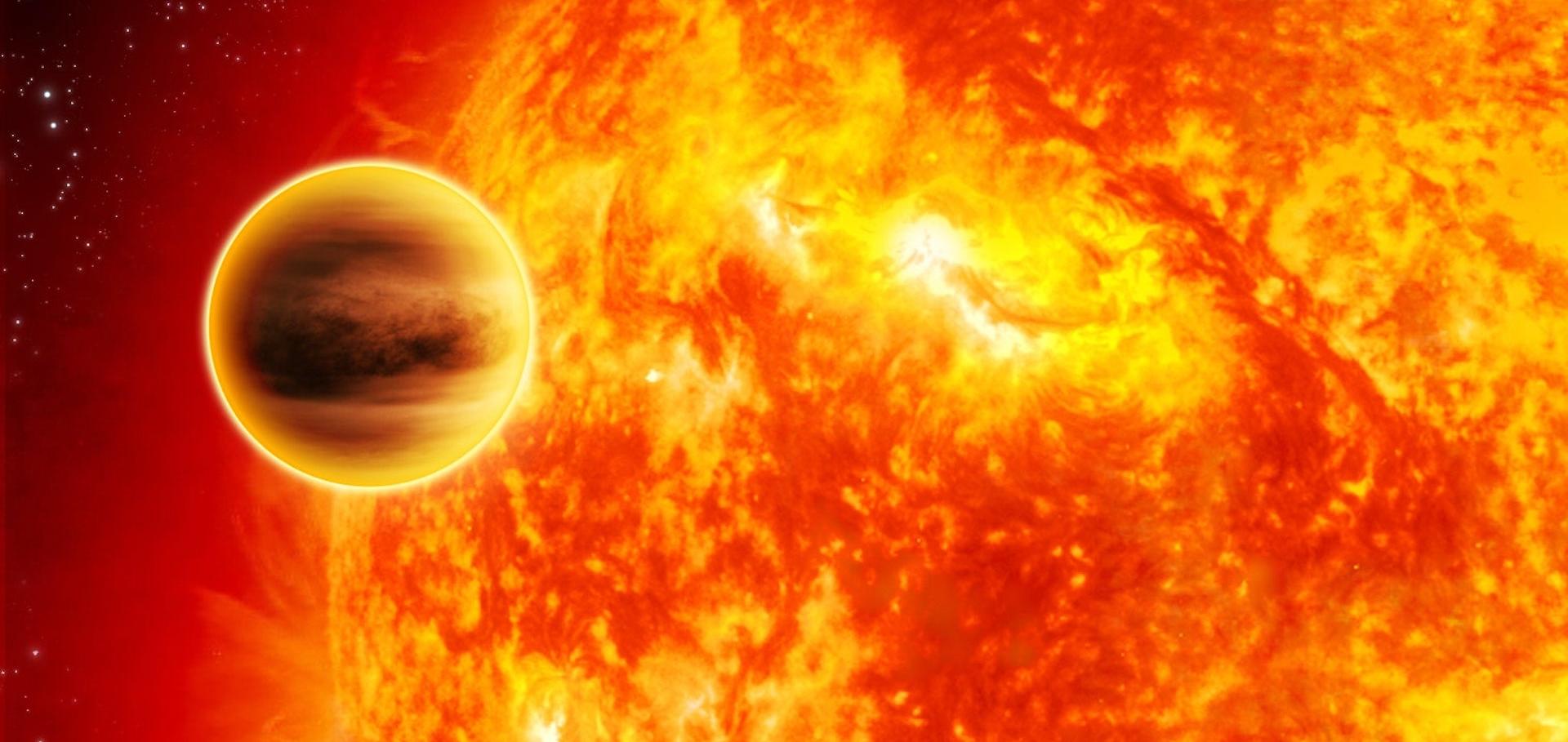
How does thermal scattering shape the infrared spectra of cloudy exoplanets? A theoretical framework and consequences for atmospheric retrievals in the JWST era
Monthly Notices of the Royal Astronomical Society Oxford University Press (OUP)
Abstract:
Observational studies of exoplanets are suggestive of an ubiquitous presence of clouds. The current modelling techniques used in emission to account for the clouds tend to require prior knowledge of the cloud condensing species and often do not consider the scattering effects of the cloud. We explore the effects that thermal scattering has on the emission spectra by modelling a suite of hot Jupiter atmospheres with varying cloud single-scattering albedos (SSAs) and temperature profiles. We examine cases ranging from simple isothermal conditions to more complex structures and physically driven cloud modelling. We show that scattering from nightside clouds would lead to brightness temperatures that are cooler than the real atmospheric temperature, if scattering is unaccounted for. We show that scattering can produce spectral signatures in the emission spectrum even for isothermal atmospheres. We identify the retrieval degeneracies and biases that arise in the context of simulated JWST spectra when the scattering from the clouds dominates the spectral shape. Finally, we propose a novel method of fitting the SSA spectrum of the cloud in emission retrievals, using a technique that does not require any prior knowledge of the cloud chemical or physical properties.Ice-shelf damming in the glacial Arctic Ocean: dynamical regimes of a basin-covering kilometre thick ice shelf
Inferring probabilistic stellar rotation periods using Gaussian processes
Monthly Notices of the Royal Astronomical Society Blackwell Publishing Inc.