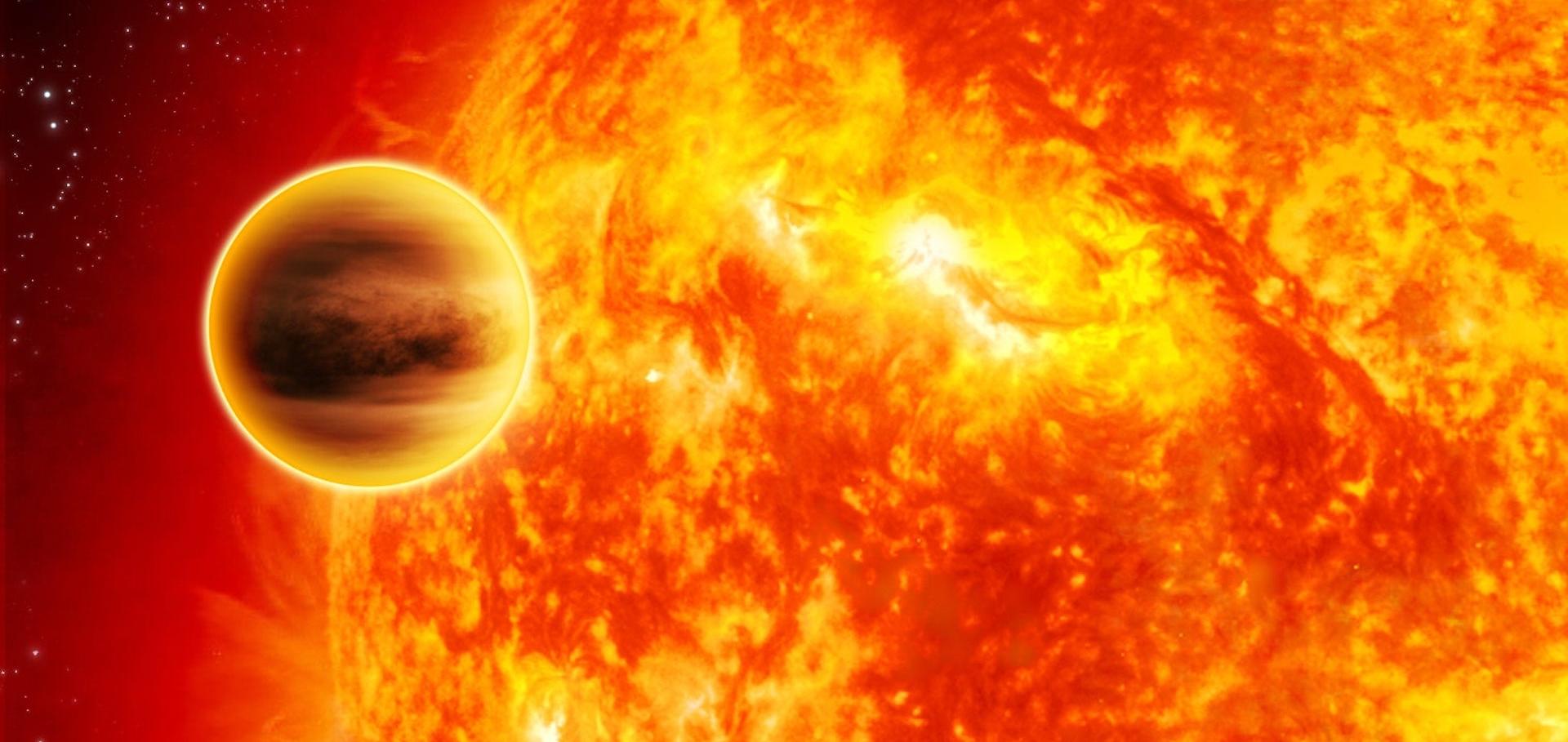
A reflective, metal-rich atmosphere for GJ 1214b from its JWST phase curve

Nature Springer Nature 620 (2023) 67-71

Authors:

Eliza M-R Kempton, Michael Zhang, Jacob L Bean, Maria E Steinrueck, Anjali AA Piette, Vivien Parmentier, Isaac Malsky, Michael T Roman, Emily Rauscher, Peter Gao, Taylor J Bell, Qiao Xue, Jake Taylor, Arjun B Savel, Kenneth E Arnold, Matthew C Nixon, Kevin B Stevenson, Megan Mansfield, Sarah Kendrew, Sebastian Zieba, Elsa Ducrot, Achrène Dyrek, Pierre-Olivier Lagage, Keivan G Stassun, Gregory W Henry, Travis Barman, Roxana Lupu, Matej Malik, Tiffany Kataria, Jegug Ih, Guangwei Fu, Luis Welbanks, Peter McGill

Abstract:

There are no planets intermediate in size between Earth and Neptune in our Solar System, yet these objects are found around a substantial fraction of other stars [1]. Population statistics show that close-in planets in this size range bifurcate into two classes based on their radii [2, 3]. It is hypothesized that the group with larger radii (referred to as "sub-Neptunes") is distinguished by having hydrogen-dominated atmospheres that are a few percent of the total mass of the planets [4]. GJ 1214b is an archetype sub-Neptune that has been observed extensively using transmission spectroscopy to test this hypothesis [5-14]. However, themeasured spectra are featureless, and thus inconclusive, due to the presence of high-altitude aerosols in the planet's atmosphere. Here we report a spectroscopic thermal phase curve of GJ 1214b obtained with JWST in the mid-infrared. The dayside and nightside spectra (average brightness temperatures of 553 ± 9 and 437 ± 19 K, respectively) each show >3σ evidence of absorption features, with H2O as the most likely cause in both. The measured global thermal emission implies that GJ 1214b's Bond albedo is 0.51 ± 0.06. Comparison between the spectroscopic phase curve data and three-dimensional models of GJ 1214b reveal a planet with a high metallicity atmosphere blanketed by a thick and highly reflective layer of clouds or haze.

Hotter than Expected: Hubble Space Telescope (HST)/WFC3 Phase-resolved Spectroscopy of a Rare Irradiated Brown Dwarf with Strong Internal Heat Flux

The Astrophysical Journal American Astronomical Society 948:2 (2023) 129

Authors:

Rachael C Amaro, Dániel Apai, Yifan Zhou, Ben WP Lew, Sarah L Casewell, LC Mayorga, Mark S Marley, Xianyu Tan, Joshua D Lothringer, Vivien Parmentier, Travis Barman

Applying a temporal systematics model to vector Apodizing Phase Plate coronagraphic data: TRAP4vAPP

(2023)

Authors:

Pengyu Liu, Alexander J Bohn, David S Doelman, Ben J Sutlieff, Matthias Samland, Matthew A Kenworthy, Frans Snik, Jayne L Birkby, Beth A Biller, Jared R Males, Katie M Morzinski, Laird M Close, Gilles PPL Otten

Carbon monoxide emission lines reveal an inverted atmosphere in the ultra hot Jupiter WASP-33 b consistent with an eastward hot spot

Monthly Notices of the Royal Astronomical Society Oxford University Press (OUP) 522:2 (2023) 2145-2170

Authors:

Lennart van Sluijs, Jayne L Birkby, Joshua Lothringer, Elspeth KH Lee, Ian JM Crossfield, Vivien Parmentier, Matteo Brogi, Craig Kulesa, Don McCarthy, David Charbonneau

Revisiting K2-233 spectroscopic time-series with multidimensional Gaussian processes

Monthly Notices of the Royal Astronomical Society Oxford University Press 522:3 (2023) 3458-3471

Authors:

Oscar Barragan Villanueva, Edward Gillen, Suzanne Aigrain, Annabella Meech, Baptiste Klein, Louise Dyregaard Nielsen, Haochuan Yu, Niamh K O'Sullivan, Belinda A Nicholson, Jorge Lillo-Box

Abstract:

Detecting planetary signatures in radial velocity time-series of young stars is challenging due to their inherently strong stellar activity. However, it is possible to learn information about the properties of the stellar signal by using activity indicators measured from the same stellar spectra used to extract radial velocities. In this manuscript, we present a reanalysis of spectroscopic High Accuracy Radial Velocity Planet Searcher data of the young star K2-233, which hosts three transiting planets. We perform a multidimensional Gaussian process regression on the radial velocity and the activity indicators to characterize the planetary Doppler signals. We demonstrate, for the first time on a real data set, that the use of a multidimensional Gaussian process can boost the precision with which we measure the planetary signals compared to a one-dimensional Gaussian process applied to the radial velocities alone. We measure the semi-amplitudes of K2-233 b, c, and d as 1.31+0.81−0.74, 1.81+0.71−0.67, and 2.72+0.66−0.70 m s−1, which translate into planetary masses of 2.4+1.5−1.3, 4.6+1.8−1.7, and 10.3+2.4−2.6 M⊕, respectively. These new mass measurements make K2-233 d a valuable target for transmission spectroscopy observations with JWST. K2-233 is the only young system with two detected inner planets below the radius valley and a third outer planet above it. This makes it an excellent target to perform comparative studies, to inform our theories of planet evolution, formation, migration, and atmospheric evolution.