

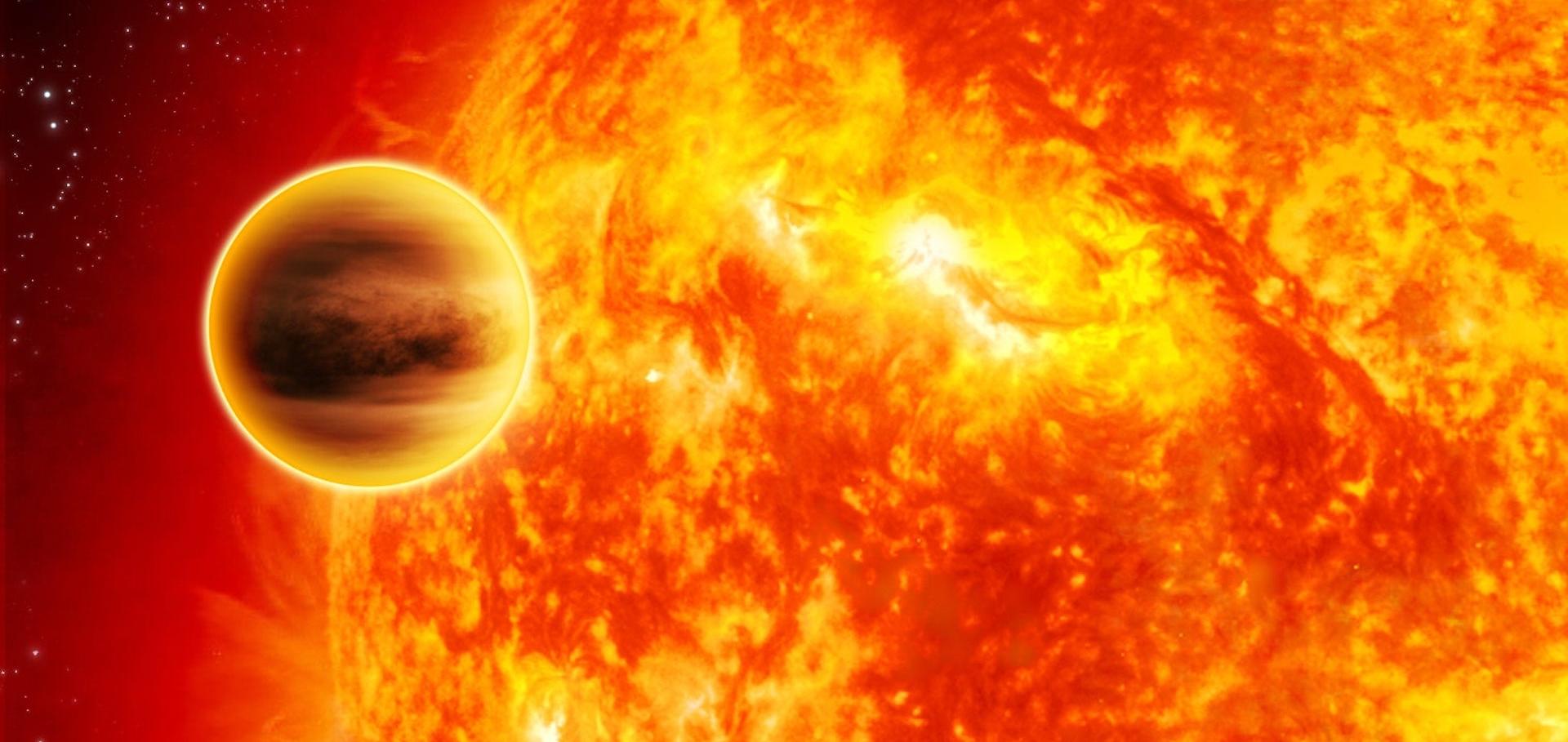
Muted Features in the JWST NIRISS Transmission Spectrum of Hot Neptune LTT 9779b
The Astrophysical Journal Letters American Astronomical Society 962:1 (2024) L20-L20
Abstract:
The ExoMol database (www.exomol.com) provides molecular data for spectroscopic studies of hot atmospheres. These data are widely used to model atmospheres of exoplanets, cool stars and other astronomical objects, as well as a variety of terrestrial applications. The 2024 data release reports the current status of the database which contains recommended line lists for 91 molecules and 224 isotopologues giving a total of almost 10$^{12}$ individual transitions. New features of the database include extensive "MARVELization" of line lists to allow them to be used for high resolutions studies, extension of several line lists to ultraviolet wavelengths, provision of photodissociation cross sections and extended provision of broadening parameters. Some of the in-house data specifications have been rewritten in JSON and moved to conformity with other international standards. Data products, including specific heats, a database of lifetimes for plasma studies, and the ExoMolHR web app which allows exclusively high resolution data to be extracted, are discussedStructures Of Dust and gAs (SODA): Constraining the innermost dust properties of II Zw96 with JWST observations of H2O and CO
Astronomy & Astrophysics EDP Sciences 682 (2024) L5-L5
Abstract:
12 pags., 10 figs., 2 tabs.We analyze JWST NIRSpec+MIRI/MRS observations of the infrared (IR) gas-phase molecular bands of the most enshrouded source (D1) within the interacting system and luminous IR galaxy II Zw 096. We report the detection of rovibrational lines of HO ν = 1-0 (~4;5.3-7.2 μm) and CO ν = 1-0 (~4;4.45-4.95 μm) in D1. The CO band shows the R- and P-branches in emission and the spectrum of the HO band shows the P-branch in emission and the R-branch in absorption. The HO R-branch in absorption unveils an IR-bright embedded compact source in D1 and the CO broad component features a highly turbulent environment. From both bands, we also identified extended intense star-forming (SF) activity associated with circumnuclear photodissociation regions (PDRs), consistent with the strong emission of the ionised 7.7 μm polycyclic aromatic hydrocarbon band in this source. By including the 4.5-7.0 μm continuum information derived from the HO and CO analysis, we modelled the IR emission of D1 with a dusty torus and SF component. The torus is very compact (diameter of ~4;3 pc at 5 μm) and characterised by warm dust (~4;370 K), giving an IR surface brightness of ~4;3.6 × 10 L pc. This result suggests the presence of a dust-obscured active galactic nucleus (AGN) in D1, which has an exceptionally high covering factor that prevents the direct detection of AGN emission. Our results open a new way to investigate the physical conditions of inner dusty tori via modelling the observed IR molecular bands.I.G.B. and D.R. acknowledge support from STFC through grants ST/S000488/1 and ST/W000903/1. E.G.-A. acknowledges grants PID2019-105552RB-C4 and PID2022-137779OB-C41 funded by the Spanish MCIN/AEI/10.13039/501100011033. M.P.S. acknowledges support from grant RYC2021-033094-I funded by MCIN/AEI/10.13039/501100011033 and the EU NextGenerationEU/PRTRBehind the mask: can HARMONI@ELT detect biosignatures in the reflected light of Proxima b?
Monthly Notices of the Royal Astronomical Society Oxford University Press (OUP) 528:2 (2024) 3509-3522
Near-infrared transmission spectroscopy of HAT-P-18 b with NIRISS: Disentangling planetary and stellar features in the era of JWST
Monthly Notices of the Royal Astronomical Society Oxford University Press (OUP) 528:2 (2024) 3354-3377
Behind the Mask: can HARMONI@ELT detect biosignatures in the reflected light of Proxima b?
(2024)