

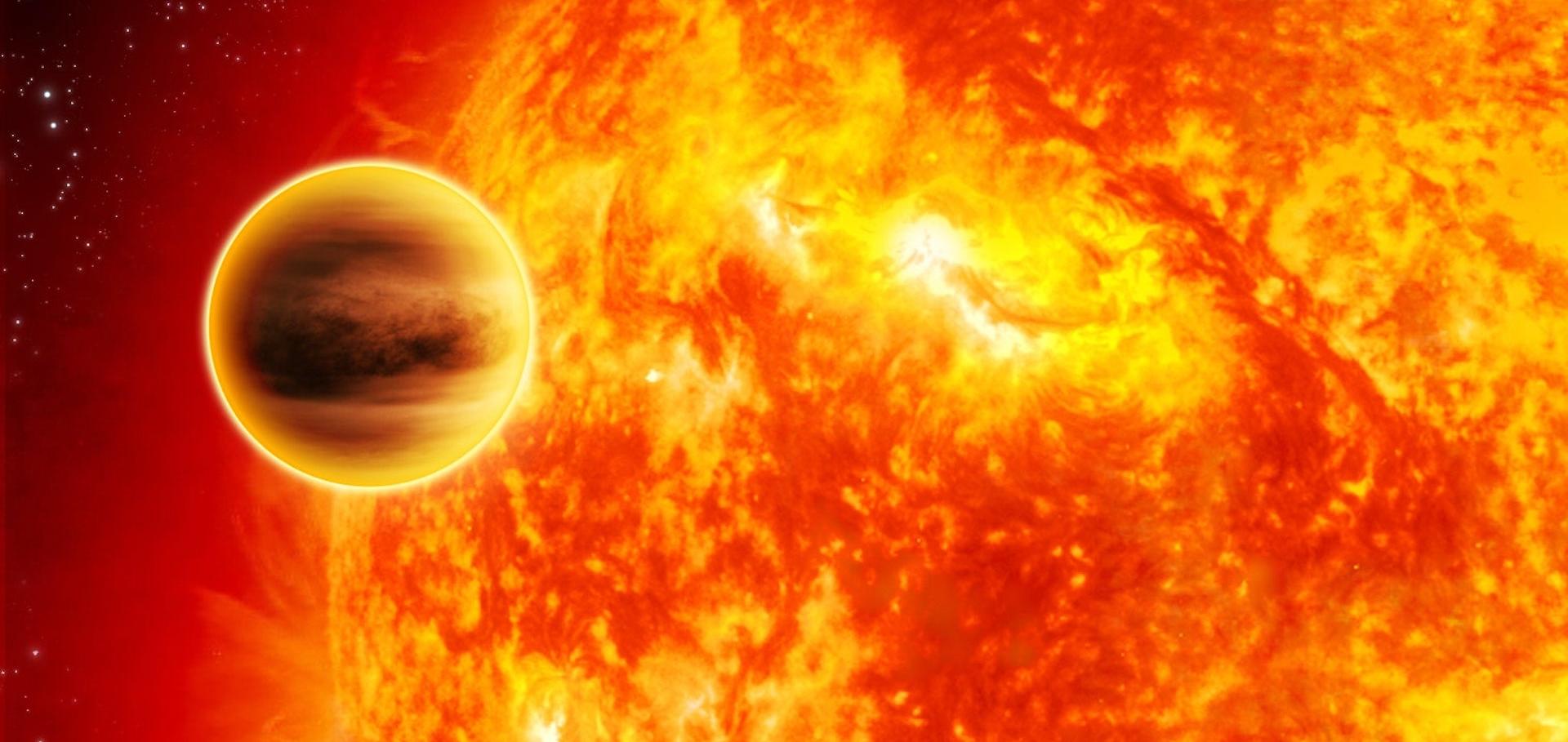
Direct discovery of the inner exoplanet in the HD 206893 system : Evidence for deuterium burning in a planetary-mass companion
Astronomy and Astrophysics EDP Sciences 671 (2023) L5
Abstract:
Aims. HD 206893 is a nearby debris disk star that hosts a previously identified brown dwarf companion with an orbital separation of ∼10 au. Long-term precise radial velocity (RV) monitoring, as well as anomalies in the system proper motion, has suggested the presence of an additional, inner companion in the system.Methods. Using information from ongoing precision RV measurements with the HARPS spectrograph, as well as Gaia host star astrometry, we have undertaken a multi-epoch search for the purported additional planet using the VLTI/GRAVITY instrument.
Results. We report a high-significance detection over three epochs of the companion HD 206893c, which shows clear evidence for Keplerian orbital motion. Our astrometry with ∼50−100 μarcsec precision afforded by GRAVITY allows us to derive a dynamical mass of 12.7MJup and an orbital separation of 3.53 au for HD 206893c. Our fits to the orbits of both companions in the system use both Gaia astrometry and RVs to also provide a precise dynamical estimate of the previously uncertain mass of the B component, and therefore allow us to derive an age of 155 ± 15 Myr for the system. We find that theoretical atmospheric and evolutionary models that incorporate deuterium burning for HD 206893c, parameterized by cloudy atmosphere models as well as a “hybrid sequence” (encompassing a transition from cloudy to cloud-free), provide a good simultaneous fit to the luminosity of both HD 206893B and c. Thus, accounting for both deuterium burning and clouds is crucial to understanding the luminosity evolution of HD 206893c.
Conclusions. In addition to using long-term RV information, this effort is an early example of a direct imaging discovery of a bona fide exoplanet that was guided in part by Gaia astrometry. Utilizing Gaia astrometry is expected to be one of the primary techniques going forward for identifying and characterizing additional directly imaged planets. In addition, HD 206893c is an example of an object narrowly straddling the deuterium-burning limit but unambiguously undergoing deuterium burning. Additional discoveries like this may therefore help clarify the discrimination between a brown dwarf and an extrasolar planet. Lastly, this discovery is another example of the power of optical interferometry to directly detect and characterize extrasolar planets where they form, at ice-line orbital separations of 2−4 au.
Early Release Science of the exoplanet WASP-39b with JWST NIRSpec PRISM
Nature Springer Nature 614:7949 (2023) 659-663
Early Release Science of the exoplanet WASP-39b with JWST NIRCam
Nature Springer Nature 614:7949 (2023) 653-658
Early Release Science of the exoplanet WASP-39b with JWST NIRISS
Nature Springer Nature 614:7949 (2023) 670-675
Measuring the variability of directly imaged exoplanets using vector Apodizing Phase Plates combined with ground-based differential spectrophotometry
Monthly Notices of the Royal Astronomical Society Oxford University Press (OUP) 520:3 (2023) 4235-4257