

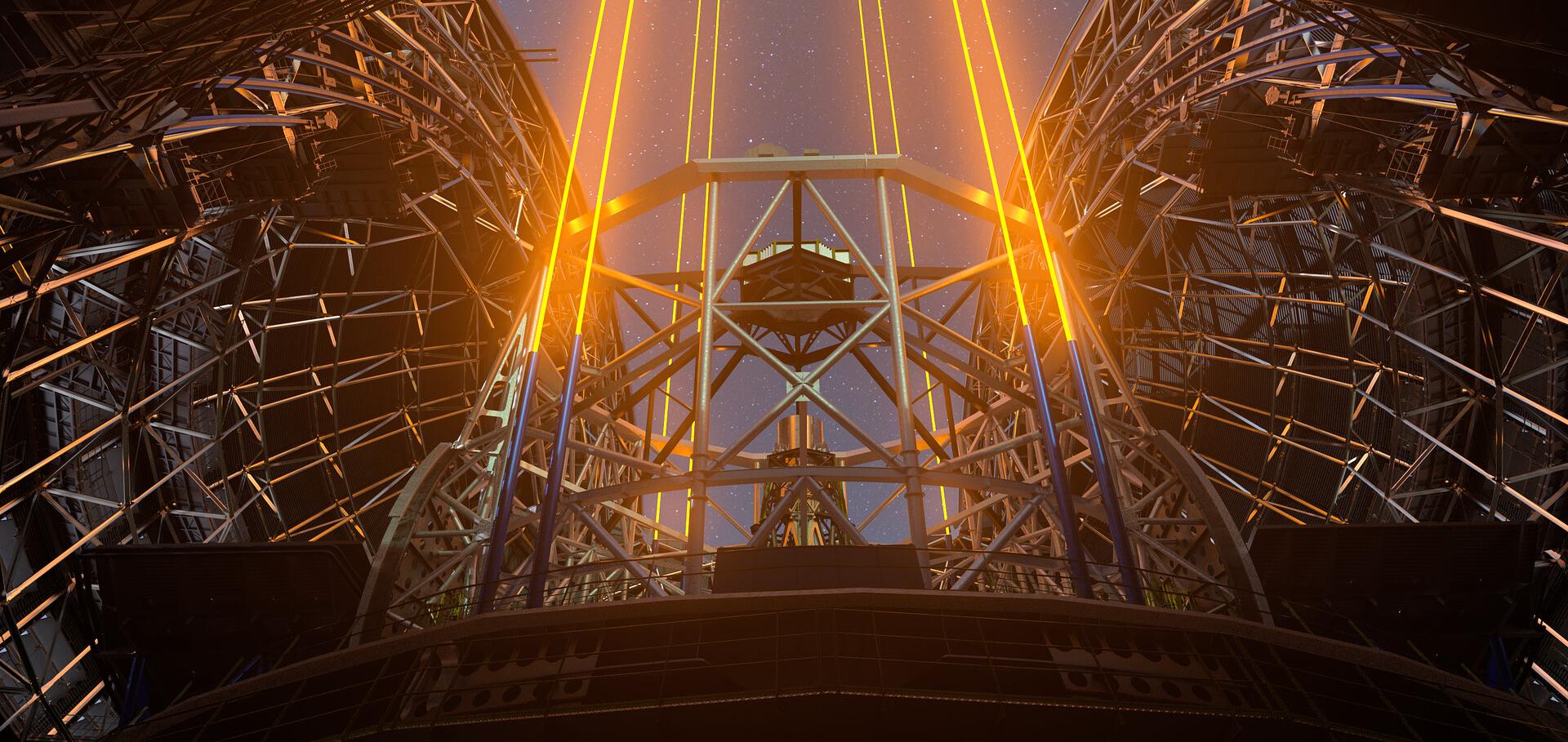
A story of errors and bias: The optimization of the LGS WFS for HARMONI
AO4ELT 2019 - Proceedings 6th Adaptive Optics for Extremely Large Telescopes (2019)
Abstract:
© 2019 AO4ELT 2019 - Proceedings 6th Adaptive Optics for Extremely Large Telescopes. All rights reserved. Laser Guide Star [LGS] wave-front sensing is a key element of the Laser Tomographic AO system and mainly drives the final performance of any ground based high resolution instrument. In that framework, HARMONI the first light spectro-imager of the ELT [1,2], will use 6 Laser focused around 90km(@Zenith) with a circular geometry in order to sense, reconstruct and correct for the turbulence volume located above the telescope. LGS wave-front sensing suffers from several well-known limitations [3] which are exacerbated by the giant size of the Extremely Large Telescopes. In that context, the presentation is threefold: (1) we will describe, quantify and analyse the various effects (bias and noise) induced by the LGS WFS in the context of ELT. Among other points, we will focus on the spurious low order signal generated by the spatially and temporally variable sodium layer. (2) we will propose a global design trade-off for the LGS WFS and Tomographic reconstruction process in the HARMONI context. We will show that, under strong technical constraints (especially concerning the detectors characteristics), a mix of opto-mechanic and numerical optimisations will allow to get rid of WFS bias induce by spot elongation without degrading the ultimate system performance (3) beyond HARMONI baseline, we will briefly present alternative strategies (from components, concepts and algorithms point of view) that could solve the LGS spot elongation issues at lower costs and better robustness.Design of the HARMONI pyramid WFS module
Ao4elt 2019 Proceedings 6th Adaptive Optics for Extremely Large Telescopes (2019)
Abstract:
Current designs for all three extremely large telescopes show the overwhelming adoption of the pyramid wavefront sensor (P-WFS) as the WFS of choice for adaptive optics (AO) systems sensing on natural guide stars (NGS) or extended objects. The key advantages of the P-WFS over the Shack-Hartmann are known and are mainly provided by the improved sensitivity (fainter NGS) and reduced sensitivity to spatial aliasing. However, robustness and tolerances of the P-WFS for the ELTs are not currently well understood. In this paper, we present simulation results for the single-conjugate AO mode of HARMONI, a visible and near-infrared integral field spectrograph for the European Extremely Large Telescope. We first explore the wavefront sensing issues related to the telescope itself; namely the island effect (i.e. differential piston) and M1 segments phasing errors. We present mitigation strategies to the island effect and their performance. We then focus on some performance optimisation aspects of the AO design to explore the impact of the RTC latency and the optical gain issues, which will in particular affect the high-contrast mode of HARMONI. Finally, we investigate the influence of the quality of glass pyramid prism itself, and of optical aberrations on the final AO performance. By relaxing the tolerances on the fabrication of the prism, we are able to reduce hardware costs and simplify integration. We show the importance of calibration (i.e. updating the control matrix) to capture any displacement of the telescope pupil and rotation of the support structure for M4. We also show the importance of the number of pixels used for wavefront sensing to relax tolerances of the pyramid prism. Finally, we present a detailed optical design of the pyramid prism, central element of the P-WFS.Design of the HARMONI pyramid WFS module
AO4ELT 2019 - Proceedings 6th Adaptive Optics for Extremely Large Telescopes (2019)
Abstract:
© 2019 AO4ELT 2019 - Proceedings 6th Adaptive Optics for Extremely Large Telescopes. All rights reserved. Current designs for all three extremely large telescopes show the overwhelming adoption of the pyramid wavefront sensor (P-WFS) as the WFS of choice for adaptive optics (AO) systems sensing on natural guide stars (NGS) or extended objects. The key advantages of the P-WFS over the Shack-Hartmann are known and are mainly provided by the improved sensitivity (fainter NGS) and reduced sensitivity to spatial aliasing. However, robustness and tolerances of the P-WFS for the ELTs are not currently well understood. In this paper, we present simulation results for the single-conjugate AO mode of HARMONI, a visible and near-infrared integral field spectrograph for the European Extremely Large Telescope. We first explore the wavefront sensing issues related to the telescope itself; namely the island effect (i.e. differential piston) and M1 segments phasing errors. We present mitigation strategies to the island effect and their performance. We then focus on some performance optimisation aspects of the AO design to explore the impact of the RTC latency and the optical gain issues, which will in particular affect the high-contrast mode of HARMONI. Finally, we investigate the influence of the quality of glass pyramid prism itself, and of optical aberrations on the final AO performance. By relaxing the tolerances on the fabrication of the prism, we are able to reduce hardware costs and simplify integration. We show the importance of calibration (i.e. updating the control matrix) to capture any displacement of the telescope pupil and rotation of the support structure for M4. We also show the importance of the number of pixels used for wavefront sensing to relax tolerances of the pyramid prism. Finally, we present a detailed optical design of the pyramid prism, central element of the P-WFS.Detecting radio-AGN signatures in red geysers
Astrophysical Journal Institute of Physics 869:2 (2018) 117
Abstract:
A new class of quiescent galaxies harboring possible AGN-driven winds has been discovered using spatially resolved optical spectroscopy from the ongoing SDSS-IV MaNGA survey. These galaxies, termed “red geysers”, constitute 5 - 10% of the local quiescent population and are characterized by narrow bisymmetric patterns in ionized gas emission features. Cheung et al. argued that these galaxies host large-scale AGN-driven winds that may play a role in suppressing star formation at late times. In this work, we test the hypothesis that AGN activity is ultimately responsible for the red geyser phenomenon. We compare the nuclear radio activity of the red geysers to a matched control sample with similar stellar mass, redshift, rest frame NUV -r color, axis ratio and presence of ionized gas. We have used the 1.4 GHz radio continuum data from VLA FIRST survey to stack the radio flux from the red geyser and control samples. In addition to a 3 times higher FIRST detection rate, we find that red geysers have a 5σ higher level of average radio flux than control galaxies. After restricting to rest-frame NUV - r color > 5 and checking mid-IR WISE photometry, we rule out star formation contamination and conclude that red geysers are associated with more active AGN. Red geysers and a possibly-related class with disturbed Hα emission account for 40% of all radio-detected red galaxies with log (M*/M⊙) < 11. Our results support a picture in which episodic AGN activity drives large-scale-relatively weak ionized winds that may provide a feedback mechanism for many early-type galaxies.The Fifteenth Data Release of the Sloan Digital Sky Surveys: First Release of MaNGA Derived Quantities, Data Visualization Tools and Stellar Library
(2018)