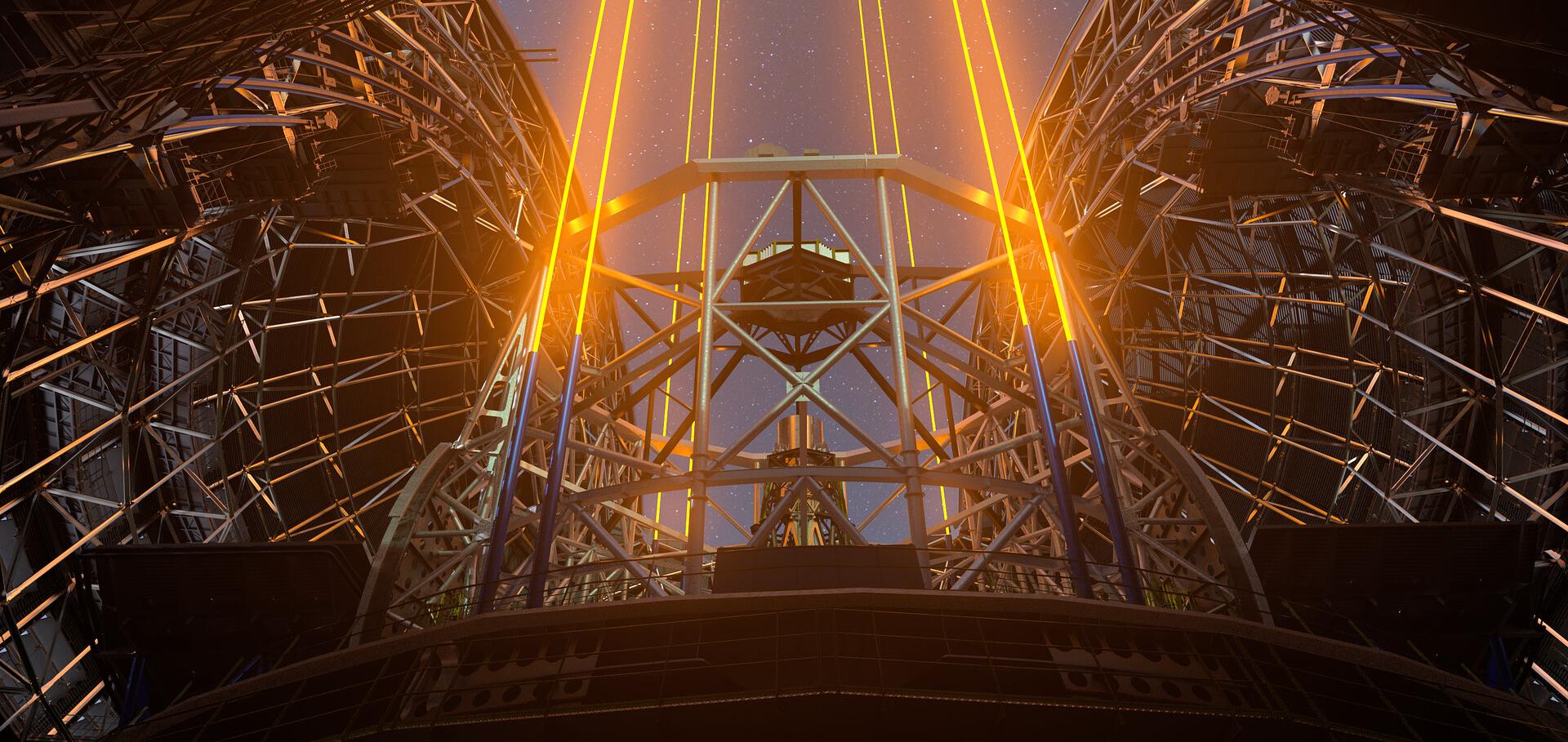
Scientific requirements for a European ELT

Proceedings of SPIE - The International Society for Optical Engineering 6267 II (2006)

Authors:

I Hook, G Dalton, R Gilmozzi

Abstract:

The science case for the next generation of Extremely Large Telescopes (ELTs) covers a huge range of astronomical topics and requires a wide range of capabilities. Here we describe top-level requirements on an ELT, which were derived from some of the key science cases identified by European astronomers. After a brief summary of these science cases we discuss the requirements on the ELT system in terms of several parameters, including wavelength range, field of view, image quality etc. We discuss the science driver that sets the limits on each parameter. We also discuss specific requirements on instrumentation, site and adaptive optics. In several cases, detailed simulated observations will be required in order to set the requirements. While the example science cases provide a useful guide, we also note that an important goal is to develop a facility that covers a broad parameter space, and maintains flexibility in order to adapt to new scientific directions.

The fundamental plane in RX J0142.0+2131: A galaxy cluster merger at z = 0.28

Astrophysical Journal 649:1 II (2006)

Authors:

J Barr, I Jørgensen, K Chiboucas, R Davies, M Bergmann

Abstract:

We present the fundamental plane (FP) in the z = 0.28 cluster of galaxies RX J0142.0+2131. There is no evidence for a difference in the slope of the FP when compared with the Coma Cluster, although the internal scatter is larger. On average, stellar populations in RX J0142.0+2131 have rest-frame V-band mass-to-light ratios (MILv) 0.29 ± 0.03 dex lower than in Coma. This is significantly lower than expected for a passively evolving cluster formed at zf = 2. Lenticular galaxies have lower average M/L v and a distribution of M/Lv with larger scatter than ellipticals. Lower mass-to-light ratios are not due to recent star formation: our previous spectroscopic observations of RX J0142.0+2131 E/S0 galaxies showed no evidence for significant star formation within the past ∼4 Gyr. However, cluster members have enhanced α-element abundance ratios, which may act to decrease M/Lv. The increased scatter in the RX J0142.0+2131 FP reflects a large scatter in M/Lv implying that galaxies have undergone bursts of star formation over a range of epochs. The seven easternmost cluster galaxies, including the second brightest member, have M/Lv consistent with passive evolution and zf = 2. We speculate that RX J0142.0+2131 is a cluster-cluster merger where the galaxies to the east are yet to fall into the main cluster body or have not experienced star formation as a result of the merger. © 2006. The American Astronomical Society. All rights reserved.

Stars and Gas in the Inner Parts of Galaxies seen in SAURON Integral Field Observations

(2006)

Authors:

RF Peletier, K Fathi, EL Allard, JH Knapen, M Sarzi, G van de Ven, J Falcon-Barroso, M Cappellari, PT de Zeeuw, E Emsellem

The SAURON project - VIII. OASIS/CFHT integral-field spectroscopy of elliptical and lenticular galaxy centres

(2006)

Authors:

RM McDermid, E Emsellem, KL Shapiro, R Bacon, M Bureau, M Cappellari, RL Davies, T de Zeeuw, J Falcon-Barroso, D Krajnovic, H Kuntschner, RF Peletier, M Sarzi

Galaxy clusters at 0.6 < z < 1.4 in the UKIDSS Ultra Deep Survey Early Data Release

(2006)

Authors:

C van Breukelen, L Clewley, DG Bonfield, S Rawlings, MJ Jarvis, JM Barr, S Foucaud, O Almaini, M Cirasuolo, G Dalton, JS Dunlop, AC Edge, P Hirst, RJ McLure, MJ Page, K Sekiguchi, C Simpson, I Smail, MG Watson