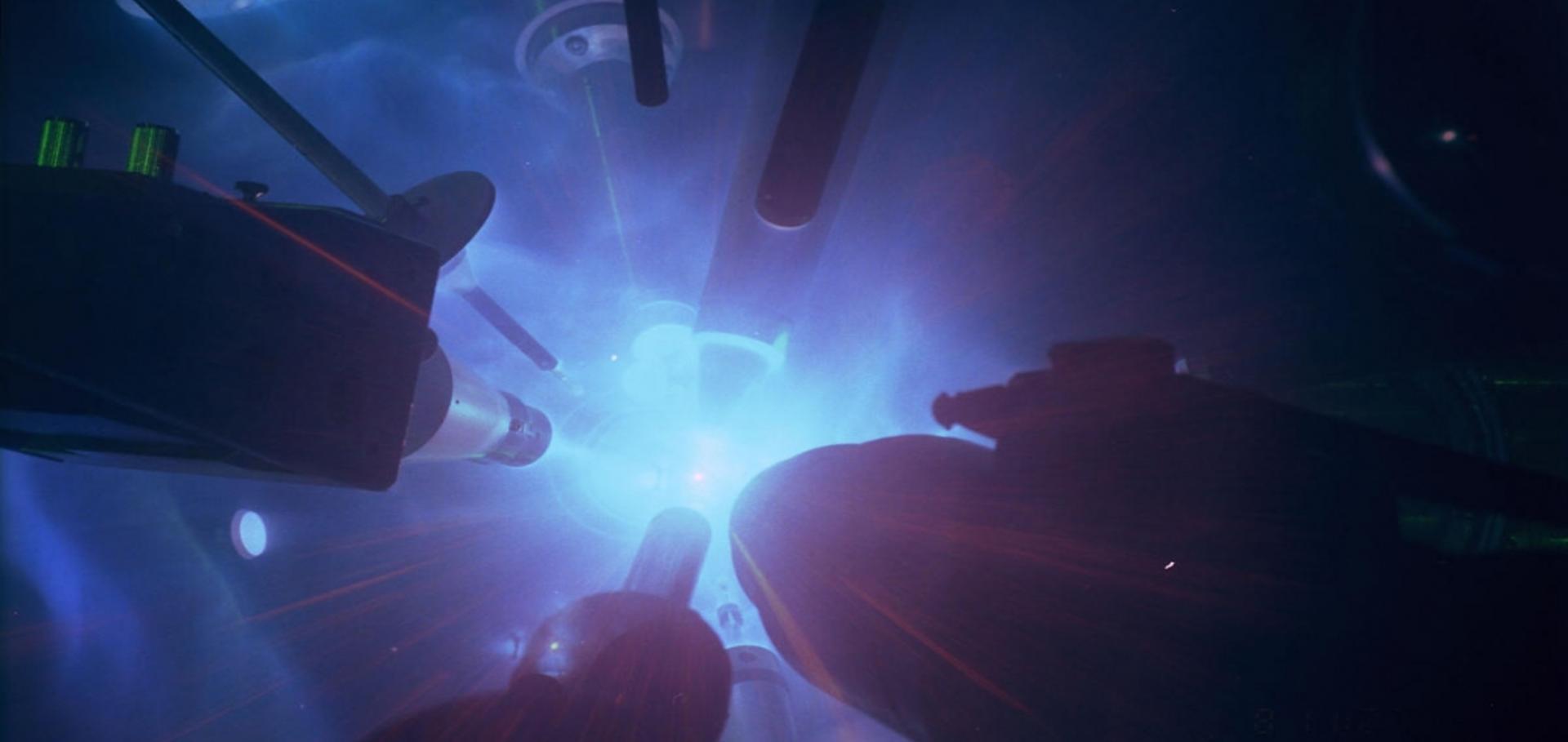
Development of a new quantum trajectory molecular dynamics framework
(2022)
Searches for Neutrinos from Gamma-Ray Bursts Using the IceCube Neutrino Observatory
The Astrophysical Journal American Astronomical Society 939:2 (2022) 116-116
Abstract:
The discovery of high-energy astrophysical neutrinos in the TeV-PeV range by IceCube marked the start of neutrino astronomy, and the search for their sources continues. Two promising source candidates have been identified by IceCube: NGC 1068 in the 1 TeV-10 TeV range and TXS 0506+056 in the 0.1-1 PeV range. Both sources have gamma-ray counterparts, but additional time information of both neutrinos and gamma rays were essential for the identification of TXS 0506+056. The Planetary Neutrino Monitoring (PLEnuM) concept is an approach for combining the exposures of all current and future neutrino observatories - such as KM3NeT, Baikal-GVD, P-ONE in the Northern Hemisphere, and IceCube-Gen2 in the Southern Hemisphere. Using this PLEnuM approach, we estimate how the detection capability for transient sources candidates like blazars and GRBs improves once the future neutrino observatories come online. In addition, we present how the combined, instantaneous field of view of PLEnuM improves the real-time detection rate of rare, very-high-energy neutrinos across the entire sky.Comment: Presented at the 38th International Cosmic Ray Conference (ICRC2023) in Nagoya, JapaSearching for High-energy Neutrino Emission from Galaxy Clusters with IceCube
The Astrophysical Journal Letters American Astronomical Society 938:2 (2022) L11-L11
Abstract:
The Galactic plane, harboring a diffuse neutrino flux, is a particularly interesting target to study potential cosmic-ray acceleration sites. Recent gamma-ray observations by HAWC and LHAASO have presented evidence for multiple Galactic sources that exhibit a spatially extended morphology and have energy spectra continuing beyond 100 TeV. A fraction of such emission could be produced by interactions of accelerated hadronic cosmic rays, resulting in an excess of high-energy neutrinos clustered near these regions. Using 10 years of IceCube data comprising track-like events that originate from charged-current muon neutrino interactions, we perform a dedicated search for extended neutrino sources in the Galaxy. We find no evidence for time-integrated neutrino emission from the potential extended sources studied in the Galactic plane. The most significant location, at 2.6$\sigma$ post-trials, is a 1.7$^\circ$ sized region coincident with the unidentified TeV gamma-ray source 3HWC J1951+266. We provide strong constraints on hadronic emission from several regions in the Galaxy.Comment: 13 pages, 4 figures, 5 tables including an appendix. Accepted for publication in Astrophysical JournaUN'INEDITA STATUA DELLA VIRTVS CORP. COLL. DENDROPHORVM DA CAREIAE (SANTA MARIA DI GALERIA)
Papers of the British School at Rome Cambridge University Press (CUP) 90 (2022) 35-61