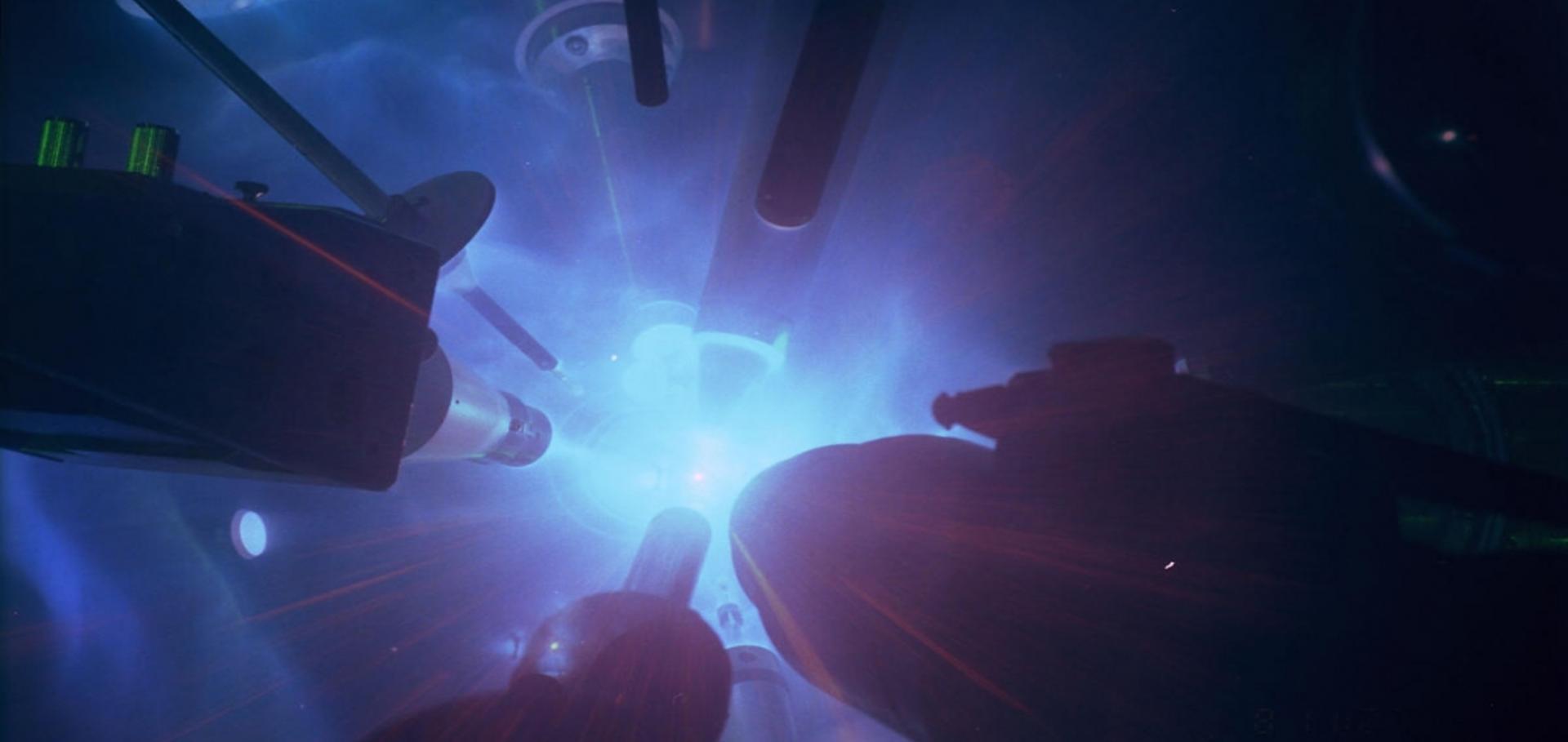
Laboratory analogue of a supersonic accretion column in a binary star system.

Nature Communications Nature Publishing Group 7 (2016) ncomms11899

Authors:

JE Cross, Gianluca Gregori, JM Foster, P Graham, JM Bonnet-Bidaud, C Busschaert, N Charpentier, CN Danson, HW Doyle, RP Drake, J Fyrth, ET Gumbrell, M Koenig, C Krauland, CC Kuranz, B Loupias, C Michaut, M Mouchet, S Patankar, J Skidmore, C Spindloe, ER Tubman, N Woolsey, R Yurchak, É Falize

Abstract:

Astrophysical flows exhibit rich behaviour resulting from the interplay of different forms of energy-gravitational, thermal, magnetic and radiative. For magnetic cataclysmic variable stars, material from a late, main sequence star is pulled onto a highly magnetized (B>10 MG) white dwarf. The magnetic field is sufficiently large to direct the flow as an accretion column onto the poles of the white dwarf, a star subclass known as AM Herculis. A stationary radiative shock is expected to form 100-1,000 km above the surface of the white dwarf, far too small to be resolved with current telescopes. Here we report the results of a laboratory experiment showing the evolution of a reverse shock when both ionization and radiative losses are important. We find that the stand-off position of the shock agrees with radiation hydrodynamic simulations and is consistent, when scaled to AM Herculis star systems, with theoretical predictions.

The institution and the anniversary of Augustus' birthday in epigraphic documentation

MAIA-Rivista di Letterature Classiche 68:2 (2016) 446-459

Authors:

G Almagno, GL Gregori

Abstract:

This study explores the institution of a public holiday on September 23rd, Augustus' birthday, the related ceremonies and especially its commemoration along the centuries through epigraphical records. These documents mainly consist in Calendars, the so-called Fasti, but we also analyze inscriptions dedicated on this special day. We have noticed that this commemoration quickly became an instrument of propaganda and then one of the most important anniversaries of Rome's history, celebrated for a long time.

Theory of Thomson scattering in inhomogeneous media

(2016)

Authors:

PM Kozlowski, BJB Crowley, DO Gericke, SP Regan, G Gregori

Theory of Thomson scattering in inhomogeneous media

Scientific reports Nature Publishing Group 6 (2016) 24283

Authors:

PM Kozlowski, BJ Crowley, SP Regan, Gianluca Gregori

Abstract:

Thomson scattering of laser light is one of the most fundamental diagnostics of plasma density, temperature and magnetic fields. It relies on the assumption that the properties in the probed volume are homogeneous and constant during the probing time. On the other hand, laboratory plasmas are seldom uniform and homogeneous on the temporal and spatial dimensions over which data is collected. This is particularly true for laser-produced high-energy-density matter, which often exhibits steep gradients in temperature, density and pressure, on a scale determined by the laser focus. Here, we discuss the modification of the cross section for Thomson scattering in fully-ionized media exhibiting steep spatial inhomogeneities and/or fast temporal fluctuations. We show that the predicted Thomson scattering spectra are greatly altered compared to the uniform case, and may lead to violations of detailed balance. Therefore, careful interpretation of the spectra is necessary for spatially or temporally inhomogeneous systems.

A laboratory model of post-Newtonian gravity with high power lasers and 4th generation light sources

CLASSICAL AND QUANTUM GRAVITY 33:7 (2016) ARTN 075010

Authors:

G Gregori, MC Levy, MA Wadud, BJB Crowley, R Bingham