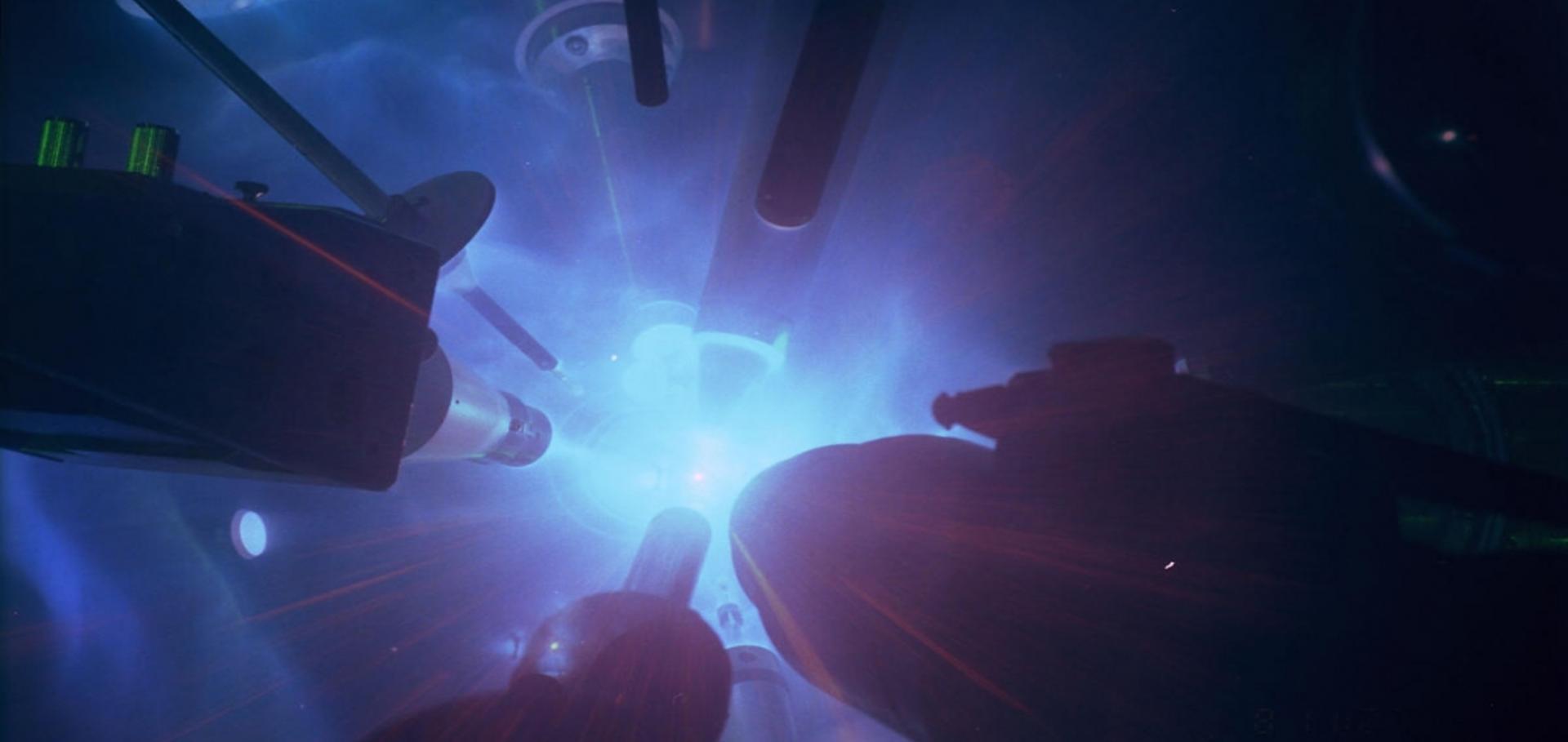
Laboratory astrophysical collisionless shock experiments on Omega and NIF

Journal of Physics: Conference Series IOP Publishing 688:1 (2016)

Authors:

Hye-Sook Park, JS Ross, CM Huntington, F Fiuza, D Ryutov, D Casey, RP Drake, G Fiksel, D Froula, Gianluca Gregori, NL Kugland, C Kuranz, MC Levy, CK Li, J Meinecke, T Morita, R Petrasso, C Plechaty, B Remington, Y Sakawa, A Spitkovsky, H Takabe, AB Zylstra

Abstract:

We are performing scaled astrophysics experiments on Omega and on NIF. Laser driven counter-streaming interpenetrating supersonic plasma flows can be studied to understand astrophysical electromagnetic plasma phenomena in a controlled laboratory setting. In our Omega experiments, the counter-streaming flow plasma state is measured using Thomson scattering diagnostics, demonstrating the plasma flows are indeed super-sonic and in the collisionless regime. We observe a surprising additional electron and ion heating from ion drag force in the double flow experiments that are attributed to the ion drag force and electrostatic instabilities. [1] A proton probe is used to image the electric and magnetic fields. We observe unexpected large, stable and reproducible electromagnetic field structures that arise in the counter-streaming flows [2]. The Biermann battery magnetic field generated near the target plane, advected along the flows, and recompressed near the midplane explains the cause of such self-organizing field structures [3]. A D3He implosion proton probe image showed very clear filamentary structures; three-dimensional Particle-In-Cell simulations and simulated proton radiography images indicate that these filamentary structures are generated by Weibel instabilities and that the magnetization level (ratio of magnetic energy over kinetic energy in the system) is ∼0.01 [4]. These findings have very high astrophysical relevance and significant implications. We expect to observe true collisionless shock formation when we use >100 kJ laser energy on NIF.

Proton imaging of an electrostatic field structure formed in laser-produced counter-streaming plasmas

8th International Conference on Inertial Fusion Sciences and Applications (IFSA 2013) 8–13 September 2013, Nara, Japan IOP Publishing Ltd. 688:1 (2016) 012071-012071

Authors:

T Morita, NL Kugland, W Wan, R Crowston, RP Drake, F Fiuza, Gianluca Gregori, C Huntington, T Ishikawa, M Koenig, C Kuranz, MC Levy, D Martinez, J Meinecke, F Miniati, CD Murphy, A Pelka, C Plechaty, R Presura, N Quirós, BA Remington, B Reville, JS Ross, DD Ryutov, Y Sakawa, L Steele, H Takabe, Y Yamaura, N Woolsey, HS Park

Abstract:

We report the measurements of electrostatic field structures associated with an electrostatic shock formed in laser-produced counter-streaming plasmas with proton imaging. The thickness of the electrostatic structure is estimated from proton images with different proton kinetic energies from 4.7 MeV to 10.7 MeV. The width of the transition region is characterized by electron scale length in the laser-produced plasma, suggesting that the field structure is formed due to a collisionless electrostatic shock.

Spherical shock in the presence of an external magnetic field

Journal of Physics: Conference Series IOP Publishing: Conference Series 688:1 (2016) 012056

Authors:

Y Kuramitsu, S Matsukiyo, S Isayama, D Harada, T Oyama, R Fujino, Y Sakawa, T Morita, Y Yamaura, T Ishikawa, T Moritaka, T Sano, K Tomita, R Shimoda, Y Sato, K Uchino, A Pelka, R Crowston, N Woolsey, Gianluca Gregori, M Koenig, CL Yin, YT Li, K Zhang, H Takabe

Abstract:

We investigate spherical collisionless shocks in the presence of an external magnetic field. Spherical collisionless shocks are common resultant of interactions between a expanding plasma and a surrounding plasma, such as the solar wind, stellar winds, and supernova remnants. Anisotropies often observed in shock propagations and their emissions, and it is widely believed a magnetic field plays a major role. Since the local observations of magnetic fields in astrophysical plasmas are not accessible, laboratory experiments provide unique capability to investigate such phenomena. We model the spherical shocks in the universe by irradiating a solid spherical target surrounded by a plasma in the presence of a magnetic field. We present preliminary results obtained by shadowgraphy.

Thomson scattering measurement of a collimated plasma jet generated by a high-power laser system

Journal of Physics: Conference Series IOP Publishing: Conference Series 688 (2016) 012098

Authors:

T Ishikawa, Y Sakawa, T Morita, Y Yamaura, Y Kuramitsu, T Moritaka, T Sano, R Shimoda, K Tomita, K Uchino, S Matsukiyo, A Mizuta, N Ohnishi, R Crowston, N Woolsey, H Doyle, Gianluca Gregori, M Koenig, C Michaut, A Pelka, D Yuan, Y Li, K Zhang, J Zhong, F Wang, H Takabe

Abstract:

One of the important and interesting problems in astrophysics and plasma physics is collimation of plasma jets. The collimation mechanism, which causes a plasma flow to propagate a long distance, has not been understood in detail. We have been investigating a model experiment to simulate astrophysical plasma jets with an external magnetic field [Nishio et al., EPJ. Web of Conferences 59, 15005 (2013)]. The experiment was performed by using Gekko XII HIPER laser system at Institute of Laser Engineering, Osaka University. We shot CH plane targets (3 mm × 3 mm × 10 μm) and observed rear-side plasma flows. A collimated plasma flow or plasma jet was generated by separating focal spots of laser beams. In this report, we measured plasma jet structure without an external magnetic field with shadowgraphy, and simultaneously measured the local parameters of the plasma jet, i.e., electron density, electron and ion temperatures, charge state, and drift velocity, with collective Thomson scattering.

Model experiment of magnetic field amplification in laser-produced plasmas via the Richtmyer-Meshkov instability

Physics of Plasmas AIP Publishing 23:3 (2016) 032126-032126

Authors:

Y Kuramitsu, N Ohnishi, Y Sakawa, T Morita, H Tanji, T Ide, K Nishio, CD Gregory, JN Waugh, N Booth, R Heathcote, C Murphy, Gianluca Gregori, J Smallcombe, C Barton, A Dizière, M Koenig, N Woolsey, Y Matsumoto, A Mizuta, T Sugiyama, S Matsukiyo, T Moritaka, T Sano, H Takabe

Abstract:

A model experiment of magnetic field amplification (MFA) via the Richtmyer-Meshkov instability (RMI) in supernova remnants (SNRs) was performed using a high-power laser. In order to account for very-fast acceleration of cosmic rays observed in SNRs, it is considered that the magnetic field has to be amplified by orders of magnitude from its background level. A possible mechanism for the MFA in SNRs is stretching and mixing of the magnetic field via the RMI when shock waves pass through dense molecular clouds in interstellar media. In order to model the astrophysical phenomenon in laboratories, there are three necessary factors for the RMI to be operative: a shock wave, an external magnetic field, and density inhomogeneity. By irradiating a double-foil target with several laser beams with focal spot displacement under influence of an external magnetic field, shock waves were excited and passed through the density inhomogeneity. Radiative hydrodynamic simulations show that the RMI evolves as the density inhomogeneity is shocked, resulting in higher MFA.